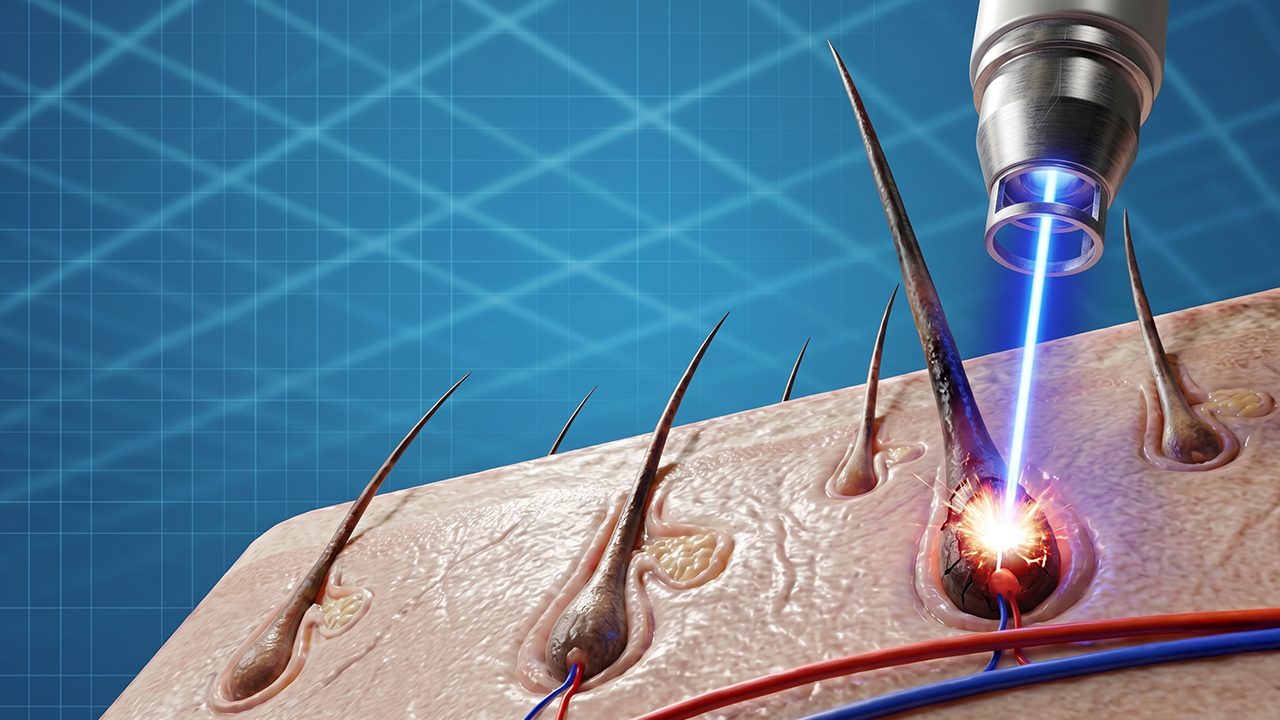
THE’laser hair removal exploits a principle of selective photothermolysis, a monochromatic light beam it selectively affects the melanin contained in the hair, heats it in a few milliseconds and damages the germinal matrix, i.e. the “factory” of cells found in the bulb and which allows the hair to regrow. Unlike the razor, which only cuts the shaft, and waxing, which eradicates the hair but does not affect the follicle, the laser acts directly on the structure that produces the hair, guaranteeing much more long-lasting results. To work, however, the hair must be in its growth phase and must contain enough pigment: the treatment is therefore very effective on dark hair, while it struggles with blond, red or white hair. Skin type also matters, and for this reason there are different lasers designed to adapt to light or dark phototypes. On average, 6 to 10 sessions are needed to achieve a stable hair reduction, which is around 80-90%. Costs vary greatly: starting from approx 30-50 euros per session for small areas and you get to 80-100 euros for the larger ones.
What a hair is made of and its life cycle
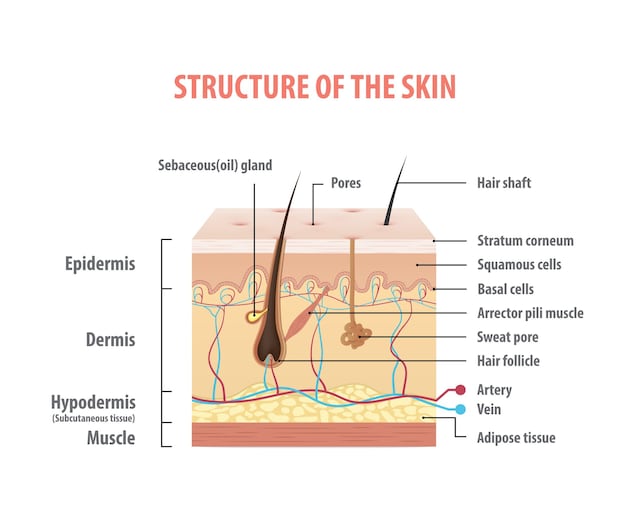
To understand how the laser works, we first need to know what a hair looks like. What we see on the outside of the skin is the stem: a non-living structure, essentially made of keratin, a protein. This is why cutting your hair or shaving does not cause pain: you are not touching living cells, but only “sticks” of proteins inserted into small cavities in the skin called hair follicles. The lively and interesting part is found at the root. As described in the Thompson Rivers University Human Biology Textbook, in bulb of the hair there is the so-called germinal matrixa cluster of cells which, continually dividing, produce new keratin cells which will form the stem. The matrix, in practice, is the “factory” of the hair: keep this concept in mind, because it will be fundamental to understanding how the laser works.
Also in the bulb are the melanocytesthe cells that produce melanin, i.e. the pigment that gives color to the hair (and which explains why black, brown, blond or red hair exists). Finally, inside the follicle we also find a sebaceous gland which lubricates the hair with sebum, and a small erector musclethe one that makes us stand up when we’re cold.
Each hair follows a life cycle divided into four phases. The first is the growthin which the matrix is active and the stem elongates. Follows theinvolutionin which the matrix activity slows down, then the restin which growth stops completely, and finally the fallmoment in which the hair falls out physiologically and a new one is born in the same follicle.
The duration of these phases varies greatly depending on the area of the body. Hair, for example, has a growth phase that lasts from 3 to 6 years, which is why it can become very long. Arm hair, on the other hand, grows for just about thirty days: this is why it remains short.
Depilation and hair removal: two different things
Before talking about lasers, it’s worth clarifying an often confusing distinction. As the American Academy of Dermatology explains, the hair removal it only removes the external part of the hair, the shaft: this is what we do with razors and depilatory creams. THE’hair removalinstead, extracts the hair from the root, as happens with waxing, electric epilators and, indeed, the laser.
It is not a modern practice: already in 3000 BC, Egyptians and ancient Greeks shaved for aesthetic, hygienic and social reasons, using copper or bronze razors and rudimentary waxes based on honey, sugar or resins.
The problem with all these traditional methods is that they are not definitive. The razor only cuts the shaft without affecting the life cycle of the hair, which therefore grows back practically immediately. Waxing works a little better because it eradicates the hair at the root, forcing it to start from the beginning of its cycle, but even in this case, after a few days or weeks, we find ourselves back to square one.
How the laser destroys hair: selective photothermolysis
The first laser was built in 1960. At the time we certainly weren’t thinking about hair removal, but in the following years we realized that that technology could be very useful for tackling the hair problem in a much more radical way.
But what exactly is a laser? The word is an English acronym: Light Amplification by Stimulated Emission of Radiationi.e. “amplification of light through stimulated emission of radiation”. Simply put: light is made by electromagnetic waves that normally propagate in all directions. As an in-depth study from the University of Southern California explains, the laser, on the other hand, is a device that concentrates all these waves in a single direction, producing a compact and very powerful beam.
Then there is another crucial feature: the laser beam is monochromethat is, it has a single wavelength. This allows you to hit very specific targets and concentrate all the energy in a precise point.
And here we are at the point. As we have seen, hair contains melanin, the pigment that determines its color. The hair removal laser is set to a wavelength capable of hitting selectively the melanin of the hair, largely ignoring the surrounding tissues. This principle is called selective photothermolysis.
The laser emits very fast pulses, in the order of milliseconds. Melanin absorbs light energy, heats up rapidly, and transmits that heat to nearby structures, particularly the germinal matrix of the hair. The result is that the hair cell “factory” is damaged, and consequently hair is no longer produced. The speed of the impulse is fundamental: the heat is concentrated in the hair without spreading to the surrounding skin, which remains protected.
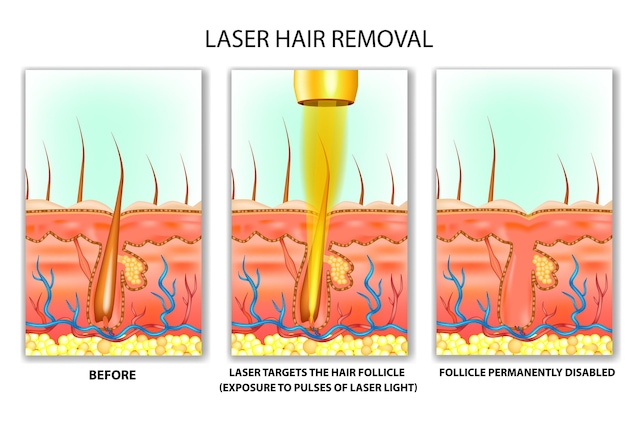
A very important detail: for the treatment to work, the hair must be in the growth phasethe only one in which the matrix is active and therefore vulnerable to thermal damage. For this reason, laser hair removal requires multiple sessions: it is needed both because a single pulse is not enough to damage all the cells of the matrix, and because our hairs are never all in the same phase of the cycle. At each session, in practice, a part of the hair is “neutralized”, while the rest will be affected in subsequent sessions.
Coat color and skin type: the two key factors
Two variables strongly influence the effectiveness of the treatment: the color of the hair and the type of skin. On the fur color there is little that can be done: the laser only works well on sufficiently dark hair, because it needs melanin to hit. On blond, red or white hair the effectiveness collapses, because the target is practically invisible to the light beam.
As the doctors of the Humanitas Clinical Institute explain, the ideal condition, in theory, is that of dark fur on light skin: the contrast is maximum and the laser is able to precisely center the target, leaving the surrounding tissues intact. On darker skin, however, the melanin in the epidermis risks absorbing part of the energy, reducing effectiveness and increasing the risk of side effects.
Luckily, technology has improved a lot in recent years. As reported by the European Dermatological Institute, there are different types of lasers, the most widespread of which areAlexandritewith a wavelength of 755 nanometers, particularly effective on light skin, andNd:YAGwith a wavelength of 1064 nanometers. The latter, thanks to its longer wavelength, is able to penetrate deeper into the skin, “bypassing” the melanin of the epidermis and reaching the bulb directly: for this reason it is suitable for darker skin.
Is it really permanent and how long does it last?
Let’s get to the million dollar question: is laser hair removal permanent? The honest answer is Noor rather: not at all. According to what was reported by the Pio XI Bocconi-Gavazzeni Hospital, the treatment guarantees a very significant permanent reduction in the amount of hair, but rarely reaches 100%. On average, we are talking about an effectiveness of around80-90%.
There are mainly two reasons. On the one hand, some follicles may have been only partially damaged during the sessions (which are generally from 6 to 10, depending on the type of hair and skin). On the other hand, especially hormonal factors can activate new follicles over time that until then were “silent”, causing hair to grow in areas that have already been treated.
How much does hair removal cost
Prices vary greatly based on the area of the body treated, the technology used and the center you turn to. As a guide, for small areas such as the groin, mustache or armpits, start from approximately 30-50 euros per sessionwhile for larger areas such as legs, arms or back it goes up to 80-100 euros. This must be multiplied by the number of sessions needed, which can range from 4 to 10 depending on the type of hair and skin.
Overall, the initial investment is significant, but considering that the result is stable, long-lasting hair reduction, it’s worth it for many people, especially compared to the cumulative cost of a lifetime of waxing or shaving.
