The Christmas it is a Christian holiday which occurs on December 25th and celebrates the birth of Jesus. In the liturgical year it is preceded byAdvent and marks the beginning of the Christmas holidays, which end withEpiphany on January 6th.
It is one of the most widespread religious and cultural celebrations in the world, originally created to celebrate the Nativity narrated in the Gospels of the New Testament and which took place, according to the Christian faith, in Bethlehem. Today, despite being a public holiday in many countriesChristmas is associated above all with secular and commercial customs.
The origins of the holiday and the etymology of the word Christmas
The origins of the celebration of Christmas are uncertain. As we know, according to Christian tradition the anniversary celebrates the birth of Jesusborn in Bethlehem on 25 December. And, not surprisingly, the word Christmas is short for Dies Natalis Christithat is, “the day of the birth of Christ”. The problem is that, from a historical point of view, the date of Jesus’ birth is far from clear. The gospels, in fact, do not mention it and in the first centuries of the Christian era the communities recognized different dates, including January 6th.
December 25th as the official date of Christmas, certified for the first time in Rome in the year 336became common use only in 5th century.
The meaning of Christmas and the choice of December 25th
Most likely, therefore, the choice of this date originates from pagan cults. The Romans, in particular, used to celebrate on December 25th Dies Natalis solis invictior the day of the birth of the “invincible Sun”, considered the protective deity of imperial power and celebrated at the moment of the year in which the duration of daylight began to increase, immediately after the winter solstice.
Not everyone, however, agrees with this theory: some intellectuals maintain that the choice of the date was developed in a Christian context, without connections with pagan cults. Other scholars trace the origins of Christmas to the Jewish festival of lights, the Hanukkahwhich celebrates the consecration of a new altar in the Temple of Jerusalem. Christmas, according to this interpretation, would be the Christian version of a Jewish holiday, as happens with Easter and other celebrations that “passed” from Judaism to Christianity.
Diffusion in Italy and around the world
As mentioned, it was from the 5th century onwards that Christmas celebrations began to take hold, also influencing the liturgical calendar. In 567 the Council of Tours established that the “Christmas time” lasted twelve daysfrom December 25th to January 5th, thus connecting to the Epiphany. Hence, the origin of today’s Christmas holidays.
As time passed, the celebration of Christmas spread throughout the Christian world, as did the associated traditions, including that of crecheborn in the 13th century in Assisi, and that oftree, from the 15th to the 16th centuries in Europe.
Since the Middle Ages, the habit of exchanging gifts also spread among the wealthiest people, a tradition that originally took place on December 6th, the day of Saint Nicholasa figure that would inspire that of Santa Claus.
But how did we get to the present Christmas? Only in the nineteenth century did December 25th become a family-focused holiday, also thanks to authors such as Charles Dickens And Washington Irvingwho in their works described the anniversary in terms similar to current ones. In the 20th century, with the development of mass society and globalization, Christmas took on the appearance of a predominantly commercial and consumerist celebration.
Christmas today
Today Christmas is celebrated in almost all countries of the world, including many of those where Christianity is not the prevailing religion.
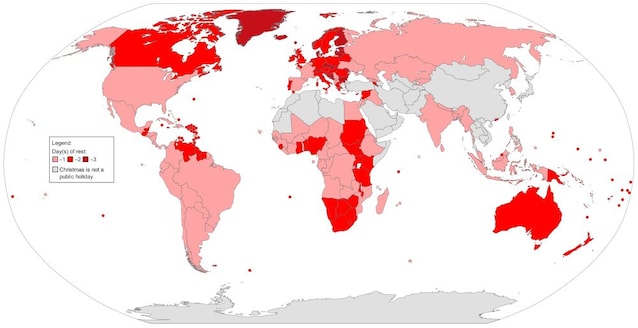
The anniversary has not lost its religious significance and is the day on which churches record the largest presence of faithful. However, it is an occasion also experienced as moment for socialization and consumption. Indeed, according to a survey by Altroconsumo, for Christmas 2025 the average expenditure of Italians will be around 600 eurosdivided between dinners, short holidays and gifts.
