Next, the newsletter of Europa Today which every Monday morning tells you what will happen in the European week
Top of the agenda
Retreat to the castle – Convened by the President of the European Council António Costa, the informal retreat of the heads of state and government of the 27 EU member countries will be held on Thursday 12 February in the medieval castle of Alden Biesen, about fifty kilometers from Brussels. The informal summit will have on the table a crucial topic for the European Union at this stormy start to 2026: the competitiveness of the continent, put in crisis by a geoeconomic context of growing pressure, not only from China but also from Donald Trump’s United States.
The Single Market on a plate – “We must do more to effectively reduce national barriers and make the regulatory framework – at all levels, including the European one – more favorable to investment, innovation and business growth”, is President Costa’s exhortation in his letter of invitation to the 27 EU leaders. Speaking of strengthening the Single Market as an “urgent strategic imperative”, the President of the European Council calls for it to become “a powerful driver of simplification for both citizens and businesses”.
The 28th regime – One of the concrete solutions is that of the establishment of the so-called “28th regime”, i.e. the initiative that will be presented by the Commission to simplify the operations of European companies and start-ups and reduce the technological competitiveness gap with the United States and China. To anticipate its characteristics the President of the European Commission Ursula von der Leyen was at the World Economic Forum in Davos. It should be called “EU-Inc” and is called the “28th regime” because it would work like a real 28th Member State where a new company can be registered “within 48 hours and entirely online”, explained von der Leyen.
Global growth and trade – For Costa, however, it is also necessary to push on making European companies – particularly in “key sectors such as digital, telecommunications, capital markets and energy” – large enough to reach the levels of investment and innovation required by a global market. Because the Union, as demonstrated by the agreements with Mercosur And with India, “is open for trade” and will continue to pursue a program of trade diversification. “But our openness must not be mistaken for weakness”, warned the President of the European Council, making it clear that European companies will always be defended from unfair competition “through targeted protection”, including by exploiting European preference clauses in strategic sectors.
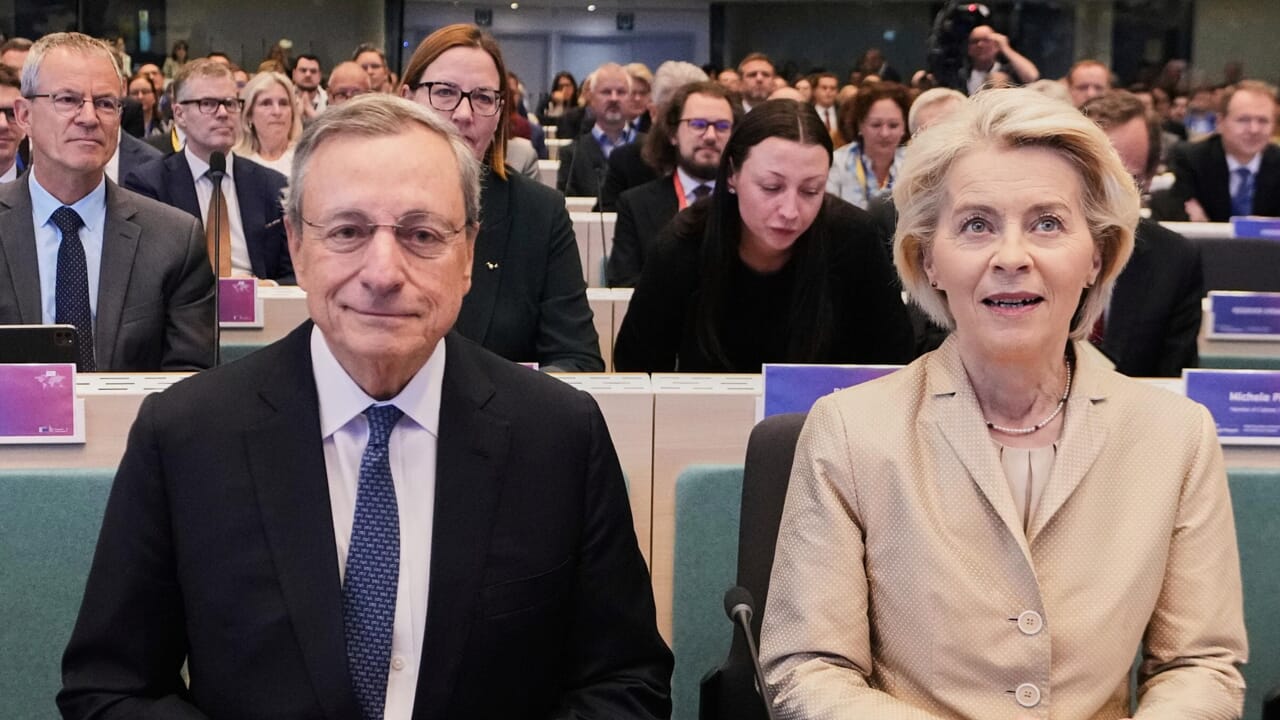
The Italian guests – There will be three Italians at the discussion table. In addition to Prime Minister Giorgia Meloni, President Costa also invited two other former prime ministers: Mario Draghi and Enrico Letta, the authors of two key reports – commissioned by the EU institutions – on the topic that will be addressed by the Alden Biesen summit. Letta published the report on the Single Market in April 2024, while Draghi the one on competitiveness in September of the same year. Although poorly applied so far, the two reports are considered the starting point of any reflection on how to position the European Union in a world characterized by economic competition and growing trade imbalances, strengthening its strategic autonomy. The two former Italian prime ministers will share with the Council their visions on European competitiveness and how they have evolved over the last two years.
Appointment coming up – After the informal retreat on 12 February, the issue of European competitiveness and strengthening the Single Market will return to the center of leaders’ discussions at the next formal summit on 19-20 March. “I intend to reflect these informal discussions in the preparations and outcomes of the March European Council,” Costa anticipated. By then the Commission’s proposal on the 28th regime should also be on the table, expected according to the provisional agenda of the College of Commissioners for next 18 March.
Registering a business in 48 hours and with one euro of capital: this is how the EU wants to relaunch the single market
Other hot topics
Australia’s turn? – On Thursday 12 February the Australian Trade Minister, Don Farrell, will be in Brussels for a meeting with commissioners Maroš Šefčovič and Christophe Hansen, to try to move forward Free trade agreement negotiations started in 2018 and halted in 2023 at near photo finish due to the sticking point of beef exports from Australia.
Response to Trump – With the aggressive trade policy of the United States – which threatens both Brussels and Canberra – the two parties seem to have come closer to the point of finding a compromise to sign another historic agreement for the EU strategy of trade diversification. If the meeting yields positive results, the free trade agreement could be signed as early as the end of February or the end of March, even if President von der Leyen could once again find herself under the crossfire of protests from European farmers.
Support for Ukraine – The Foreign Affairs Council with the formation of defense ministers will be held in Brussels on Wednesday 11 February, with the only item on the agenda being EU support for Ukraine. The Council, chaired by High Representative Kaja Kallas, will focus on military support and technological innovation, starting from an informal discussion with the Ukrainian Defense Minister, Mykhailo Fedorov, present in person at the summit with his 27 EU colleagues.
Commission action plans – Two Commission action plans are expected in Strasbourg on Tuesday 10 February, which should outline different European strategies – with legislative and non-legislative proposals. A plan to combat cyberbullying and one to define security measures for drones (and anti-drone ones).
Against cyberbullying – The action plan against cyberbullying is one of the priorities of the von der Leyen II Commission and, according to initial indications, will focus on minors and vulnerable groups of young people (up to 29 years old), such as people with disabilities, LGBTQI people, migrants and members of religious, racial or ethnic minorities. According to World Health Organization estimates, one in six adolescents has experienced cyberbullying. In parallel to the action plan, several EU measures are designed to protect and empower children online, including the Digital Services Act (DSA) guidelines providing practical recommendations to online platforms and the harmonized approach to age verification.
For drone safety – The action plan on drone security and anti-drone security will instead aim to update the strategy published in 2023 and define concrete policies to address both the risks of drones for commercial and recreational use, and the potential threats posed by the illegal or terrorist use of unmanned aerial systems. The Commission reports that numerous incidents relating to drone security have been reported in recent years, such as the transport of illegal goods into prisons and across national borders, the monitoring of police activities, cyber attacks, invasion of privacy and disruption of air traffic.
One year after the Munich Conference – The 2026 edition of the Munich Security Conference, the world’s leading forum for discussing the most pressing challenges to international security, will be held on Friday 13 February in Munich, Germany. This year, Secretary of State Marco Rubio will participate in the US administration, after in 2025 Vice President JD Vance showed for the first time the aggressive approach of Trump’s new United States with his harsh criticism of Europe and legislation that, according to Washington, will lead to the destruction of democracy.
From the European Parliament
The European Parliament, which meets in plenary session this week, is preparing to approve a reform of the rules on asylum and migration which will make it easier to expel irregular migrants not only to their countries of origin, but also to third countries considered safe. The vote in the Plenary is scheduled for Tuesday 10th and should pass thanks to a center-right majority that unites popular groups, conservatives and reformists, Patriots for Europe and the Europe of sovereign nations.
The reform also expands the concept of “safe third country”, allowing asylum applications to be declared inadmissible even in the absence of a personal link with the country of referral. National governments will have broad discretion in defining which states are considered safe.
Socialists, Greens and the radical left oppose the text, denouncing a limitation of the right to asylum and an externalization of the EU’s migratory responsibilities. The People’s Party, on the other hand, is in favour, defending the reform as a tool to speed up procedures and strengthen control of flows.
The vote once again confirms a fluid parliamentary majority, with the EPP at the center of the new political dynamics of the European Chamber.
Discover all the main topics under discussion at the Strasbourg Plenary
