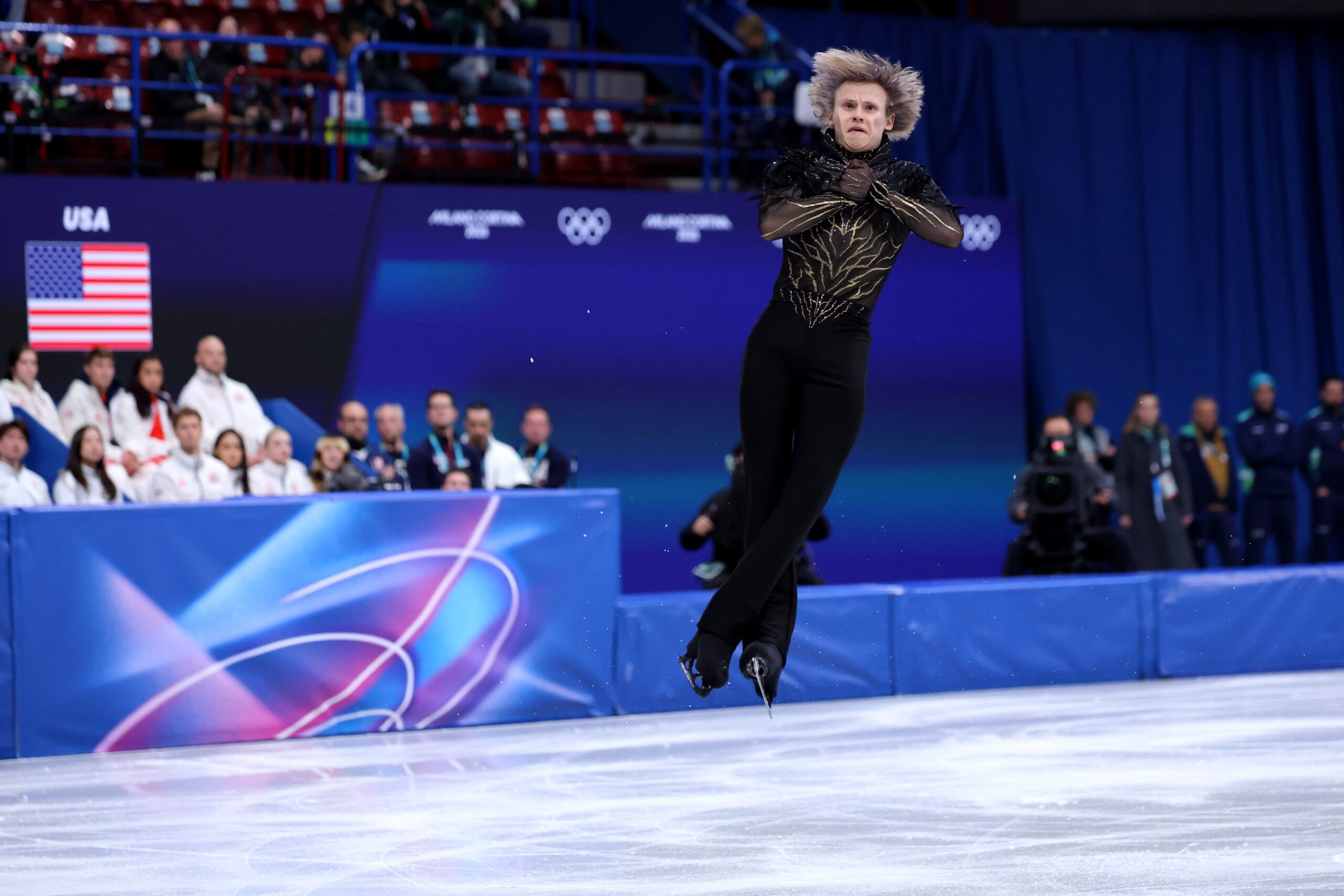
The skater’s performance Ilia Malinin at the Milan Ice Skating Arena he left everyone speechless. If the first racing weekend gave theItaly a historic bronze medal in the team event, the eyes of the world remained glued to the American phenomenon. Malinin not only showed off his trademark, the quadruple Axel (4 and a half turns, the most difficult jump ever), but he also performed a backward somersault (backflip), a move prohibited from 1976 to 2024.
The figure skatingwhich has its roots in antiquity, combines the grace of ballet with acrobatics in the air and turns on the ice. The athletes on stage these days at the Milan-Cortina Winter Olympics spin like tops at very high speeds yet never lose their balance and they don’t have dizzinessbehind their performances there are years of training but also tricks that involve physics and biology.
The quadruple Axel and the backflip banned for 50 years
The Axel performed by Ilia Malinin during the team skating final he is a concentration of talent, training and physics. This is a type of jump that is performed starting directly from the blade. In fact, figure skating jumps differ in the first part, i.e. the step with which one detaches oneself from the ice, while the flight and landing phases always have the same characteristics. As soon as you leave the ground you try to reach one most “closed” position possible in order to maintain the speed of the jump and be able to perform more turns. You clasp your arms to your chest and keep your left leg overlapping the right. Landing occurs on the outer edge of the blade of the right leg, sliding back.
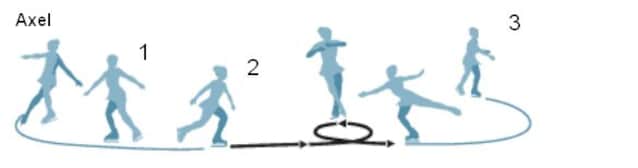
Unlike other jumps that start backwards, the Axel starts forward. This forces the athlete to make an extra half-turn rotation to land backwards. A “quadruple” Axel is therefore actually a jump from 4.5 rotations.
To perform a technical gesture of this level, the skater must jump high enough to guarantee the flight time necessary to complete the rotations and, at the same time, generate a very high rotation speed. The athlete must have excellent explosive muscular strength, but must also be light and compact to minimize inertia resistance. The mechanical secret lies in the management of angular momentum. As soon as he comes off the ice, Malinin recalls his legs and arms to his body in a fraction of a second: by reducing his “diameter”, the rotation speed increases. In the United States there is speculation that it is only a matter of time before the leap is made quintuplean achievement at the limits of human biomechanics.
In addition to the complexity of the Axel, Malinin – nicknamed “Quad God” or the king of quadruples – brought back into competition an acrobatic element that had been banned for almost fifty years: the backward somersaultor backflip. Performed for the first time by the American Terry Kubicka in 1976, it was banned shortly afterwards by the international federation (ISU) for safety reasons (risks to the neck upon landing) and because it was considered devoid of technical value in figure skating. In 2024 the rule was removed allowing it to return to the track, after the last execution in 1998.
The physics behind ice skating: angular momentum
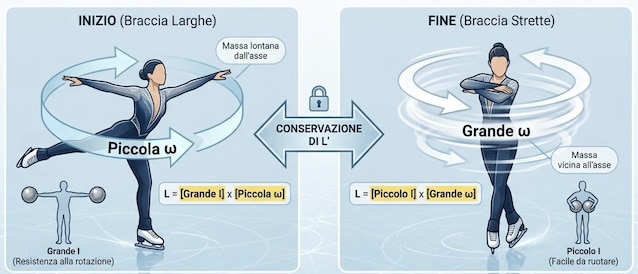
When a skater starts spinning like a top, you will surely have noticed that his speed changes based on the position of his arms. This is where physics comes into play, and in particular the principle of conservation of angular momentum.
The angular momentumand (L) is a vector quantity that, simply put, “measures” the rotation potential of a body. It is calculated with this formula: L = Iω
Where:
- I (moment of inertia): represents the body’s resistance to changing its rotation speed. It depends on how the mass is distributed with respect to the rotation axis: the further the arms and legs are from the body (therefore “wide”), the greater the moment of inertia and the more difficult it is to rotate.
- ω (angular velocity): it’s simply how fast the skater spins.
Since the angular momentum must remain constant, the two quantities I and ω are inversely proportional. When the skater closes his arms to his chestreduces its moment of inertia. To compensate and keep L unchanged, physics “forces” the rotation speed to increase.
Why don’t skaters feel dizzy?
Normally, our balance is managed by vestibular system located ininner ear. This is where the position of the head, its speed and orientation in space are monitored. The vestibular labyrinth is made up of three semicircular canals who perceive three types of rotational movements: nodding (up and down), shaking the head (right and left) and tilting it sideways. Inside these channels there is a liquid, theendolymphwhich moves following the movements of the head. The endolymph flows to a chamber covered in sensory cells with microscopic “cilia” on top (the stereocilia). When the liquid bends them, they send electrical signals to the brain to inform it of the movement. The system is then closely connected to sight, allowing us to coordinate balance and gaze.
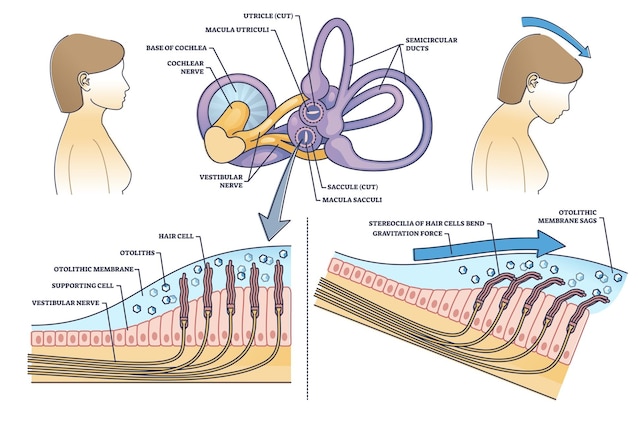
Why is our head spinning? When we rotate and then suddenly stop, the endolymph continues to move by inertia within the channels, sending the brain the wrong message: “you’re still spinning!”. This creates a sensory conflict between the ears (which hear movement) and the eyes (which see that we are still), causing dizziness.
Skaters and dancers, however, avoid this mechanism with two methods. First, years of training. Skaters’ brains learn to ignore confusing signals from the inner ear. Scientific studies have shown that the areas of the brain that manage these signals become less active in athletes, creating a sort of “filter” against dizziness.
The second method is gaze management. THE dancers they use it “spotting”. While the body rotates, the head remains still on a fixed point for as long as possible, and then suddenly turns and immediately finds the same reference.
THE skatershowever, they spin too fast to be able to use this technique with 7/8 rotations and the record recorded in history of 342 revolutions per minute (RPM). For them, control of the comes into play optokinetic nystagmus. To understand this mechanism, think about when you watch the landscape pass by quickly from the window of a train. The eyes lock onto an object (a tree, a pole), follow it until it disappears from view and then quickly snap back to “hook” the next one with a rhythmic and involuntary movement. Skaters train their brain to control this reflex and as soon as they finish the spin they force their gaze to immediately fix a fixed point.
