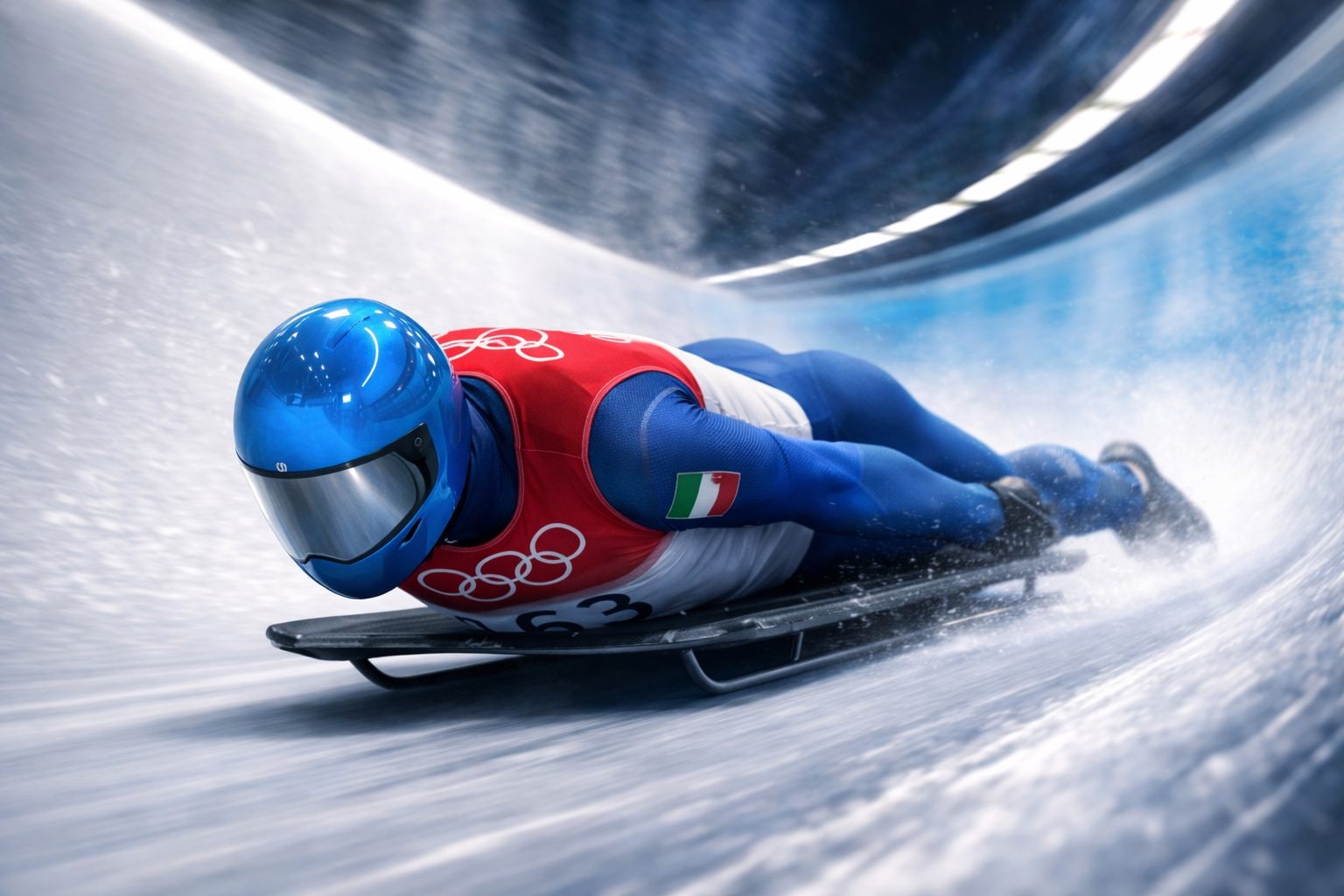
The skeleton it is an individual winter sport, undoubtedly among the most adrenaline-filled Milan-Cortina 2026 Olympics. Try to imagine being an athlete and throwing yourself at 130 km/h along an ice tube with one sledding on your stomachin a prone position, with the chin just 5 centimeters from the ground. Similar to bob for the track, the skeleton owes its name to the shape of the first metal sled, which actually resembled a human skeleton. Among the oldest disciplines of the Winter Olympic Games, it is the “slowest” when compared to bobsleigh and luge, even if the perception of speed upside down is incredible. It’s not just a thrilling test of courage: each descent is a game of millimeter precision where the athlete must transform the energy of his initial run into pure speed, managing reduced friction and G forces which crush the body with a violence similar to that experienced by fighter pilots.
In the new Sliding Center in Cortina named after Eugenio Monti, Italian stars like the champion are ready to compete Alessandra Fumagalli in the feminine e Amedeo Bagnis in the men’s who finished the first two heats in fifth place. In the meantime, skeleton is currently at the center of the news due to a diplomatic case, the Ukrainian athlete Vladyslav Heraskevych he was disqualified for refusing to remove the helmet with the names of the victims of the war underway in his country.
How skeleton works, the Winter Olympic sport: sprinting
It all starts with one explosive thrust which lasts approx 30 metersa crucial moment in which the athlete runs across the ice pushing the sled before diving on board. To avoid slipping and unloading all their power on the ground, skeletonists wear special shoes equipped with approx 300 metal micro-nailsno more than 5 millimeters long. This push phase is so rapid that the best in the world manage to cover the first 50 meters of the track in 5 seconds, already reaching 40 km/h before even starting the actual descent. Once the athlete “climbs” the sled, he must do so with total fluidity: any sudden movement in this phase would create vibrations or lateral oscillations that would dissipate precious energy.
Skeleton is like Formula 1 on ice: you need the power of a sprinter at the start, the precision of a driver on the track and a lot of work in the garage on the set-up of the sled
Amedeo Bagnis (Italian national Skeleton athlete)
A “skeleton” without brakes: design and weight limits
The name skeleton was not chosen by chance: it derives from the essential and bare appearance of the first sled introduced at the end of the nineteenth century, which resembled a skeleton. Today the sled is the result of continuous technical evolution and is composed of a chassis in steel and light alloys, one ergonomic saddle and two smooth skates (called runners), which flow directly onto the ice.
The weight of the sled is regulated: it cannot exceed 43 kilos for men hey 35 kilos for women. In addition to the main components, the sled is equipped with front and rear bumperswhich protect both the athlete and the structure in case of contact with the track walls, and handlesused exclusively in the starting phase for the initial push.
This technology obviously comes at a cost: a competitive level skeleton sled can go up to exceed 10,000 eurosdepending on the materials used and the degree of customization.
The most incredible aspect? There are no brakes. Once started, the only way to stop is to reach the end of the track, where the slope rises or mats and fresh snow are placed to progressively slow down the race.
How to drive the sled belly down on ice at 130km/h
To minimize air resistance, the athlete does lie as flat as possiblealigning the head, trunk and legs with the sled, transforming the body into a projectile. Once on board, the athlete becomes one with the sled and begins the dance with the G forces. In the fastest parabolic curves, the 5 G: it means that the athlete perceives a weight five times greater than his own, as if a 400 kg block were crushing him against the ice.
But how do you drive if there are no levers or controls? Steering occurs through almost imperceptible movements of the body. By pressing with a shoulder or knee on a corner of the sled, the athlete manages to slightly deform the frame, causing the skates to change trajectory. Even turning your head or lifting your chin slightly changes the airflow and can help correct your line of descent. It’s an extreme biomechanical challenge: the neck must remain tense to look forward while the G forces push the head downwards and the vibrations of the ice are transmitted directly to the skull. In some places, the helmet also comes to touch the surfaceincreasing the stresses. A set of factors that can cause dizziness and mental fatigue at the end of the day, a phenomenon known among athletes as sled head.
On the fastest tracks you regularly exceed 130 km/h: the record is 146 km/ha threshold reached on the track in Whistler, Canada, during the 2010 Vancouver Olympics.
Four runs for glory: the rules of the Olympic competition system
In skeleton it’s not enough to be the fastest in a single run; you have to be the most constants. In Olympic competitions, the final ranking is determined by the sum of the times 4 different heats usually held in two days. This system is ruthless: a millimetric error in just one heat can compromise the entire race, even if the other three were perfect. The winner is the one who has the lowest total time, often trailing his opponents by just a few hundredths of a second after kilometers of descent.
A legendary example of this constancy was Martins Dukursthe Latvian who dominated the World Cup for a decade, winning 11 titles overall. Despite his technical superiority, Dukurs never managed to win Olympic gold, demonstrating how sensitive this sport is to tiny variables: a small driving error can compromise years of absolute dominance.
