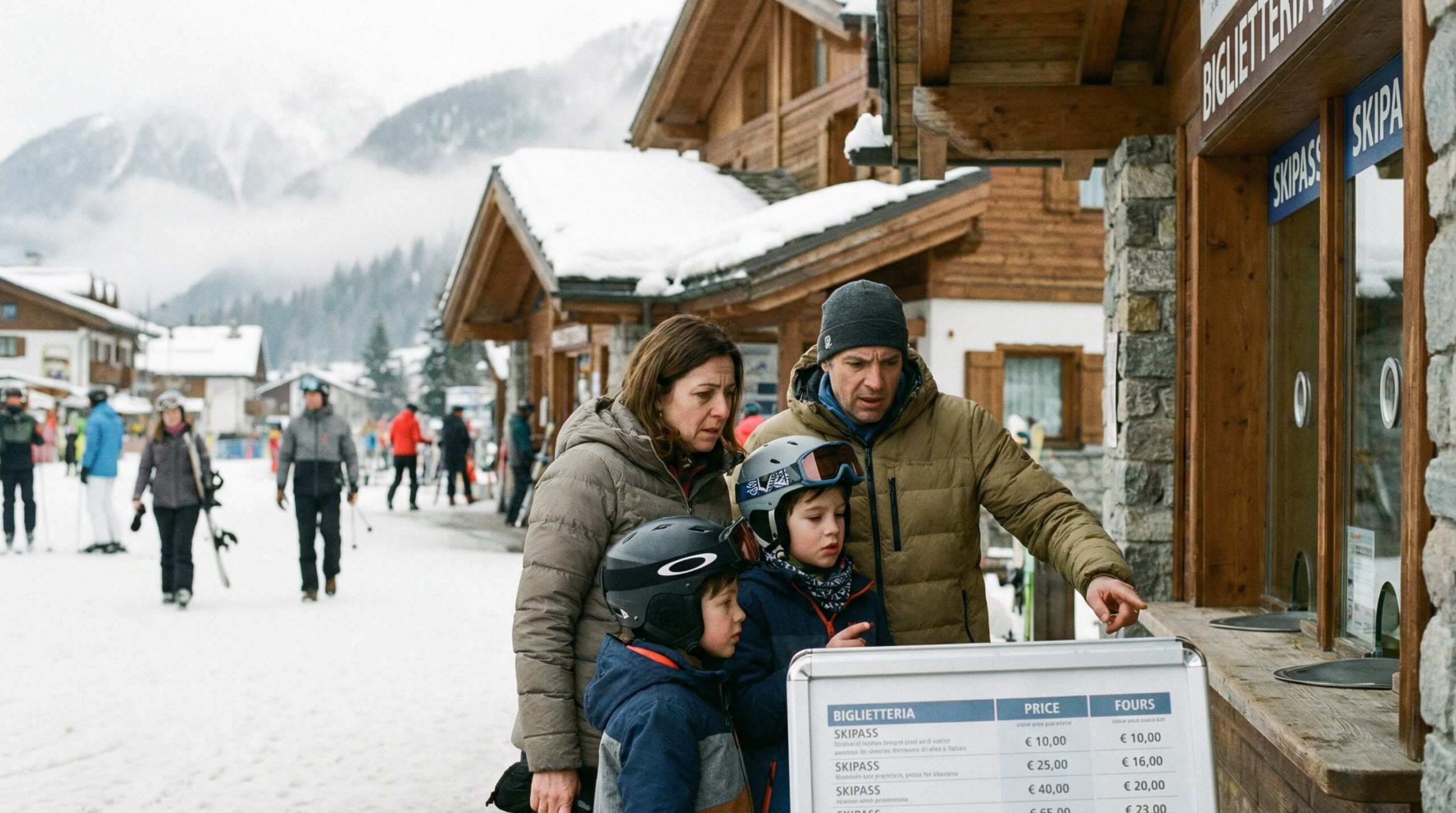
Have you ever gone skiing in these winter months and thought: “has it always been so expensive?”. In fact, in the 2025/2026 season skiing is more expensive than previous years and fewer people can afford it.
According to an analysis carried out by Radical Storage (a private company specializing in travel services that compared the prices of daily ski passes in 100 of the main European ski resorts, located mainly in Switzerland, Austria and Italy, and corrected them for inflation using data from the International Monetary Fund), the cost of ski passes in Europe increased 34.8% above inflation between 2015 and 2024.
Since 2005, the average cost of a daily ski pass in the top 100 European ski resorts — particularly in Switzerland, Austria and Italy — it has almost doubledreaching figures over 80 euros in Italy and Switzerland. Prices whose increase is justified by the costs of energy (the electricity needed to power the ski lifts), the need to activate artificial snow systems, together with shorter seasons. Furthermore, inflation has increased the costs of hotels, restaurants and related services.
Skiing in Friuli-Venezia Giulia or on Apenninesi in general it costs lesswhile the Dolomites between Trentino-Alto Adige and Veneto have the highest prices. The location with the absolute cheapest price is Champorcher, in Valle d’Aosta, with 36 euros for an adult daily ski pass, while in Madonna di Campiglio (Trentino-Alto Adige) the price rises to 85, surpassed only by the Dolomiti Superski pass, which reaches 86.
For a day (or a week) on skis, obviously, a ski pass is not enough: you add equipment, accommodation, meals and so on. Here a skiing week for a family of 4 adds up to 7,856.44 euros. But let’s look at the prices in detail.
How much does a ski pass cost in Italy and where is it more or less expensive to ski
One of the sports that was accessible to many and became increasingly mainstream in the 1950s and 1960s is now becoming a luxury again – in a way that some call “unjustified”. Some studies and consumer associations report that in recent comparisons between seasons, attendance on Italian slopes has decreased by over one million, partly attributable to the growth in the overall costs of skiing.
Throughout Italy there are approximately 280 ski areas, with slopes and facilities distributed above all in the Alps and the Apennines (for a total of between 5 and 7 thousand km of slopes). How much does it cost to ski in the various resorts today? In the Dolomiti Superski areas (one of the largest in the world, with around 1,200 km of slopes and 12 ski areas between Trentino, Alto Adige and Belluno), in high season, costs up to 86 eurosthe highest figure of all Italian districts. Among the least expensive is the daily ski pass in the Champorcher – Monterosa Ski area, in Valle d’Aosta, with a price of 36 euros for an adult daily ticket on holidays. We specify that in general the prices considered are indicative and mainly refer to adult daily tickets in high season (with the values changing for medium/low season and in the case of advance bookings) and weekends, therefore more expensive.
The least expensive places to ski (adult daily ski pass price, holidays, Altroconsumo data) are:
- Champorcher (Valle d’Aosta): 36 euros
- Campo Felice (Abruzzo): 43 euros
- Piancavallo, Sella Nevea, Zoncolan, Tarvisio (Friuli-Venezia Giulia): 44 euros
- Ovindoli (Abruzzo): 46 euros
- Limone (Piedmont): 48 euros
- Bardonecchia (Piedmont): 49 euros
The most expensive places to ski (adult daily ski pass price, holidays, Altroconsumo data) are:
- Alta Badia, Alta Pusteria, Plan De Corones, Val Gardena (Trentino-Alto Adige): 80 euros
- Cortina d’Ampezzo (Veneto): 80 euros
- Madonna di Campiglio (Trentino-Alto Adige): 85 euros
- Dolomiti Superski (Trentino-Alto Adige): 86 euros
- Cervinia-Zermatt (Aosta Valley + Switzerland): 87 euros
In many locations prices are dynamicthat is, they change depending on the request: for example. the prices of the Monterosa Ski 3 Valli ski passes are subject to dynamic rates and are included in a price range ranging from 38 euros to 69 euros for the adult daily ticket. “This dynamic system – we read on the rates page – continues to process prices based on sales data, and stops at midnight every day”. At that point the day’s rate will be determined, which will remain fixed, while that of the following day will evolve.
An investigation by Altroconsumo analyzed in December the prices of 44 ski resorts in Italy (considering the high season ones such as Christmas, New Year, Carnival and public holidays, official price lists published by the ski resorts): by choosing cheaper resorts you can save something, but considering a family of 3 adults, a day of skiing it can be expensive. Access the slopes, ski lifts, you spend on average 188 euros, up to a total of 260 in the most expensive locations – including Trentino-Alto Adige.
The increases calculated by Altroconsumo compared to the previous season are +3.8% for the Apennines area, +4.4% for Trentino-Alto Adige (in Madonna di Campiglio there is even a +7.6%, with the ski pass rising from 79 to 85 euros in high season); +3.4% in Valle d’Aosta, +3.3% in Veneto, +5.1% in Lombardy, +4.4% in Piedmont (with +13% in Alagna Valsesia). The Friuli-Venezia Giulia is the only region where no increases have been reported or price changes compared to the previous season, while abroad the figures rise on average by 6.2%. On average, in Italy, the cost of the daily ticket increased by 4%, while the 5-day multi-day ticket increased by 4.4%.
In general, buy the ski pass online allows you to save a little something – usually 5%. Again according to Altroconsumo research, the resorts where skiing costs the least, even in high season, Champorcher (Valle d’Aosta), with 36 euros, Tarvisio (Friuli-Venezia Giulia), with 44, Sella Nevea (Friuli-Venezia Giulia), with around 44, smaller resorts in the Apennines, with prices between 40 and 50 euros – for example in Campo Imperatore, on the Gran Sasso, the winter ski pass on holidays it costs 35 euros.
The prices of the ski week
The National Federconsumatori Observatory reports that a family of 4 will spend on average to spend a ski week in 2026 7,856.44 euros+7% compared to the previous season – a calculation made considering equipment rental, 6 nights in a hotel, meals and ski passes in the most popular ski resorts between Veneto, Valle D’Aosta, Trentino-Alto Adige, Lombardy, Abruzzo and central Italy and considering the central weeks of December-January-February. Among the highest increases are the weekly ski pass (+13%) and hotels (+9%), while the regions with the highest increases are Trentino Alto-Adige (+14%), Lombardy (+7%) and Valle d’Aosta (+6%).
According to the data collected, the region that proves to be the most expensive is Venetowith a cost of 2,336.78 euros per person (+5% compared to the previous season) for the ski week – very expensive even before the Winter Olympics. On the contrary, the places where it is most convenient are Abruzzo and central Italywhere the expense is approx 1,472.15 euros per person. In detail, a week of equipment rental (skis and poles, boots, helmet) costs around 300 euros, the weekly ski pass around 400 euros (with higher peaks in some locations), over 700 euros for the hotel for 6 nights per person, not counting meals. An hour of private lesson in high season costs on average 65 euros.
According to data from Altroconsumo, the five-day pass to the ski slopes how much saves only 12% compared to the daily ticket (around 40 euros per person), and ranges from 135 euros (Gran Sasso, Campo Imperatore) to 386 (Superskirama Dolomiti Adamello-Brenta). So how can you save? Taking into consideration cheaper locations, such as Champorcher, the stations of Friuli-Venezia Giulia (Piancavallo, Sella Nevea, Zoncolan and Tarvisio, 182.50 euros for a 5-day ski pass, have not applied increases). Booking your ski pass online in advance can allow you to save something, and avoiding the busiest weeks, such as Christmas and Carnival, can reduce accommodation costs by 20-30%.
The Altroconsumo survey indicates that the increases were also recorded in the rest of Europe, to a lesser extent between France and Austria.
The cheapest and most exclusive ski resorts in Europe
The European Correspondentbased on data from Skiresort.info – therefore a database different from those considered for Italy – made a comparison between the prices of the season 2020/21 and of that 2025/26 (with rounding, i.e. these are indicative average values, not identical prices for the same resorts) for an adult day ski pass in European ski resorts that is most popular during the high season – when prices therefore peak.
Again according to data from Altroconsumo, in some Swiss locations for a daily ski pass even exceeds 100 euros: more precisely 103 euros in Sankt Moritz, 106 in Zermatt and 125 in Zermatt with connection to Cervinia, in Italy.
