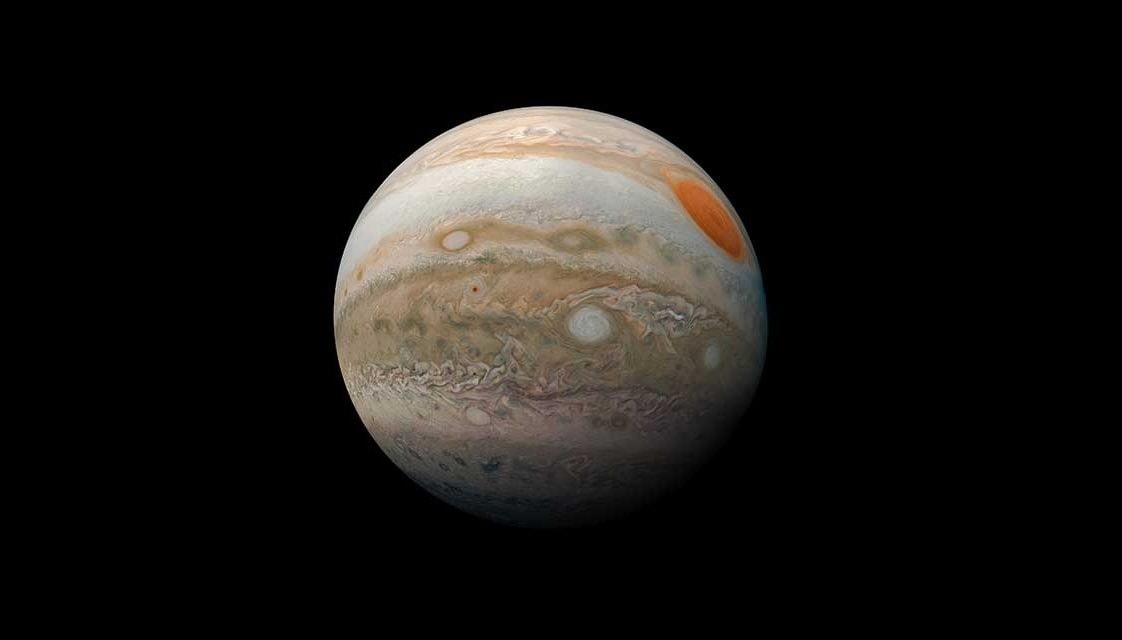
The gas giant Jupiter would be smaller and more flattened at the poles than previously estimated. A study published in Nature Astronomy in fact, it updates the estimates dating back to the Pioneer and Voyager missions of the 1970s thanks to new measures carried out by Juno probe of NASA, in orbit around the king of planets since 2016 to study its characteristics and its court of natural satellites. Thanks to the measures of radio occultationwhich take advantage of the blocking and temporary diversion of the probe’s radio signal as it passes behind Jupiter from Earth’s perspective, scientists have determined how Jupiter appears 8 kilometers narrower at the equator and 24 kilometers narrower at the poles. These measures have important implications for models that describe the internal structure of Jupiterreconciling the discrepancies between the temperature measurements made by the Voyager and Galileo probes with the predictions of the theoretical models.
Details of the NASA study
The previous estimates of Jupiter’s dimensions came from the measurements taken more than 50 years ago from the probes Pioneer And Voyager of NASA. These estimates did not take into account the strong winds present at the planet’s cloud level and had a mistake on size estimation of the order of 4 km. These measurements, together with the temperature measurements carried out by the Galileo probe, also from NASA, constituted a reason for discrepancy with theoretical models which describe the internal structure of the gas giant.
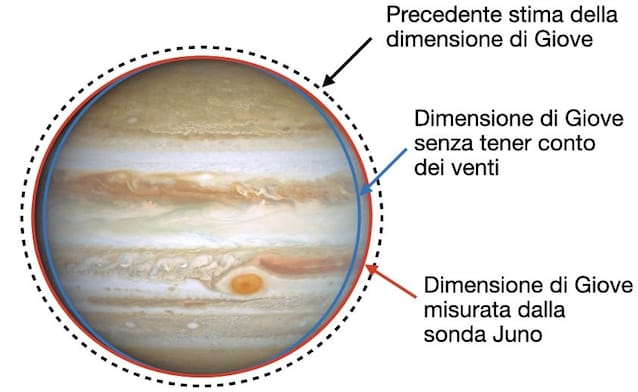
The new measures carried out by the probe Juno they seem like it though reconcile theory and observationsas reported by a study published in the journal Nature Astronomy. The NASA probe made measurements of the size of the planet thanks to the technique of radio occultations: the idea is to exploit the moment in which the probe hides behind Jupiter from the Earth’s point of view to study how radio signals are bent as they pass through the atmosphere of the planet. This allows you to create new, more detailed maps of the temperature and density of the planet, thus providing a better estimate than its own dimensions And form.
Compared to previous measurements, moreover, scientists have this time also considering the effect of the very strong zonal winds (flow parallel to the lines of latitude) of the planet, reducing uncertainty of the measurement by a factor of 10. The new measures report a polar radius of 66,842 kma equatorial radius of 71,488 km and a average radius of 69,884 kmwhich are respectively 12, 4 and 8 km smaller of previous estimates. Since Jupiter does not have a solid surface, in all three cases, the radius is defined at the point where the The planet’s atmospheric pressure is 1 barequivalent to that on Earth at an altitude of 111 meters at 15 °C.
Because Jupiter is crushed at the poles
The gas giant Jupiter it is not a perfectly spherical planet. Its form is that of one oblate spheroidthat is, one ball which it was crushed at the poles And widened at the equator. This shape is the result ofbalance between the gravitational forcewhich tends to push the matter towards the center in a radial direction, and the centrifugal forceproduced by the very fast rotation of Jupiter (9 hours 55 minutes and 29 seconds for a complete rotation) around its axis. Not being a rigid body in its physical definition of the term, Jupiter it rotates with different speeds at the poles and the equatorthus creating a different balance between gravity and centrifugal force, which is maximum at the equator and zero at the poles. This causes the material from the planet “swells” at the equator and “shrinks” at the polesproducing an equatorial radius approximately the 7% greater than the polar one.
Jupiter though it is not a perfect oblate spheroid. Two others are added to the centrifugal effect which contribute to determining the final shape of Jupiter. The first is that the density varies drastically between the cloud tops and the inner layers, where it reaches levels of the order of thousands of kilograms per cubic meter. This determines latitudinal variations in the gravitational field which change the shape of Jupiter by tens of km compared to that of a simple oblate spheroid. The second effect is the one due to very strong zonal winds which exist at cloud level. These modify centrifugal forces creating variations on the order of 10 km in the size of the planet, mainly at low latitudes.
