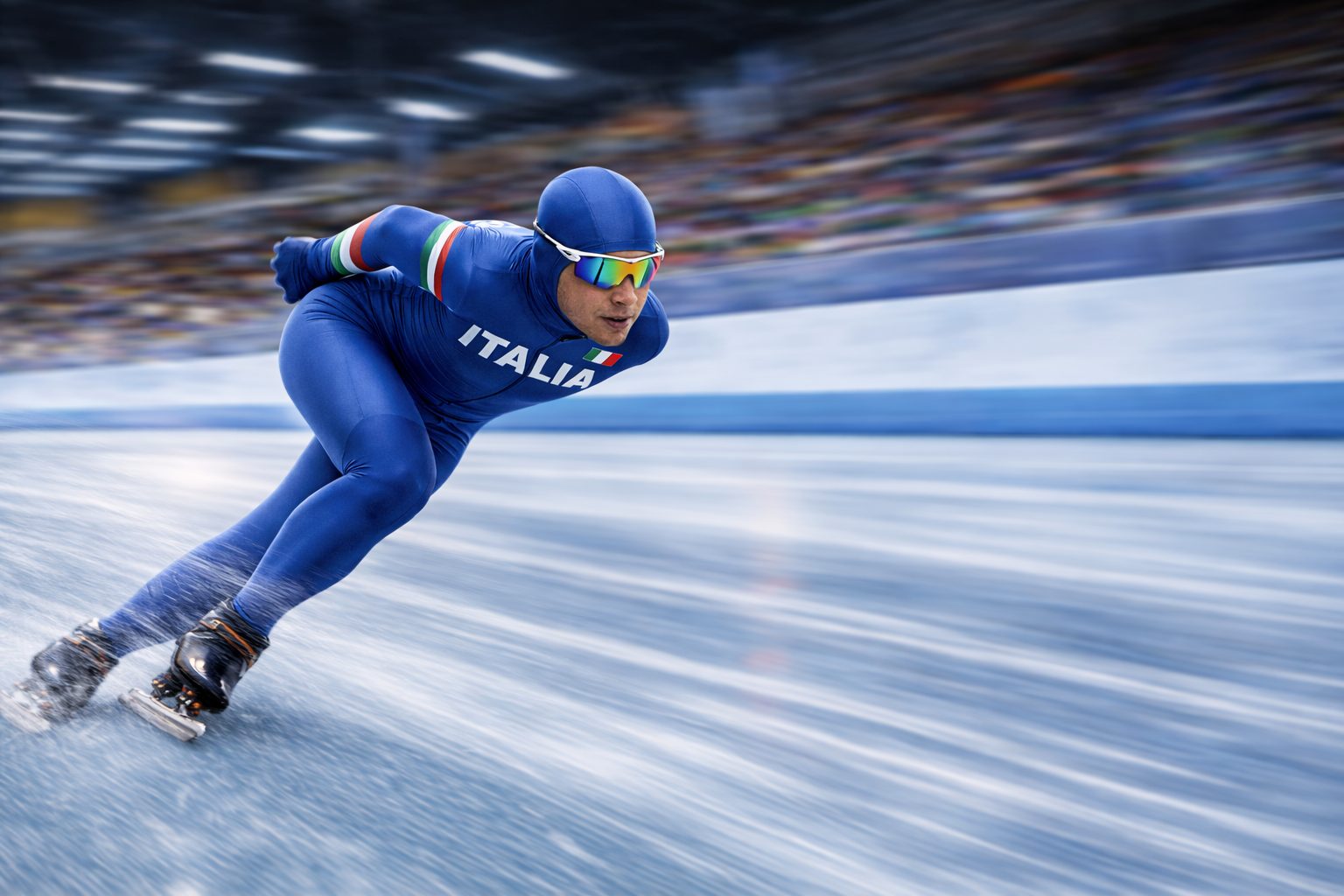
The ice of the Milan-Cortina 2026 Winter Olympics has been dyed blue in recent days with Francesca Lollobrigida which he conquered well two gold medals (in the 3000 and 5000 m), while Riccardo Lorello gave Italy another splendid bronze in the 5000 m, confirming the state of grace of our national team. If you have watched their races, you will have noticed something almost hypnotic: the athletes seem to glide effortlessly, touching the 60 km/h with razor-thin blades.
But be careful not to confuse it with lo short tracks (the one of the legend Arianna Fontana and the myth Steven Bradbury). The difference is substantial: while in the short track you race “at speed” in a group on a small ring (111 metres), here we are in the pspeed landing on plong time. You run on an Olympic ring 400 metersusually in pairs and in separate lanes: it is not a fight against the physical opponent, but a challenge against time and air resistance. It’s pure applied aerodynamics, where every gesture is designed to reduce friction and allow champions like Lollobrigida and Lorello to rewrite history.
Speed skating is a dance at 60 km/h: energetic and powerful, but always harmonious, movements that make you glide… and, in the right shape, fly.
Enrico Fabris – two-time Olympic gold medalist in speed skating
Ice Speed Skating’s Secret Weapon: How Clap Skates Work
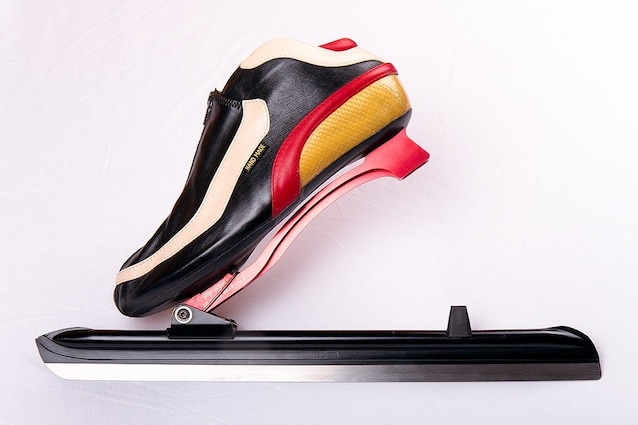
Watching a long track speed skating competition, you notice a characteristic sound: a “clap” dry with each thrust. It’s the sound of clap skatesthe skates that revolutionized the sport in the late ’90s. Unlike traditional skates, where the blade is fixed, here the blade is attached to the shoe only at the toe via a hinge. This allows the heel to rise while the blade remains flat on the ice until the end of the movement. In this way, the athlete can fully extend the leg and continue pushing for a few more fractions of a second, without the tip of the blade “digging” into the ice, slowing down the stroke. It is a small measure that has made it possible to break world records in almost all disciplines, making the much more natural and efficient thrust.
Today world records travel at average speeds that, until a few years ago, seemed unattainable: Kjeld Nuis he covered 1000 meters or more 55 km/h on averageAnd Davide Ghiotto the 10,000 meters above 48 km/h. Both records were obtained on high altitude slopes, a Salt Lake City and Calgary. At these altitudes the air is thinner, meaning there are fewer air molecules that hit the athlete as he advances. Fewer molecules means less aerodynamic drag. Since at 60 km/h air resistance is the main obstacle to progress, racing at altitude is equivalent to having a more powerful engine for the same effort. It is here that athletes manage to overcome limits that seemed insurmountable at sea level.
Nuis has even gone beyond the confines of official competitions. In an extreme experiment conducted in Norway, shown in the video below, by skating behind a car equipped with a shield to break down aerodynamic drag, he achieved 103 km/h. This shows that the real limit is not the friction between the blade and the ice, but the “wall” of air which they must continually cleave.
Posture and biomechanics in Olympic sport
Skating at 50 km/h requires optimized posture. In the straights, the goal is to reduce air resistance: athletes keep their torso nearly parallel to the ice and hold one or both hands crossed behind the back. This position not only serves to reduce aerodynamic resistance, but contributes to lowering the center of gravity, limiting unnecessary movements of the trunk and allowing more efficient transmission of force, while the legs work cyclically and independently.
The challenge changes radically when cornering. This is where the “crossed step” (crossover): the skater crosses the outside leg over the inside one, leaning towards the center of the rink up to incredible angles, even beyond 40 degrees compared to the surface. At this stage, the high speed generates intense lateral forces, and only one blade (thick only 1 mm) which cuts into the ice well and allows you to maintain the trajectory. Below is the video of Davide Ghiotto’s victory at the world championships.
The science of ice: much more than just cold water
In view of Milan-Cortina 2026ice preparation becomes a decisive element for long track speed skating, a discipline in which the quality of the surface directly affects performance. For example, a complex refrigeration system with pipes in which a refrigerant fluid (glycol) circulates, designed to keep the ice uniform and controllable to a tenth of a degree.
The goal is to find the best compromise between smoothness and controland this also involves targeted temperature management. In curves it keeps the ice lightly less harshcorresponding to a higher temperature, to increase the grip of the blades during the high lateral forces to which the athlete is subjected. In the straighton the contrary, we tend to keep an ice colder and harderso as to reduce friction and maximize pure speed.
This fine tuning, along with the use of treated water without salts — essential for obtaining more compact ice, free of micro air bubbles — and constant maintenance, allows you to build a rink capable of meeting the needs of speed skating.
The secret of the performance? Maintaining elegance even at the peak of effort, when the fatigue is hellish and the muscles burn.
Enrico Fabris – two-time Olympic gold medalist in speed skating
