For years we have imagined the brain of a newborn like a blank slate, one white board who awaits experience to learn to distinguish the world. It was thought that the ability to classify objects (understanding what a dog is and what a stone is) came only after many months of observation. However, a new study conducted on over 100 newborns has shown that already a 2 months the brain has incredibly rich and organized visual categories.
100 children and an MRI: the experiment
For a long time we thought that newborns saw the world as a messy collection of shapes and that only after many months did they learn to distinguish a cat from a toy. New research published in Nature Neuroscience However, he demonstrated that this is not the case: alone two monthsthe human brain already has mental “drawers” ready to divide what it sees into categories.
Studying the brain of such a small child is a titanic undertaking: you have to convince him to sit still in an MRI (fMRI) while he is awake. To accomplish this, the researchers projected “looming” images (that gradually enlarged) to capture their attention.
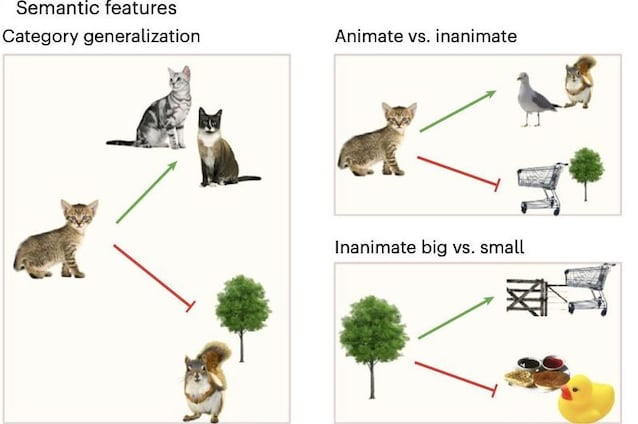
The little participants (101 at two months and 44 at nine months) observed images of 12 different categoriesincluding cats, birds, chairs, trees and even rubber ducks.
What did the researchers discover?
Analyzing the activity of ventrotemporal cortex (an area of the brain fundamental for visual recognition), scientists have found an already “mature” structure. Already at 2 months, the brain responds markedly differently whether the stimulus is an animate being or an inanimate object.
The brain distinguishes him too objects based on theirs size real in the world, understanding that a tree is “big” and a cup is “small”, even if they appear the same size in the image.
The most incredible discovery is that these categories appear earlier in the “high-level” visual cortex than in the lateral one, suggesting that the brain does not just learn one piece at a time starting from simple details, but already has a early overview.
To confirm these data, the team compared the neural responses of newborns with those of models Artificial intelligence (AI) of the Deep Neural Network type.
The result? The reactions of babies as young as 2 months old are aligned with those of an AI fully trained. This means that newborn brains process information using “rules” similar to those that machines use to classify objects accurately.
Why is this a revolutionary discovery?
This research suggests that we are not born “in the dark.” There is a biological mechanism that prepares the brain to recognize the fundamental categories of life immediately after birth. The experience of the following months then serves to “refine” and perfect these already existing mental drawers.
In practice, the human brain seems designed to make sense of the world much earlier than behavioral tests (such as eye fixation times) are able to measure.
Infants have rich visual categories in ventrotemporal cortex at 2 months of age – Nature Neuroscience
