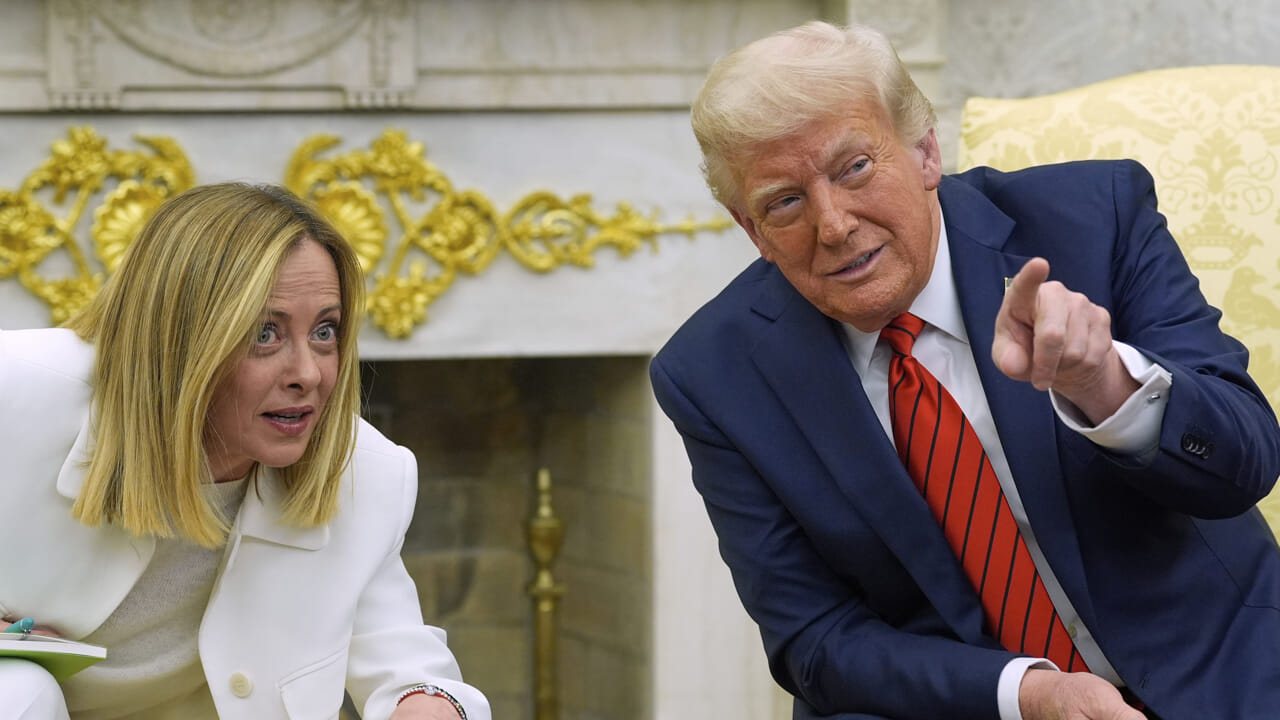
What Meloni gains from Trump’s Board of Peace
“Do you notice me more if I come and stay away or if I don’t come at all?” Donald Trump’s Board of Peace is shaking the minds of European leaders, pushing them to ask themselves a Morettian dilemma on the actual and symbolic cost of joining a body in which the only “for life” holder is a president who looks more at business than at the protection of human rights.
The doubt arises when observing the Board’s clumsy attempt to present itself as a multilateral body, while in reality it conceals a profoundly centralizing approach. The founding statute of the Committee – in which Gaza is never mentioned – is not limited to establishing international coordination, but perpetually locks the authority in the hands of a single figure: President Donald Trump, who also has the power to appoint or remove members and has the right of veto.
The UN for a fee
But with the shadow of President Trump dominating the global agenda, participation in the new Council has become a forced act for many states to avoid being excluded from the “tables that matter”. For chancelleries around the world (mainly military regimes, autocracies and absolute monarchies) the question has never been “whether” to join the Board of Peace, but how to do it.
Meloni’s obstinacy
Giorgia Meloni’s executive asked himself the same question, but gave himself an answer. The Italian government has decided that it will be an “observer” of the Board from the first meeting in Washington. This is a formula which, in fact, avoids formal membership and allows us to circumvent the constitutional limit imposed by Article 11 of our Charter. A non-random choice.
Meloni says yes to Trump: what does it mean that Italy participates in the Board of Peace as an observer
Presenting itself as an “observer” allows the Meloni government to sit at the table, follow the work closely and, potentially, influence the direction of the decisions to be made. It is a choice that has both a symbolic and political value. Meloni, who in recent weeks has sought the support of German Chancellor Friedrich Merz, has decided to place himself within a body led directly by Trump, with rules still being defined and with objectives that have clear strategic and economic implications.
The Board of Peace is not limited to the age-old – and made unsolvable – question of self-determination of the Palestinian people (this too was never mentioned in the statute of the committee led by Trump), but extends its range of action into other conflicts. It is therefore not surprising that several European governments – with the exception of Hungary and Slovakia, led by pro-Trump leaders – have declined the invitation to be part of this international body which clearly wants to replace the UN.
Nonetheless, the prime minister has decided to be part of the work – albeit as an observer – of a private body whose permanent seats are assigned on the basis of a commitment of one billion dollars. He has chosen – despite criticism from the opposition – to be part of a committee that is based on the participation of states willing to finance projects in exchange for visibility in international contexts alternative to the traditional ones, from which they have mostly been excluded. Meloni therefore considers it plausible to discuss the purely building future of what has been christened the “Gaza Riviera”, with suggestions coming from Israel (whose president, Benjamin Netanyahu, is wanted by the International Criminal Court for war crimes) but not from the Palestinians. The White House’s expectations are high, with Trump announcing on Sunday that the next meeting will serve to put five billion dollars in humanitarian aid and reconstruction aid for Gaza on the table. But to restore a real future to the Strip and its population, at least 70 billion are needed. As a starting point, at least.
Draw inspiration from the lessons of the past
With the approval of Resolution 2803 last November 17, the United Nations Security Council officially launched the Board of Peace. Presented by Trump as the “new frontier of global stabilization”, the body was created with the ambitious aim of managing the world’s most complex crises. Today Gaza and the future of the Strip. Tomorrow Ukraine. And then, will it be the turn of Sudan, Myanmar or Cuba? The question remains open, because the Board was born outside the traditional multilateral channels but presents itself as an alternative arena compared to the balances founded decades ago. But behind the rhetoric of novelty, the model chosen by the head of the White House appears anything but new. The structure of the Board, in fact, follows patterns already tested in the past, which have shown more shadows than lights, more failures than successes.
The most immediate precedent is that of the United Nations Interim Administration Mission in Kosovo, established in 1999 under Security Council Resolution 1244. On paper, it was the perfect mission: a robust mandate to govern, stabilize and guide a battered territory towards self-government. Yet, the centralized, internationally-led structure, whose officials had the final say on every issue, immediately showed its critical issues: ethnic divisions have intensified, the idea of an autonomous local government has faded and Kosovo is still struggling to claim its total independence.
Another example comes with the United Nations Transitional Administration in East Timor (UNTAET), established by the UN from the end of 1999 until independence in 2002. The body succeeded in rebuilding institutions, services and security from scratch, but went down in history for an excessively top-down approach. That is, decisions were made in international rooms, with minimal – if not zero – involvement of local leaders.
In the catalog of failures of post-conflict administrations, the case of the Coalition Provisional Authority (CPA) in Iraq remains, more than twenty years later, the most striking example of how short-sighted and top-down international management can transform a military victory into a humanitarian and political disaster. The US-led authority, created in the aftermath of the 2003 invasion, did more than just manage the transition: it attempted to rewrite the identity of a nation from scratch with new technocratic structures and free market reforms, but triggered a chain reaction that bloodied the Middle Eastern region for decades to come. Finally, it was 2003 when the so-called Quartet (United States, European Union, United Nations and Russia) presented the Road Map for Peace to the whole world. It was supposed to be the definitive path towards the two-state solution in the Israeli-Palestinian conflict, a step-by-step path made up of institutional reforms and security guarantees. But more than 20 years later, that road map is taken as an example of an ambitious strategy on paper, but tragically unsuccessful in reality. Now the risk for the Board of Peace is to generate the same sense of detachment and frustration in the Palestinian population who should, in theory, be protected. With the possibility of political and social chaos in the region, fueled by the seed of hatred.
These historical precedents should serve as a warning for “new initiatives” such as the Board of Peace and for those who want to join it. Because the lesson is clear: when external actors – be they coalitions of the willing or officials of the United Nations – choose the path of centralized and top-down command, they almost inevitably end up suffocating “local ownership”. The result is a diplomatic and political paradox: in the attempt to build (impose, considering some precedents) an autonomous state, it is emptied of its lifeblood, i.e. the participation and self-determination of a people who inhabit and live that land.
What price are we willing to pay?
Is this, then, the price we are willing to pay? The Italian executive does not seem to ask itself this question. On the contrary. The Italian government’s decision to join, albeit with observer status, the newly formed Board of Peace – a decision defended in Parliament by Minister Tajani in the face of opposition accusations of bending our country to the neocolonial project of US real estate developers – does not only concern the reconstruction of Gaza. Above all, it is a choice that signals the prime minister’s desire to position herself in the new global balances, which tend to exclude and fragment Europe (absent from Trump’s new organism), and which redefine the directions of Italian foreign policy.
Meloni’s move in fact represents a political signal to the European partners, in particular to France and Germany, who have maintained a much more cautious attitude towards the body promoted by Trump. The message, albeit implicit, is this: if the Board of Peace were to consolidate itself as a central platform for the management of international crises, Italy would find itself in a leading position. The downside, however, would be a possible further distancing from European allies, worried about the image of a European country increasingly aligned with President Trump’s sphere of influence.
