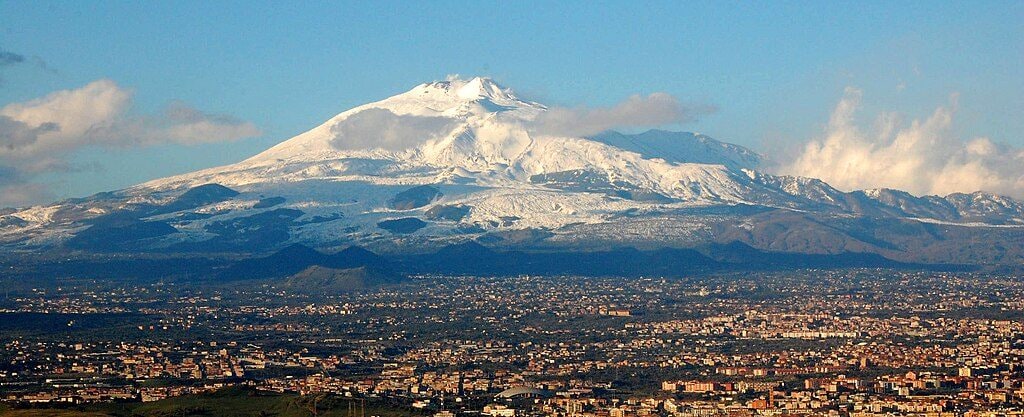
THE’Etnaa fire giant who dominates the Sicilian landscape as well as a protagonist of several myths. But… if we were to talk about it, would we say that it is “wonderful” or “wonderful”? The apparently superficial and obvious question about the ambiguous gender of Etna (whose word derives from the Greek “Aitne”, meaning “furnace”) opens a fascinating door on relationship between human language and the natural world.
First of all, in the Italian language when talking about Etna we normally use the masculine gender: “Etna erupts”, “its crater”, etc. This is due to the fact that in Italian toponymy the names of mountains, rivers and volcanoes are masculine (Mont Blanc, the Matterhorn, the Gran Paradiso, the Po). However, there are exceptions of female toponyms, singular such as the Marmolada or the Maddalena, and so also some groups called in the plural (the Alps, the Dolomites). All of this is an example of how linguistic conventions on the attribution of the gender of certain places arbitrarily consolidated over time.
In the case of Etna, the masculine gender it would be officially confirmed by the Accademia della Crusca, similarly to other names of volcanoes such as Vesuvius, following the consolidated non-rigid use of attribution of the genus to physical places. This decision forms part of a broader phenomenon present in natural languageswhere grammatical gender does not reflect biological gender or sexual identity, but follows historical, phonetic or analogical patterns and it does not depend on a natural “essence” but on local linguistic history and by analogies with other words of the language.
Yet, if you ask some Sicilians, for them the volcano remains “In Muntagna”, “Mama Etna”never being referred to as male. Therefore, in the local language of Catania Etna has a different grammatical gender than the one it has in standard Italian, precisely because the attribution of the gender is arbitrary. To better understand this phenomenon, other examples can be given without even going too far from Trinacria, think of arancino vs arancina. To simplify, in the province of Palermo they prefer to say arancina (feminine), while in Catania they use arancino (masculine). To this culinary delight, not having a natural biological gender, local linguistic uses have arbitrarily attributed a grammatical gender over time, as often happens with inanimate objects. Since both forms have established themselves in use, both have been declared correct in standard Italian in their respective contexts of use.
If we observe other more international examples, however, the same logic applies to the names of the stars such as “sun” and “moon”: in Italian the sun is masculine and the moon feminine, but in other languages these assignments change. Germans will look at the sun with the feminine gender (die Sonne), while at the moon with the masculine (der Mond), categorizing them into two of the three grammatical gender classes present within their language. Yes, because in the German language there would be a third gender, the neuter, exactly as it existed in Latin, and it too does not have to do with intrinsic characteristics of the thing described, but has its own linguistic history; another clear example of how the grammatical gender of names either a linguistic etiquettenot a reflection of biological reality. And if the neuter seems excessive, just think that some African languages have up to 20 grammatical gender categories.
In any case, arancini, arancine and Etna do not depend on any intrinsic quality, but rather on the way in which the Italian speaking community has become accustomed to referring to a given referent, an example of how human language is not an “objective” reflection of reality, but rather a system dynamic, conventional and culturally mediated and how it fundamentally changes over time.
In a historical period in which sensitivity towards gender issues is increasingly pronounced, it is interesting to observe how the language itself can reinforce implicit stereotypeseven when there is no direct link to real biological or social characteristics. The Gender stereotypes are stronger in the linguistic corpora of more developed and individualistic societiesbecause associations between words related to men and concepts such as career or science tend to be more pronounced than those related to women and areas such as family or the arts. This evidence underlines that grammatical gender and gender stereotypes, although distinct phenomena, can become intertwined in linguistic culturehelping to reinforce stereotyped perceptions about social roles or traits associated with one gender rather than the other.
This does not imply that naming Etna as masculine is in itself sexist or discriminatory. However, many studies highlight that language patterns can reflect and amplify social beliefs wider. In other words, while grammatical gender serves a structural function in language (of coherence and agreement), it also reminds us that language is a powerful cultural mirror which carries with it traces of stereotypes and social values that deserve to be consciously recognized and analyzed.
