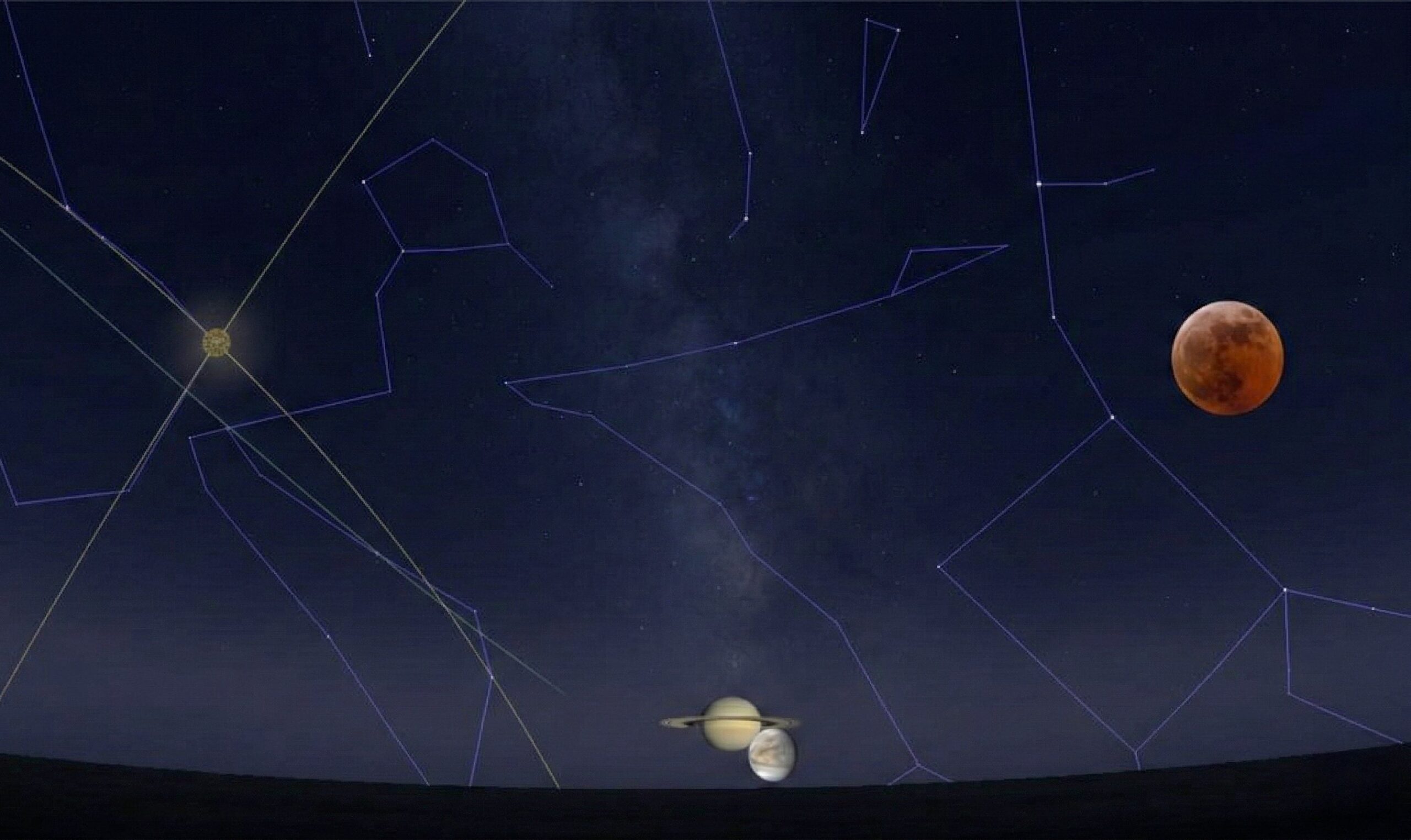
The March sky 2026 will have several noteworthy celestial events in store for us, starting from the most important one of all, thetotal lunar eclipse on March 3. Although not visible from Italy, it represents an important event because it is thelast total lunar eclipse before a two-year fast which will only break end 2028 with the New Year’s Blood Moon Eclipse. Other important events are the “celestial kiss” between Saturn and Venus at sunset on March 8, the conjunctions between Venus and Neptune and between Mars and Mercury, the lunar occultation of the star Regulus and thespring equinox on March 20th.
The total full moon eclipse on March 3 is coming
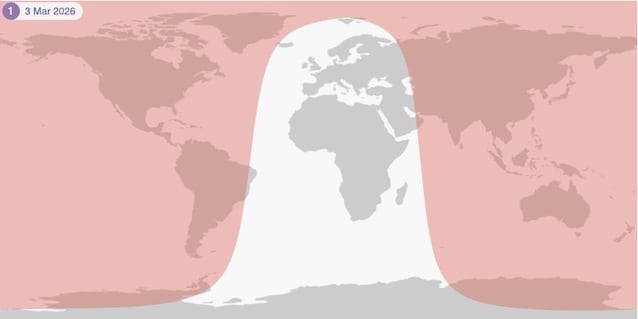
The main event of the month is the etotal lunar eclipse of March 3when the Moon is full will enter the shadow cone generated by planet Earth. It is about thelast total eclipse of Moon for the next two years; for the next in fact we will have to wait for December 31, 2028 and its New Year’s Blood Moon eclipse. Unfortunately, the total eclipse on March 3 it will not be visible from Europebut only from Asia, Australia and North America. We will therefore have to rely on online live broadcasts from these regions of the world to appreciate the celestial spectacle.
The eclipse will start at 9.44am Italian time when the Moon enters the Earth’s penumbra. There partial phase will begin at 10.50amwhile thetotal eclipse real at 12.04. The maximum will be reached at 12.33pm and half an hour later the Moon will begin to emerge from the Earth’s shadow cone. The eclipse twill end at 3.23pm with the Moon’s exit from the Earth’s penumbra.
The “celestial kiss” between Venus and Saturn and other planetary conjunctions
In March we will have three planetary conjunctionsall in the first half of the month. Let’s start with the conjunction between Venus and Neptune on March 7th which will lead the two stars to almost obscure each other, since they will reach one angular distance of only 4′a separation less than the width of a little finger held at arm’s length. While Venus is easily identifiable given its brightness, Neptune is not visible to the naked eye, so it will be necessary to equip yourself with at least a small telescope to see both stars at the same time. To complicate things, the conjunction occurs when it is 1pm in Italy, so we will have to wait for the sun to set to be able to observe this phenomenon. At the sunset of the Sun, the two stars will still be very close to each other and we will have available only until around 7pm to observe themas long as you have a completely clear western horizon. The planet will keep him company at the top left Saturn.
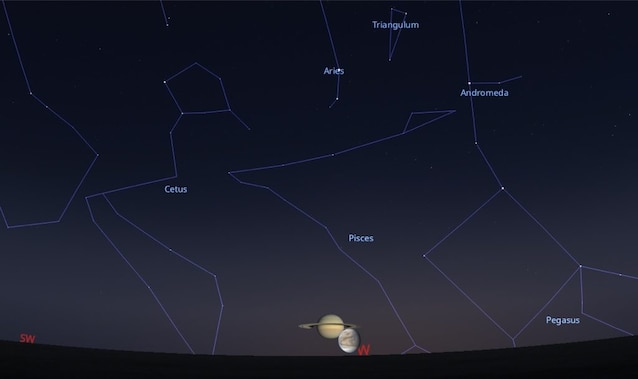
The Lord of the Rings is the protagonist of the most spectacular conjunction of the month, a “heavenly kiss” at sunset which always sees him as the protagonist together with the brilliant Venus. The two planets will reach the closest approach at 2.15pm Italian time, when they will be approximately half a degree apartwhile the conjunction will happen at 11.11pm to one distance of one degree. Venus and Saturn they will set at 7.20pm from our latitudes, so the “celestial kiss” will be observable (even with the naked eye) only in the hour and a half following the setting of the Sun. The angular distance that will separate them will be approximately equal to the width of an index finger held at arm’s length.
THE’last conjunction it’s probably that one more difficult to observe because it requires being an early riser and having the ability to see the two planets Mars and Mercury in the glow of dawn. The two celestial bodies will be in conjunction at 7:44 am on March 14th about 4 degrees apartwhile they will reach the maximum approach on the 15th at 8.09pm at a distance of 3 degrees and 21 minutes. Remember that with the term maximum approach we refer to the moment in which two bodies reach the minimum angular distance, while conjunction is the moment in which two bodies have the same right ascension.
Lunar occultations
This month the Moon will not be the protagonist occultations of the planets of the Solar System, but only of brilliant stars in the firmament. The first will be the March 2when the Luna will occult the star Regulus in the constellation of Leo from 11:53 to 15:49 Italian time, an event visible only in eastern Russia, Mongolia, northern China, the Korean peninsula and Japan. Regulus which will be the protagonist of a second lunar occultation on March 29, this time visible from Italy. The occultation will begin shortly after sunset at 6.51pm and will end at 11.04pmgiving us ample time to observe this phenomenon both with the naked eye and with optical instruments.
There third occultation lunar is instead with the star Antaresthe supergiant star in the constellation Scorpius. Also in this case unfortunately the occultation, which will take place when it is around midday in Italy, it will not be visible from our latitudesbut only in Antarctica, Madagascar, the French Southern Territories and Mauritius. THE’last occultation always sees the protagonist Moon and the star cluster of Pleiades. The March 23 a 23% illuminated Moon will obscure the bright stars in the constellation Taurus when viewed from the latitudes of Japan, Korea, northern China and Russia, as well as the northern parts of the United States, Canada and Greenland.
Minor meteor showers
While waiting for the large spring and summer meteor showers, March certainly does not shine for the abundance and importance of these spectacular astronomical events. There are three swarms, so-called minor ones, which will illuminate the nights of March. The first is that of Normidi rangeactive from February 25th to March 28th. This shower, with a maximum rate of 6 meteors per hour per peak on March 14thhas the radiant (the direction from which the meteors appear to come) in the southern constellation of Norma, which from our latitudes is always very low on the horizon, therefore making this shower poorly visible in Italy. The next two minor swarms are that of xi Herculidsactive between 6 and 20 Marchwith peak on the 12thand the eta virginidaeactive from March 8 to March 25, peaking on the 18th. Both showers, with radiants in the constellations of Hercules and Virgo respectively, will have a peak meteor rate of less than two per hour.
Spring equinox
We close the roundup of the most important astronomical events of the month with thespring equinoxmarking the end of astronomical winter in the Northern Hemisphere. This year the equinox will fall on March 20 at 3.46pm Italian time.
