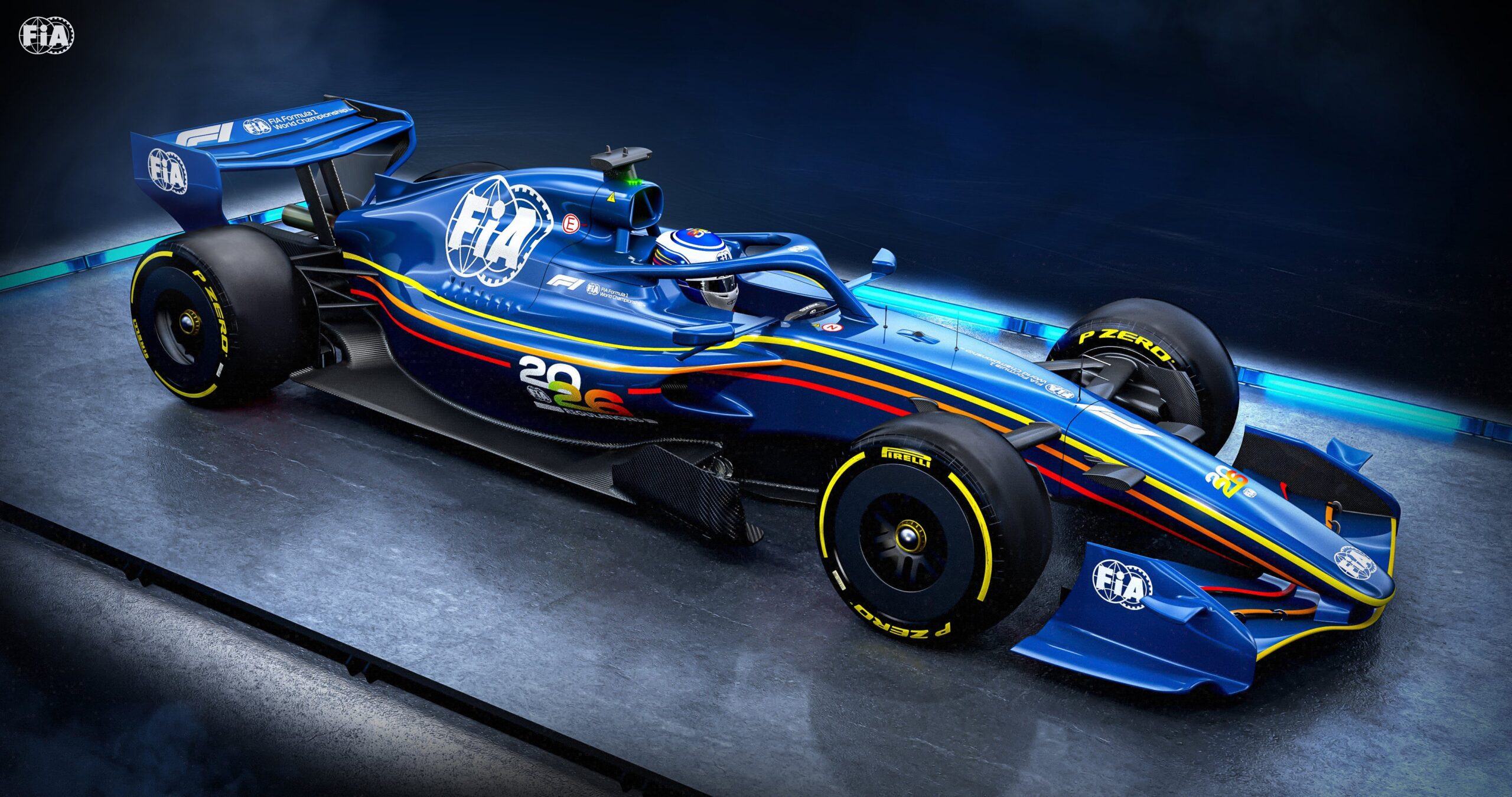
The 2026 Formula 1 World Championship begins this weekend and with it the new technical regulation drawn up by FIA for the new course of the category. There will be many new features that will affect the single-seaters and their internal components, effectively overturning everything we were used to in the Circus until last season. 2026 will also mark a historic moment for the grid, which it will welcome again 11 teams thanks to the entry of Cadillac, bringing Formula 1 back to eleven teams for the first time since 2016. The technical regulations revolve around what is truly the heart of Formula 1: the power unit. Engines prepared for the new regulation will see a strong increase relative to the part hybridthe electrical component will thus rise to 350 kW (approximately 450 hp) and the division between thermal and electric engines will be equal 50-50%.
News also from an aesthetic point of view, with the 2026 single-seaters which will see a reduction in minimum weight of approximately 30kg: the new minimum weight, therefore, will be 768kg compared to 800kg of the previous regulation. In addition to the weight, the dimensions will also change, making the narrower and shorter cars. This furthers the line promoted by the Federation of having more agile single-seaters and promoting more entertainment on the track. They will also change wingsthe tiresthe energy management and many other fundamental elements for performance and overtaking on the track. So let’s discover together the new 2026 Formula 1 technical regulations.
Power Unit and sustainability: what’s new in the 2026 F1 regulations
2026 marks a real revolution under the hood of the single-seaters. Today, F1 cars have complex power units: a heat engine (ICE)a turbochargerThe kinetic electric motor (MGU-K)The thermal electric motor (MGU-H)control unit and batteries. It is a very powerful system, but also expensive and difficult to manage. Until 2025, ICE produced approx 550–560 kWwhile the electrical part i.e MGU-K And MGU-H, contributed approx 120 kWor less than 20% of the total power. The MGU-H was among the most complex and expensive of the components, adding weight without providing much practical benefit on the track.
From this year everything changes: the power unit will maintain a total power of around 1,006 HP, but will now be divided 50% Between electric motor And heat enginewhile theMGU-H is completely eliminated. The electrical part grows from 120 kW to 350 kWalmost tripling the power available during acceleration, while the combustion engine drops to approx 400 kW. The increase in the electrical part will lead to a greater energy recovery braking thanks to the new one ERS (Energy Recovery System)arriving at approx 8.5 MJ per revolution compared to 2 MJ of past years.
All these revolutions in electrical components will bring i pilots to greater responsibility. It’s no longer just about pressing the accelerator: he will have to decide when to use the electric boost, how to manage the accumulated energy and how to optimize the drums during each lap. In practice, the management of the electric becomes an integral part of the race strategy, making every driver’s choice decisive for the result.
They will also change fuels in F1 in 2026, where for the first time in history the single-seaters will use 100% sustainable fuels compared to the petrols of the past which were sustainable at 10%. Here motorists and fuel producers will be able to choose between biofueltherefore non-food biomass, or choose thee-fuelsynthetically produced fuels. Each fuel will have to be certificate from the FIAso as to be safe, high-performance and comply with emission limits. This change in petrol is fundamental, as the composition of the fuel directly affects engine performance.
From farewell to DRS to the new active aerodynamics: how single-seaters are changing
The new generation of single-seaters will be more compact and lighterdesigned to increase agility and make on-track actions more spectacular. Compared to the 2022-2025 cars, the wheelbase drops by 200 mm, going from 3,600 mm to 3,400 mmthe length overall decreases by 100 mm, from 2,000 mm to 1,900 mmand the bottom shrinks by 150 mm. Also the minimum weight it drops by 30 kg, going from the 800 kg of the previous cars to 768 kg. These changes aren’t just about size: the aerodynamic load total decreases between 15% and the 30% thanks to the removal of the ground effect tunnels, while the aerodynamic resistance drops by approximately 55%. This will make the cars more difficult to drive but should also see races with cars closer together.
Another fundamental innovation will be theactive aerodynamics both at the front and at the rear, designed specifically to help the electrical part of the single-seater Don’t overload yourself during a ride. Active aerodynamics has two modes: Z-Mode And X-Mode effectively abolishing the system of use of DRS introduced in 2011. There Z-Mode it is essentially the standard mode which favors maximum aerodynamic load, i.e. more grip when cornering and more stability when braking. There X-Mode instead it is the open wings mode, both front and rear, here the front and rear wing flaps yes they movelowering to make the car slide better and increase speed.
The pilot can then switch from one mode to another following the FIA instructions on the areas of the track where it is permitted to activate the X-Mode which will be indicated with the sign “Straight Mode”. DRS will be replaced by two modes in particular: the first will be functionality Manual Override, in practice, the driver will be able to use the electric motor for longer at most on the straights. Today theMGU-K gives its all only up to 290 km/hbut with Manual Override you get up to 337 km/hso it can be overcome more easily. The second will be theOvertake Mode which will allow the chasing driver to benefit from an extra boost of electric energy and facilitate overtaking. To activate this new mode (operated via a button on the steering wheel), the chasing driver must be within one second of the car in front and in the only zone indicated by the FIA for activation.
The system is also very tactical: if the defender uses all his energy to block an overtaking, in the subsequent corners he risks being left open, while the attacker can use the extra power to pass. In this way every straight and every curve become key moments for overtaking and energy management becomes decisive.
The size of the tires decreases and the safety of the single-seaters increases
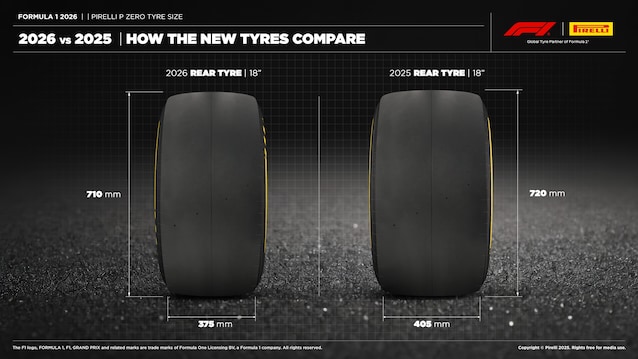
With the new technical regulation, too Pirelli had to rethink its tires to adapt to the 2026 single-seaters. The dry range P Zero will remain composed of five compounds, from C1the hardest, until C5the softest, so as to cover all the needs of the different circuits. The real news, however, concerns the dimensions. The circles remain from 18 pcsbut the tires become more compact: the tread is reduced by 25 mm at the front and of 30 mm at the rear. The total diameter also drops by 15mm in front And 10mm behind. Why this choice? Smaller and narrower tires mean less weight and less air resistancein line with the objective of the new single-seaters: to be lighter, more agile and more efficient.
The FIA has also worked a lot on safetyespecially in the front area of the single-seaters. In the past it was not uncommon to see accidents in which the front structure completely detached after a violent impact, leaving the car less protected in the event of an immediate second impact. For 2026 a solution has been introduced to “double phase”: in the event of an impact, only part of the structure breaks, while a significant portion remains connected to the frame. In this way the car maintains residual protection even after the first blow, increasing overall safety. Also the roll hoopthe structure above the pilot’s head, has been reinforced: the bearable loads pass through 16G to 20Gimproving resistance in the event of overturning.
There is also no shortage of technological updates: i LEDs on the side bulkheads of the rear wing they will be more visible, the GPS antenna has been repositioned to improve the precision of the data and encourage future developments related to active safety. Furthermore, new lights arrive on the rear-view mirrors: they flash when a car is stopped on the track, especially if positioned sideways or in heavy rain conditions, when the central rear light may not be clearly visible.
