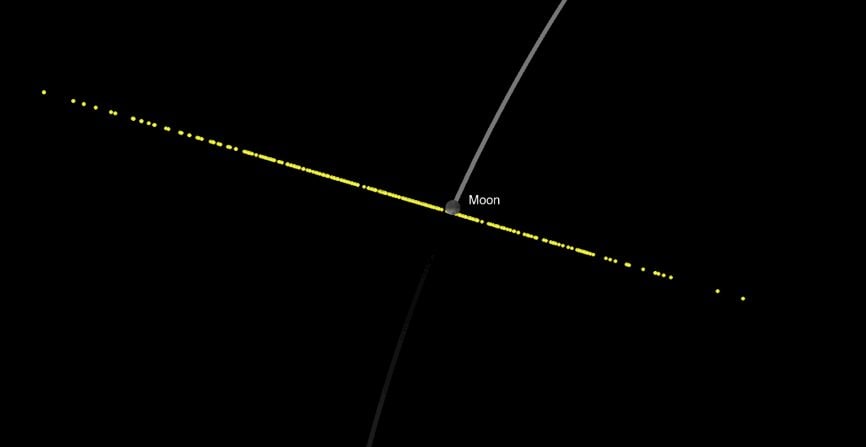
Remember the asteroid 2024 YR4 which, according to astronomers’ calculations, should have hit the Moon on December 22, 2032? According to new observations made with the space telescope James Webb between February 18 and 26, this possibility would be averted: the asteroid will pass at around 21,200 km from the surface of our satellite.
If you don’t remember about this asteroid, here’s a little one recap. In the first months of 2025, when the available data was still limited, 2024 YR4 hit the headlines for being the object with the highest value ever reached on the Turin scale, reaching a probability of impact with the Earth of as much as 3.4%. Although observations conducted with the most powerful telescopes at our disposal have eliminated this possibilitythere was a probability that the celestial body could hit the Moon on December 22, 2032. Thanks to James Webb this was now also a possibility statistically excluded: 2024 YR4 will pass 21,200 km from the lunar surface, with an uncertainty of only 700 km.
What we know about the ‘city killer’ asteroid
The asteroid 2024 YR4 was discovered on December 27, 2024 from the ATLAS observation network (Asteroid Terrestrial-impact Last Alert System), funded by NASA, in Chile, to scan the sky in search of objects potentially dangerous for our planet. 2024 YR4 is a Apollo-type asteroidthat is, objects that cross the Earth’s orbit and have an orbital semimajor axis greater than that of the Earth, but perihelion distances smaller than the aphelion distance of the Earth. With a diameter estimated among 53 and 67 meters it would seem like an asteroid like any other if not for the fact that the first estimates of its orbital trajectory gave it as in possible collision course with Earth.
At the beginning of 2025, in fact, the asteroid was classified as level 3 on the Turin scalethat is, having a greater than 1% chance of impacting our planet. Indeed, on February 18, 2025 the calculated probability of impact rose to 3.4%, a value never before reached by any asteroid. Given its size, this would have meant a event similar to that of Tunguska of 1908 in Siberia, that is, capable of releasing a energy equivalent to approx 1,000 times the Hiroshima atomic bomb. For this reason the asteroid was renamed as “city killer”. Increasingly precise observations conducted in the following months have fortunately reduced this probability more and more until completely reset it.
However, these same observations opened up to one unexpected scenario: 2024 YR4 had a About 4% chance of colliding with the Moon on December 22, 2032. On this date, models predicted that the asteroid would hit our natural satellite with enough energy to create a impact crater approximately 1 km in diameterraising a sea of debris that would have headed towards the Earth, burning spectacularly in the atmosphere at a speed of about 11 km/s, without causing damage to the ground.
What the James Webb Space Telescope observed
Since the spring of 2025, asteroid 2024 YR4 has become almost unobservable from Earth because of his very weak magnitude in optical band. This prevented an improvement in the models describing its orbital trajectory for some time, leaving open the question of its possible collision with the Moon. What came to our aid was what is currently the most powerful space telescope ever built by man, the space telescope James Webb.
Thanks to his infrared “eyes”.a team of astronomers from the Johns Hopkins Applied Physics Laboratory in Laurel, Maryland, managed to observe the asteroid on February 18 and 26, 2026, when it was at ben 470 million km from Earththus accomplishing between faintest observations ever made of an asteroid (magnitude +30.5).
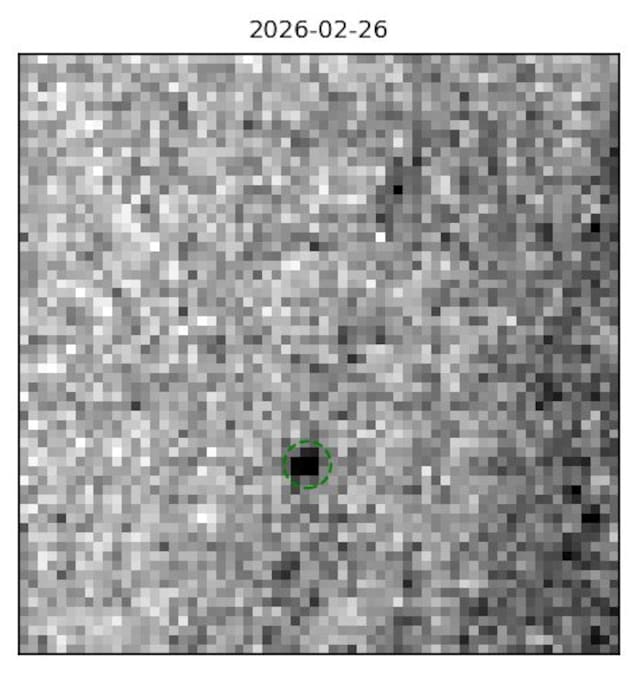
By analyzing the position of 2024 YR4 relative to background stars, whose positions are well known thanks to data from the European Space Agency’s Gaia satellite, astronomers were able to rule out any possibility that the asteroid could hit the Moon on December 22, 2032. The new estimated trajectory foresees that 2024 YR4 will pass to “only” 21,200 km from the Selenic surfacewith auncertainty of approximately 700 km which statistically excludes the impact with the Moon.
This update reflects greater precision in our understanding of where the asteroid is expected to be in 2032, not a shift in its orbital path induced by interactions with other bodies. The Moon can thus breathe a sigh of relief, although many may not rejoice at this news given that it will deprive us of a spectacular collision that we would have observed from a more than privileged point of view.
