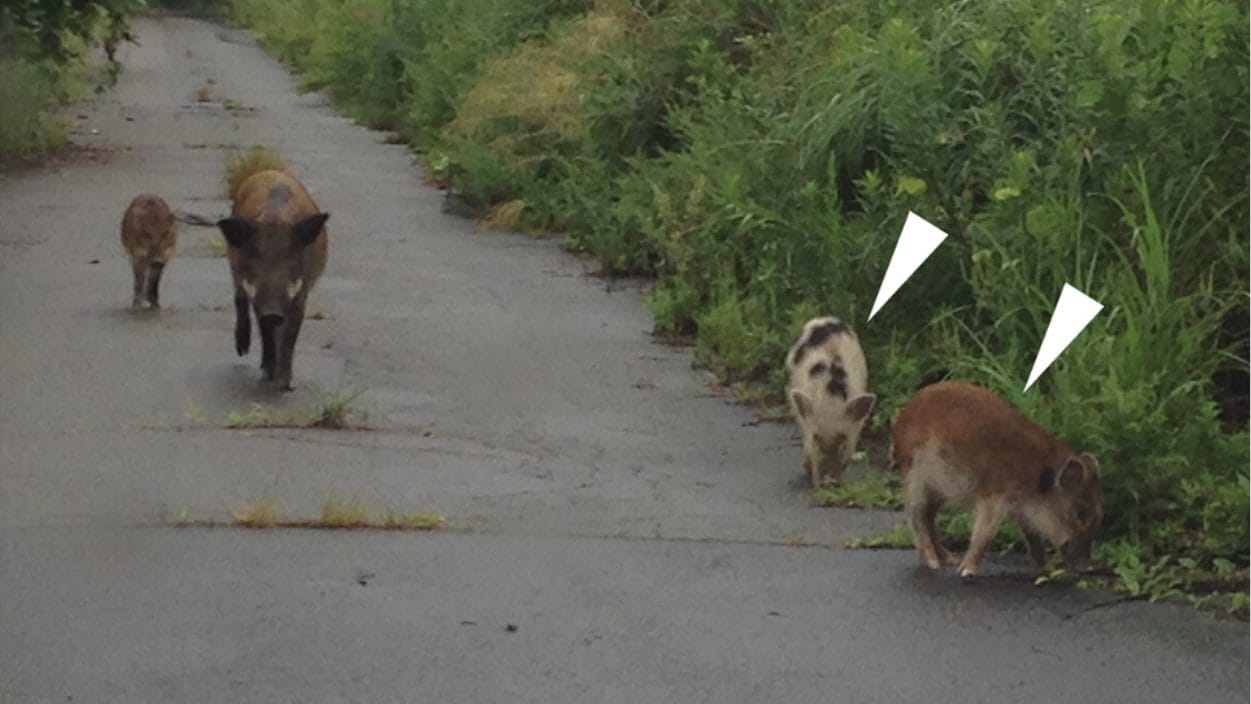
The Fukushima area in Japan, completely evacuated after the nuclear disaster, has shown among the various transformations also a phenomenon of births of pig-boar hybrids. A genetics study published last January examined the process hybridization among pigs that have escaped from farms and wild boars, right in the area abandoned for over a decade after the tsunami ofMarch 11, 2011. The study was published in a special issue of the Journal of Forest Research, entirely dedicated to long-term effects of radioactivity and depopulation in the forests that cover approximately 70% of Fukushima’s contaminated area. The case of hybridization it was not due to radioactive pollution in any waybut exclusively from the absence of man. Areas abandoned following catastrophic events, such as Fukushima or Chernobyl, undergo changes and, in many cases, the prolonged absence of anthropic pressures favors an increase in animal and plant diversity. These places become a real “natural laboratory” for different areas of research: territories contaminated by radioactive agents and devoid of human presence for years, they have attracted the attention of researchers from various disciplines and have allowed the trend of many natural phenomena to be studied for years.
The birth of pig-boar hybrids in Fukushima: what happened and what the study says
On March 11, 2011, after the earthquake of magnitude 9.0 off the coast of Japan and the tsunami that severely damaged the Fukushima nuclear power plant, a large area was immediately evacuated, approximately 164,000 people were removed and many areas remained forbidden to man for years. In August 2011, the evacuation zone covered an area of approximately 1,800 km2 and, only starting from 2017, this area was downsized. The abandonment of agricultural companies and the consequent expansion of forest environments allowed the escape of domestic pigs (Sus scrofa domesticus) from livestock farming and the colonization of new areas by wild boars (Sus scrofa leucomystax) and then the encounter of the wild with the domestic.
The researchers examined the genotype of hybrids from several generations, thus helping to clarify how animal populations evolve in environments devoid of human presence. In particular, they analyzed the portion of Mitocontrial DNA (inherited by children exclusively through the mother) in several hybrid individuals, 191 wild boars and 10 pigs, to evaluate the degree of introgression of the porcine genome in wild boar populations, i.e. the degree of transfer of pig genes into wild boar DNAfrom one generation to the next.
The effects of crossbreeding on wild boar DNA
Repeated crossbreeding of pigs and boars has given rise to multiple generations of fertile hybrid individuals. The results of the study showed that it was present in many wild boars Porcine mitochondrial DNAa sign that in many cases female pigs had crossed with male wild boars, resulting in hybrids with a greater prolificacy and with ability to reproduce all year roundtypical characteristics of domestic pigs.
With this mechanism, pigs that escaped from farms and crossed paths with wild boars favored thepopulation explosion of the latter. The study also revealed that the greater reproductive frequency resulted in a very rapid succession of generations in the space of a few years, but from one generation to the next, the portions of pig DNA decreased rather rapidly. The hybrid males, however, mated predominantly with pure female boarswhich generally have reproductive cycles only once a year, which is why there has been a reduction in the porcine portion of the DNA.
What is hybridization between species and why does the Fukushima case interest biologists
A hybrid it is an individual generated by the mating of two different species: in some cases, the hybrid is sterile, in others it is fertile and, therefore, can cross effectively with individuals of one or the other species. One of the most common examples is the mule, generated by crossing a donkey (Equus africanus asinus) with a mare (Equus caballus), but hybridization phenomena can occur in nature when two species come into contact for effect of environmental alterations. Alien species introduced voluntarily or accidentally by humans or species that migrate spontaneously under the pressure of climate change can generate hybrids that, in many cases, threaten the conservation of biodiversity.
THE’hybridization between wild and domestic it is an even more serious and frequent problem, caused by the expansion of human activities and the proximity between anthropized environments and natural environments. This study first demonstrates that, when an environment is devoid of human presence and anthropic pressures, evolutionary dynamics change rapidly and the fauna tends to recolonize and to reoccupy natural environments. The other interesting information is precisely the “dilution” of pig genes over time, which through backcrossing of hybrids leads once again to the wild genetic component of the wild boar prevailing. The hypotheses on how hybridization changes over time, at least for the case of crossbreeding pigs with wild boars, which have emerged from the Fukushima case will be very useful for biologists who also deal with wildlife management and to plan targeted interventions.
