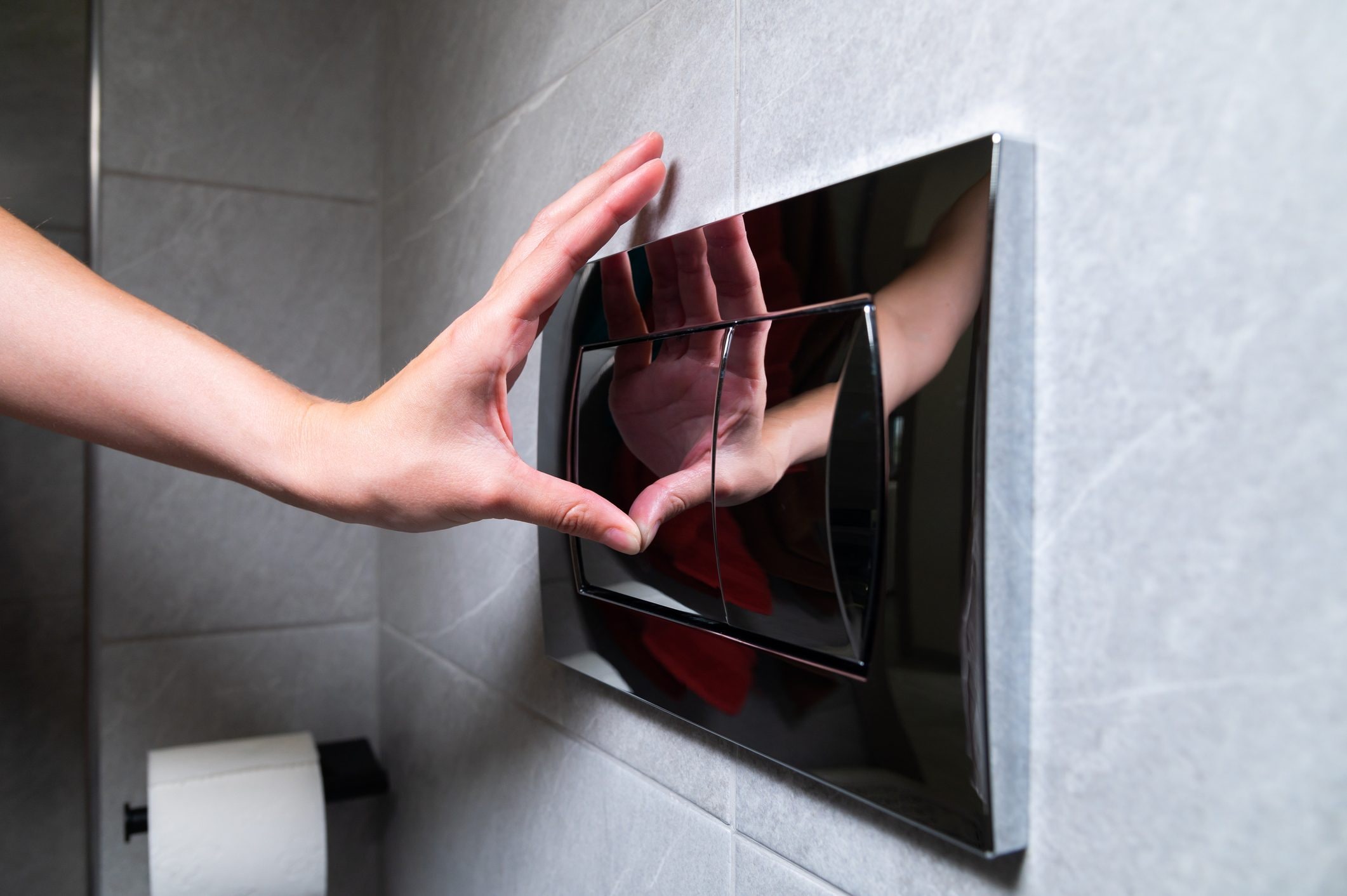
How much do we save by using the small toilet flush button? Using the small flush button saves approx 50% water with each use compared to the large button. The mathematics of toilet flushing therefore tells us that by mainly using the small button, we can significantly reduce the quantity of water used resulting in economic savings. Let’s see how much water we can actually save and how this can impact bill both of a family and of a commercial establishment.
The math of flushing the toilet is simple, but to estimate water consumption (and savings) we need to know how many times we flush and how much water we use each time we flush the toilet.
As for how many times a day we need to download, there is no fixed number, but we can make an estimate considering, by way of example, the case of a person who pees 6 times a day and defecates 1 time a day (these are frequencies considered normal). In this case, therefore, 1 time a day you need to download using the big buttonAnd 6 times you can do it using that small, if available.
As regards the quantity of water involved, the most recent toilet cisterns generally contain 6 liters of water: with the large button they all download and 6 litres in one go, but we can download half of it, 3 litresusing the small button. The older cisterns, however, have only one button with which we use the water contained in the cistern every time we flush, 6 liters each time (in some cases even 9).
But let’s get to the calculations. If we have a cassette at home with just one buttoneach time we discharge 6 liters of water: in 1 day, adding the two different bodily needs, a person manages to discharge 7 times consuming 6 × 7 = 42 liters which in 1 year makes a total of 42 × 365 = 15,330 liters. Consequently one family of 4 consumes approx 15,330 × 4 = 61,320 liters of water per yearjust for flushing the toilet, which correspond to 61.32 cubic meters of water (1 cubic meter contains 1000 liters of water): with such a quantity of water we could completely fill a 20 square meter room 3 meters high, for example a living room or a kitchen.
But what happens if instead we have a flush toilet available with the double button and we only use the big button when we go to the toilet? Repeating the calculation this time, 1 person will consume 6 liters when they go to the toilet and 3 liters every time they pee, so in our case we can calculate a consumption of 6 + 6 × 3 ì= 24 liters per dayor 8,760 liters per year per person, which for one family of 4 people correspond to 35,040 liters per year. Consumption is almost halved, with a savings of 61320 – 35040 = 26,280 litres: with such a quantity of water, which corresponds to 26280 ÷ 1000 = 26,280 cubic meters, we could fill a room of almost 9 square meters as it could be a bathroom, perhaps the same one in which we flushed the toilet.
We can go even further and estimate how much water we would save in Italy if every resident in the country had a flush toilet with the double button and used it correctly. From the calculations made above we can deduce that each person would save 15,330 – 8,760 = 6,570 liters per year, which multiplied by 58,943,464 residents in Italy make a total of approximately 387 billion liters of wateror approximately 387 million cubic meters of water, a volume corresponding to approximately 150 Pyramids of Cheops.
But from the point of view economical how much do you save? In our example, a family living in a large city like Genoa would pay approximately €2.94 (VAT included) for each cubic meter of water consumed e in a year would save approximately 2.94 × 26,280 = €77.27. However, in the event that the family did not benefit from the resident tariff, the savings would be even more pronounced given that, compared to a tariff of around €3.41 (including VAT), they would save 3.41×26.280=€89.61 per year.
But the greatest savings occur in the case of commercial establishmentswho pay higher rates. Let’s imagine we run a restaurant that serves 100 people a day and that each client needs to go to the bathroom exactly 1 time to pee. If everyone uses the small toilet flush button we can save 3 liters of water with each flush for a total of 300 liters per day, or 100 × 3 × 365=109,500 liters per yearwith an economic saving (considering a rate of €5.07 per cubic meter, VAT included) of 5.07 × 109,500 = €555.16.
