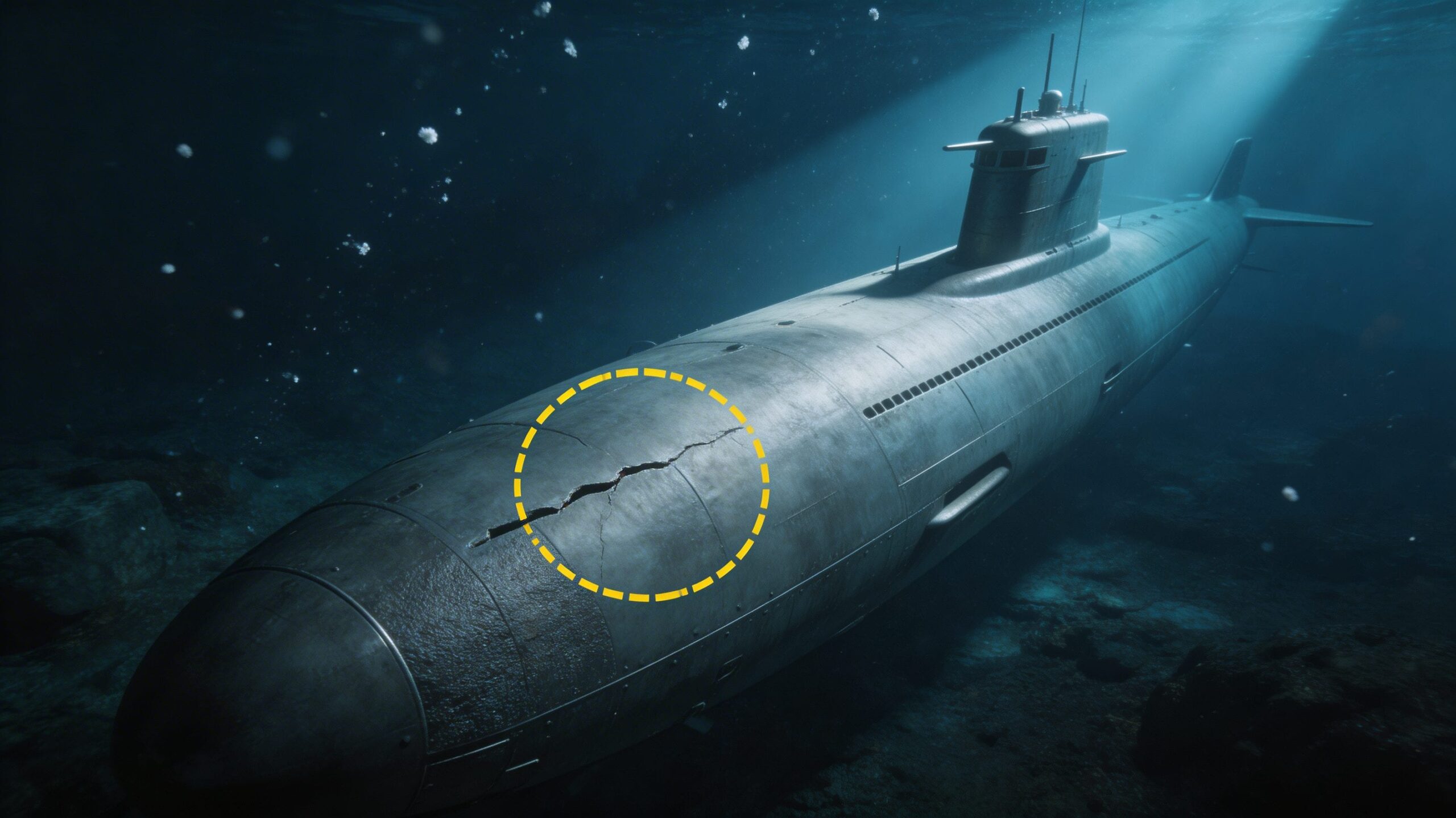
Thirty-seven years ago the Soviet nuclear submarine Komsomolets sank in the Norwegian Sea during the War Cold due to a fire. Why is this military vehicle being talked about again in 2026? The answer has to do with the continued release of radioactive material still present on board, at the center of studies and debates regarding his potential impact on the environment. Specifically, just a few days ago a new research called Status of the sunken nuclear submarine Komsomolets in the Norwegian Sea whose objective is precisely to provide as accurate a picture as possible of the situation at this moment. The first step to fully understanding this story is to see quickly how this vehicle is made and – above all – as it was sunk in 1989.
The sinking of K-278 Komsomolets 37 years ago in the Norwegian Sea
Launched in 1983, the K-278 Komsomolets it was an attack submarine a propulsion nuclear. He measured 117.5 meters in length per 10.7 wide and could operate at a maximum depth of 1.25km. The vehicle’s propulsion was guaranteed by a pressurized water nuclear reactor 190MW which allowed it to reach a maximum speed of 14 knots on the surface and about 30 submerged. As for the armament, they were present six tubes torpedo launchers capable of launching standard, anti-ship and missiles and torpedoes cruise – including those with nuclear warheads, present on board on the day of the disaster.
Finally there was one escape pod for evacuation in case of emergency: this will be used on April 7, 1989. In fact, that day something happened fire on board while the vehicle was approximately 335 meters deep in the Norwegian Sea. The fire put the electrical and nuclear propulsion systems out of action, forcing the crew to hastily abandon the vehicle: in the end, only one of the 69 people on board survived. 25.
And from that moment on Komsomolets lies at approx 1680 meters deep on the backdrop. Over time, various investigations were carried out, especially by Russia and Norway, and it was soon noticed that the front part of the submarine was the most damaged with holes And cracks.
The Soviet nuclear submarine and radioactive material at sea: the study
The research team produced this new study starting from data collected in 2019 from an expedition carried out with vehicles submarines remote controlled: the objective was precisely the collection of samples of water, sediments and organisms. The first area analyzed is precisely that hullinside which the nuclear warheads were present. The images collected confirmed the extent of the damage but, fortunately, the analyzes confirmed the absence of plutonium in the surrounding environment.
A little different discussion for the reactor. The study confirms as his emissions are still in courseeven if not continuously, with maximum concentrations of activity for the Strontium-90 and the Cesium-137, respectively 400 thousand And 800 thousands times higher than typical levels of these two radionuclides in this portion of the Norwegian Sea. It was also observed that the reactor is also emitting Plutonium-239, Plutonium-240 And Uranium-236, whose reports suggested to researchers a corrosion of nuclear fuel. The emission, specifically, would occur from a ventilation duct that connects the compartment adjacent to the reactor with the open sea.
However, the authors of the study reiterate, even if it is true that the reactor has been continuing to emit radionuclides for over 30 years, at the moment there are very little evidence regarding one of them accumulation in the surrounding environment: these seem rather dilute quickly in the surrounding water, maintaining a concentration well below the thresholds considered dangerous.
Nonetheless, it is important to continue studying the reactor to understand how the situation could evolve over time and possibly how to intervene to protect the local ecosystem.
