
The nuclear fuel cycle includes all the industrial and technological phases aimed at producing electricity from uranium in nuclear reactors. The process begins with the operations of extraction and treatment of the uranium mineral, followed by the phases of conversion And enrichmentuntil manufacturing of nuclear fuel. Once removed from the reactor, the spent fuel can be reprocessed, in order to recover reusable fissile materialsor awarded long-term in systems disposal suitable.
The stages of the uranium fuel cycle
Extraction
Today’s nuclear fuel production is based onuraniuma relatively widespread metal in nature, present in rocks, soils, waterways and marine environments. Natural uranium consists mainly of three isotopes: uranium-238 (about 99.27%), uranium-234 (traces <0.01%) e uranium-235 (about 0.72%), i.e the only fossil isotopei.e. capable of sustaining a fission reaction. The identification of uraniferous deposits occurs through airborne radiometric surveys, integrated with geochemical sampling of groundwater and soil. Once the uranium deposits have been located, campaigns are conducted detail perforationaimed at the quantitative estimate of the available resources, together with technical evaluations aimed at defining the geological characteristics of the deposit. If the warehouse is located in proximity of the surface, methods of “sky extraction open“; in case it is located at depths greater than 120 metresi, techniques are adopted “extraction underground“.
Treatment
Following extraction operations, the uranium mineral is subject to processes of mechanical crushing and grindinguntil a fine grain size is reached. The material thus prepared is subjected to leachingan aqueous suspension in the presence of a leaching agent (typically sulfuric acid), useful for solubilize uranium e separate it from the sterile matrix (rock). You get one liquid solution enriched in uranium, which comes purified and chemically treated to obtain a solid concentrate. The latter comes driedgenerally in high temperature ovens, to obtain a dust commonly referred to as “yellow cake“.
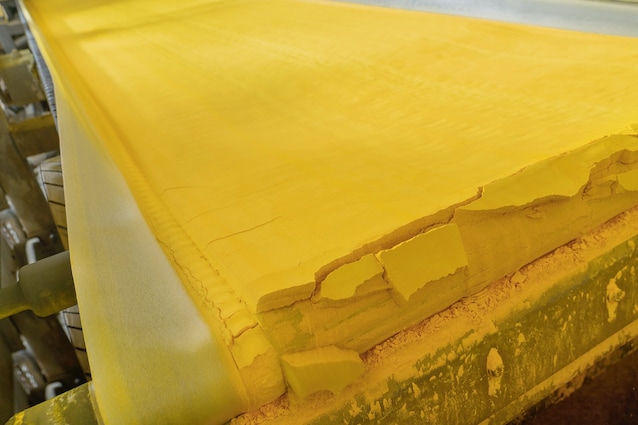
Although this definition derives from the first manufacturing processes that produced a concentrate of bright yellow colourmodern technologies give rise to a product with variable colours depending on the operating drying conditions and the residual impurity content. The yellow cake is mainly made up of triuranium octaoxide (U3OR8) and has a natural uranium content of between 70% and 90% by mass.
Conversion and Enrichment
U powder3OR8 is converted to uranium hexafluoride (UF6) in the gaseous phase, the only compound suitable for subsequent operations isotopic enrichment. This process is aimed at separation of uranium-235 from other non-fissile isotopes, and to the increase in its concentration from 0.7% up to values between 3% and 5%: levels required for use in light water nuclear reactors for the production of electricity. Currently, the most widespread and efficient isotope enrichment method involves UF6 is conveyed into gas centrifugesmade up of cylindrical rotors that rotate at very high speeds. There centripetal force pushes the uranium-238 molecules, heaviertowards the periphery of the rotor, while those of uranium-235, lighterthey thicken in the central part.
Nuclear fuel manufacturing
The UF6 enriched comes transformed powdered uranium dioxide (UO2), subsequently pressed and cooked at high temperatures (up to 1400°C) to obtain ceramic tablets with high uraniferous density. These come then insert in metal sheaths and assembled in fuel elementsintended for use inside the nuclear reactor.
Insert photo (nuclear fuel rods): https://www.istockphoto.com/it/foto/energia-nucleare-gm466310183-33627336?searchscope=image%2Cfilm
Removal
When the uranium-235 content in the pellets is reduces below operating levels, the fuel elements are removed from the reactor e replaced with a new equivalenteffectively avoiding performance drops. However, the spent fuelonce downloaded, continues to emit ionizing radiation and to generate residual heat. Therefore, it is transferred to cooling poolslocated near the nuclear site, where it remains immersed in water for a period typically ranging from 5 and 8 yearsin order to dissipate the decay power e progressively reduce the radiological intensity.
Disposal or reprocessing
At the end of the cooling period, the spent fuel is transferred to systems temporary storageawaiting its definitive management. Depending on the strategy adopted, it can be allocated to disposal long-term (open fuel cycle) in suitable geological deposits or subjected to reprocessing (closed fuel cycle), for recover fissile materials that are reusable and intended for the manufacture of new nuclear fuel.
