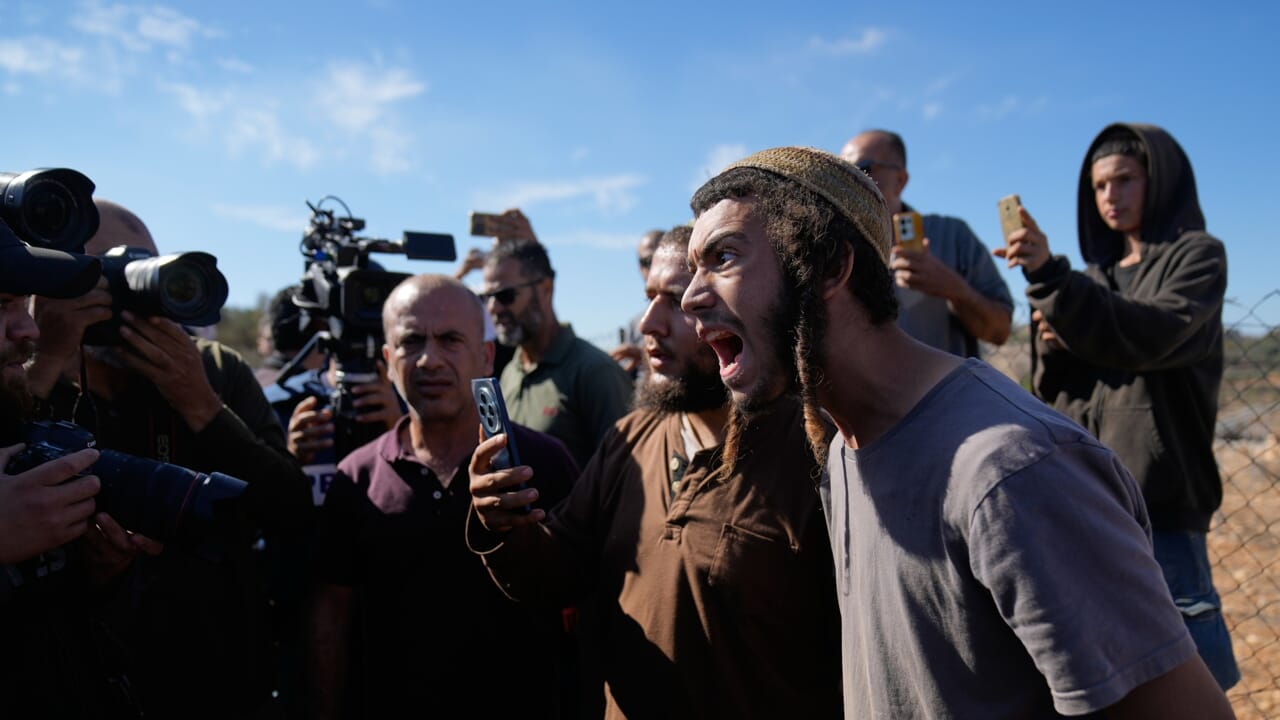
The approach that the European Union must take towards Israel is once again dividing the European Parliament, just as it divides the governments in the EU Council. For next week’s plenary it was proposed to include a debate on the disputed law in Israel that introduces the death penalty for Palestinians in Gaza and the West Bank accused of terrorism, a law that would not apply to Israelis, as well as “on the escalation of settler violence and the de facto annexation of the occupied West Bank”.
The idea, proposed in the Conference of Presidents by the group The Left, was also supported by socialists, greens and liberals, but was blocked by the People’s Party, who allied themselves with the radical right of the Chamber to stop it: from the Conservatives and reformists, which includes the Brothers of Italy, to the Patriots for Europe of the League, up to the Europe of sovereign nations of the German AfD.
Fight against anti-Semitism
A debate on the “fight against anti-Semitism and the need to protect Jews in Europe” was included on the calendar. The European Conservatives and Reformists “stand in solidarity with Jewish communities across Europe and continue to work to ensure their safety and their freedom to live without fear,” the group wrote in a statement.
“We rejected” the debate on the death penalty in Israel “not because we are in favor of the death penalty, against whose application in various countries around the world we voted many resolutions many years ago”, but because “on Wednesday there will be a four-hour debate on the crisis in the Middle East, in all its facets, so that is the place where you can denounce everything you wish to denounce”, argued Pedro López de Pablo, spokesperson for the EPP in the EU Parliament.
The association agreement
The left of the Chamber wanted to support the specific discussion on the situation in the West Bank and on the death penalty for Palestinians also to put pressure on EU governments to agree to suspend the association agreement with Israel, an idea that is blocked in the EU Council by the opposition of countries such as Germany and Italy.
“Over a million citizens and several countries such as Spain, Ireland, Slovenia and Belgium are calling for an immediate suspension of the association agreement between the EU and Israel. By continuing to treat Israel as a privileged partner, the EU becomes complicit in the genocide in Palestine and the attacks in Lebanon which have cost millions of lives”, declared Frenchwoman Manon Aubry, leader of the group.
One million Europeans sign to ask for the suspension of the agreement between the EU and Israel
“We deplore the fact that the EU Foreign Affairs Council has not taken any action regarding the suspension of the EU-Israel Association Agreement and call for the issue to be put to a formal vote without further delay,” said Utta Tuttlies, spokesperson for the S&D group in the Strasbourg Chamber.
Let’s look at the other main topics that will be discussed and voted on in the Plenary
EU budget 2028-2034, Parliament is preparing to negotiate
The European Parliament adopts its negotiating mandate on the next Multiannual Financial Framework (MFF) on Tuesday 28 April, formally paving the way for negotiations with EU governments. The proposal drawn up by the Budget Committee sets the long-term budget ceiling at 1,780 billion euros, approximately 10% more than the proposal put forward by the Commission. The difference, equal to over 175 billion, would be allocated to key EU programs, without additional funds for administration or decentralized agencies. MEPs also ask that the debt repayment of the NextGenerationEu recovery fund be managed separately, outside the MFF ceilings, so as not to affect ordinary resources.
Rape, the EU seeks a common definition
Free, informed and revocable consent as the cornerstone of the legal definition of rape at European level: this is what a resolution that the European Parliament is called to vote on on Tuesday 28 April calls for. The text, drawn up jointly by the civil liberties and women’s rights commissions, will be discussed in plenary on Monday 27th. The resolution is part of the 2024 EU directive on the fight against violence against women and domestic violence, which MEPs are calling for further strengthening. Also on the table is alignment with international standards, more robust support for victims (access to justice, specialized services, healthcare) and measures against digital violence and stereotypes.
Middle East and energy
Tensions in Iran and the region, with their repercussions on energy prices, arrive in plenary on Wednesday 29 April: MEPs will discuss with the Council and Commission how to respond to a crisis that threatens global security and the budgets of families and businesses. The de facto closure of the Strait of Hormuz, according to the International Energy Agency, has produced the largest disruption in the history of the global oil market.
Southern Lebanon, Parliament calls for ceasefire
On the afternoon of the same Wednesday 29 April, the assembly returned to southern Lebanon, the scene of incursions by the Israeli army which caused hundreds of civilian deaths and thousands of injured or displaced people. The debate, with the Commission alone and without a final resolution, will serve to take stock of a worsening humanitarian crisis. The deputies will aim to reinforce the message already expressed by the institution: sustainable ceasefire and immediate and unhindered humanitarian access to the country.
Ukraine, Parliament wants justice and compensation
Responsibility for attacks against civilians, compensation for victims and risk of normalization of relations with Moscow: the European Parliament dedicates a packed agenda to Ukraine and Russia between Tuesday and Thursday. The debate on justice for civilian victims with the Council and Commission is set for Tuesday 28 April, the vote on a resolution for Thursday 30.
Also on Tuesday, deputies will vote on the application of the emergency procedure to the proposal for EU accession to the convention establishing an International Commission for Reparations for Ukraine. If the vote passes, the matter will be put to a vote on Thursday. On Wednesday 29 April afternoon, an unresolved debate is added on the risk of normalizing relations with Moscow, sparked by a recent episode: at the Milan-Cortina 2026 Winter Paralympics, Russia paraded with the national flag, the first time in an international sporting event since the start of the large-scale invasion of Ukraine in February 2022.
Fundamental rights in the EU
On Wednesday 29 April the European Parliament votes on a report on the state of application of the Charter of Fundamental Rights in 2024 and 2025, discussed in the Plenary on the afternoon of Tuesday 28. The picture that emerges is worrying: growing pressure on democracy, equality and civic space.
The thematic scope is broad: impact of digital technologies on rights, migration and border policies, gender violence, rights of LGBT+ people, structural racism, detention conditions, social and environmental rights.
Rule of law
Also on Wednesday 29 April, Parliament votes on a report on the 2025 report of the EU Commission on the rule of law. The outcome is critical: limited progress compared to the recommendations already formulated, serious problems regarding the independence of the judiciary, corruption, media freedom and the safety of journalists. Also under scrutiny is the contraction of civic space and the risks associated with digital platforms and content generated by artificial intelligence.
Reduced duties for poor countries
On Tuesday 28 April, Parliament votes on the reform of the Generalized System of Preferences (GSP), the instrument that since 1971 has offered developing countries reduced duties on exports to the EU. The agreement with the Council dates back to December 2025. The reform expands the treaties that the beneficiaries must ratify: within the Paris Agreement, the Convention on the rights of persons with disabilities and that on the rights of the child. The preferential treatment is also conditional on cooperation on the readmission of irregular migrants.
Voting by proxy for MEPs on maternity leave
On Wednesday 29 April, Parliament votes on the introduction of proxy voting for MEPs absent due to pregnancy or maternity. The new rules allow you to delegate the vote in plenary to a colleague from three months before giving birth until six months after. The text introduces provisions on transparency, accountability and voting integrity.
Dogs and cats, the EU prohibits abusive practices
On Tuesday 28 April, Parliament will vote definitively on the new EU rules for the protection of dogs and cats. For the first time the EU sets common standards on breeding, detention, traceability and import.
All animals in the EU, including privately owned ones, will have to be identified with microchips and registered in national databases. Sellers, breeders and shelters will have 4 years to comply, while for simple owners the times rise to 10 years for dogs and 15 for cats.
Emissions market, Parliament reviews the anti-fluctuation mechanism
On Wednesday 29 April, Parliament votes on its position on the market stability reserve for Ets2, the new emissions trading system which from 2028 will extend the logic already applied to industries to road transport and construction: those who emit CO₂ must purchase a permit, and the price of that permit fluctuates on the market. The reserve is the system’s safety valve, designed to prevent prices from becoming unpredictable.
The changes proposed by the Environment Committee mean that, in the event of price spikes, extra allowances will be brought onto the market more quickly than previously expected. Unused allowances would also remain in the reserve after 2031, instead of being cancelled. Finally, the cap of 45 euros per tonne of Co₂ would be extended beyond 2029, so as to continue to protect consumers and businesses from excessive prices.
Single market, more protections against unfair competition
On Wednesday 29 April, Parliament votes on a resolution calling for more incisive EU action against unfair competition from non-European operators. The focus is on the growth of e-commerce platforms from third countries and the spread of products that do not comply with EU regulations on safety, the environment and work.
The text calls for clearer rules on the origin and traceability of products and stronger protection mechanisms for consumers. MEPs call on the Commission to make full use of trade defense instruments, including anti-dumping and anti-subsidy measures, and to reduce regulatory burdens for European businesses.
Tourism and forgotten destinations
On Tuesday 28 April, Parliament votes on a resolution on sustainable tourism, with proposals to decongest the most crowded destinations and enhance lesser-known destinations: rural areas, mountain areas and peripheral regions. Tourism is worth 10.5% of the EU GDP and employs around 12.3 million people.
Among the proposed measures: improve connectivity of emerging destinations, increase cross-border night trains, incentivize electric vehicle leasing and update the legal framework on short-term rentals. MEPs expect their proposals to be included in the future EU strategy for sustainable tourism.
Finfluencers
On Thursday 30 April, Parliament votes on a resolution to ask for EU standards on finfluencers, financial influencers on social media, who have become a primary source of financial information for young people. The text was discussed on Monday 27th evening.
Finfluencers can raise awareness in markets, but also fuel scams, hidden advertising and AI-generated deepfakes. The resolution calls for minimum standards for online financial communications and age-appropriate financial education, with attention to digital literacy and cybersecurity.
