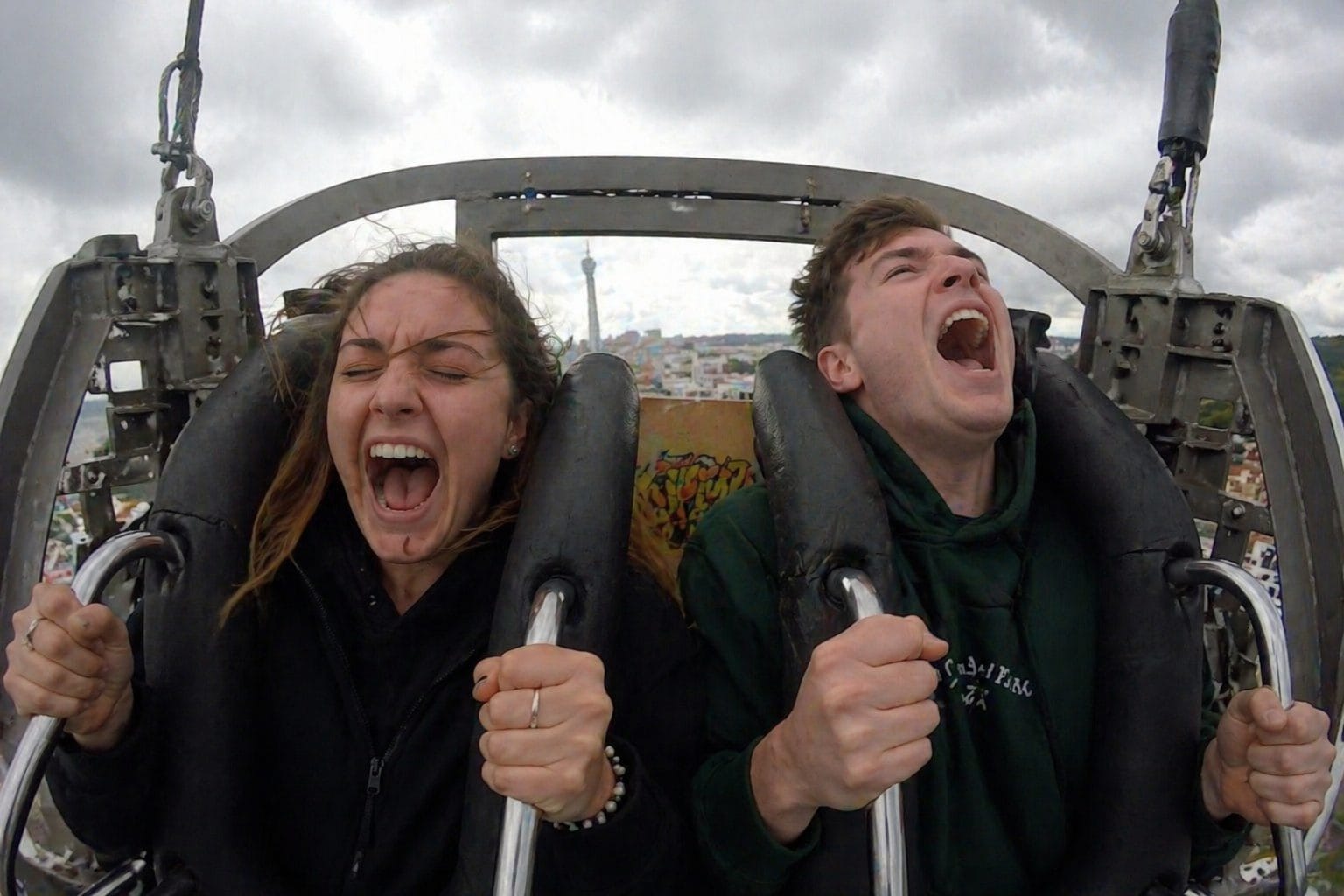
We’ve all asked ourselves that question at least once in front of videos of a slingshot ride: “Ok, what if a cable breaks?”
Yes, because you all know it: two people closed in a spherical capsule, shot tens of meters into the air, and almost always that moment, viral on TikTok and Instagram, in which they seem to faint for a few seconds. It is one of the most extreme attractions in amusement parks around the world.
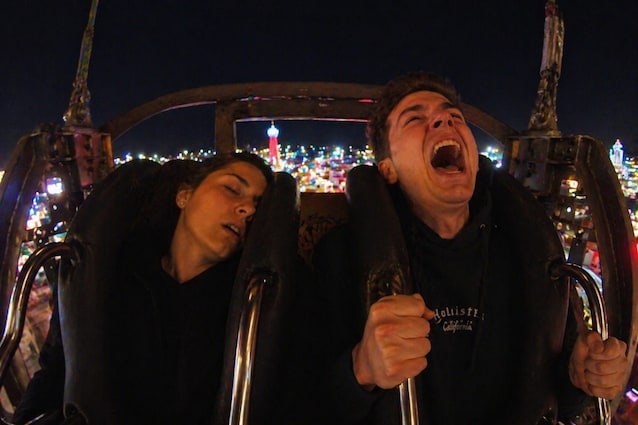
And the question is always the same: what if one of the two cables holding it gives way?
In Seville during the Feria de Abril 2026, it really happened. Let’s see what happened, how this ride really works, and why a cable can give way.
What happened at the Seville Feria: the reconstruction
The accident occurred on Friday 24 April 2026, around 8.20pm, in Calle del Infierno, the attractions area of the Feria de Abril. The ride involved is called “Steel Max” and is popularly known as “El Tirachinas”, the slingshot: a Spanish version of the classic reverse bungee.
On board the spherical capsule were two minors from Málaga, aged 11 and 17. During the second launch, according to the reconstructions of the Bomberos and the Ayuntamiento de Sevilla, one of the two lateral cables detached or broke.
From there the dynamic is clear:
– the capsule has lost the symmetry of the forces that kept it in a vertical trajectory;
– hit one of the pylons of the structure;
– remained suspended, inclined, about 5 meters high.
The Bomberos intervened quickly, lowered the capsule and took the two boys to safety. The toll is 4 lightly injured: the two minors inside the cabin, plus two people on the ground hit by detached elements. Two were taken to the Virgen Macarena hospital for checks. The attraction was seized and fenced off, and the Policía Nacional opened an investigation.
How a slingshot carousel really works
It looks like a huge toy: two pylons, two cables, a ball. It is actually a very precise engineering system, based on a very simple physical principle.
The principle: elastic energy
The two side cables of the “slingshot” work like huge rubber bands. The capsule is pulled and blocked to the ground by an electromagnetic device, while the cables are charged with tension. When the electromagnet comes off, the cables release all the accumulated energy in a few moments.
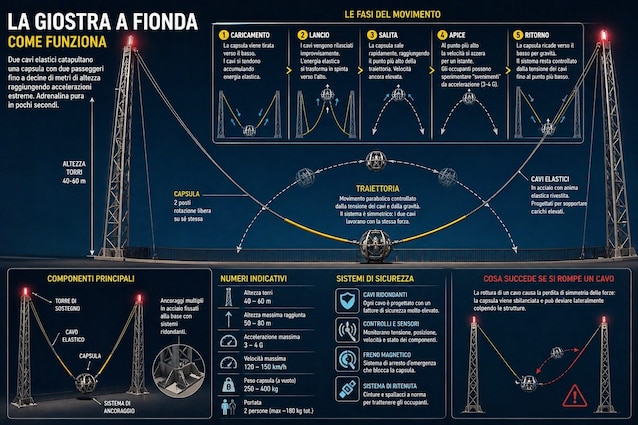
That energy, in an instant, becomes speed and upward acceleration. It’s exactly David and Goliath’s slingshot, but on an industrial scale: the capsule can reach 50 to 80 meters in height.
Why we end up “fainting”: accelerations
At the moment of launch, passengers can experience accelerations of up to 3-5 times the force of gravity (3-5 g). To give you a comparison: a Formula 1 driver can feel 5 g while braking, an astronaut at launch around 3 g.
At these accelerations the blood tends to “go down” towards the bottom of the body, and the brain receives less oxygen for a few seconds. This is why so many people, in those viral videos, lose consciousness for a few moments: it’s not “fear”, it’s physiology.
The crucial detail: symmetry
The system works because the two cables pull with the same force and keep the capsule centered along the vertical axis. It’s a dynamic balance: two equal and opposite forces at the sides, a clean trajectory.
And here we get to the heart of what happened in Seville.
What happens if one of the two cables gives out?
It doesn’t just happen that the capsule falls out. Something more complex and, in some ways, more dangerous is happening. When one of the two cables breaks or loses tension:
1. The capsule retains the energy and speed already charged by the other cable.
2. But it loses the symmetry constraint that kept it in a straight line.
3. Result: Instead of a vertical trajectory, the capsule turns into an unbalanced high-energy pendulum.
At that point it moves sideways, in an uncontrolled way, until it bumps into the first thing it comes across. In Seville, it was one of the pillars of the structure itself.
This is why in the images you can see the capsule suspended on its side, about 5 meters from the ground, and not tens of meters in the air. The energy didn’t bring her up: it threw her to the side.
But why can a cable break?
Here we come to the most important part, because it is also the most misunderstood.
The cables of a reverse bungee never work at their limit. They are designed with very high safety factors, i.e. they must withstand loads significantly higher than the actual operating ones. This means that when a cable fails, it is rarely from a single sudden cause.
There are various possible causes, and the investigation underway in Seville will have to clarify which (or which) contributed:
– Material fatigue: Cables are subjected to repeated cycles of pulling and releasing, which over time accumulate microdamage invisible to the naked eye.
– Wear and corrosion: these attractions live outdoors, exposed to sun, rain, temperature changes and dust.
– Defects in the anchoring points: often the critical point is not the cable itself, but the way it is fixed to the structure.
– Assembly or maintenance errors: in temporary installations, dismantled and reassembled from one fair to another, the control procedures are extremely delicate.
The key point is that a failure of this type is almost always the result of a chain of factors, not a single event. This is why investigations into these incidents take months.
How safe are these rides?
Statistically, a lot. Reverse bungees have been installed all over the world for decades and accidents, compared to the number of launches carried out each year, are rare. They are attractions subject to:
– mandatory periodic checks,
– material certifications,
– operational limits on the use cycles of the cables (which must be replaced in time, not when broken).
However, when an accident occurs, investigations over the years have often highlighted two occurrences: inadequate maintenance or components not replaced on schedule. And it is exactly on these two fronts that the Policía Nacional in Seville is now focusing.
