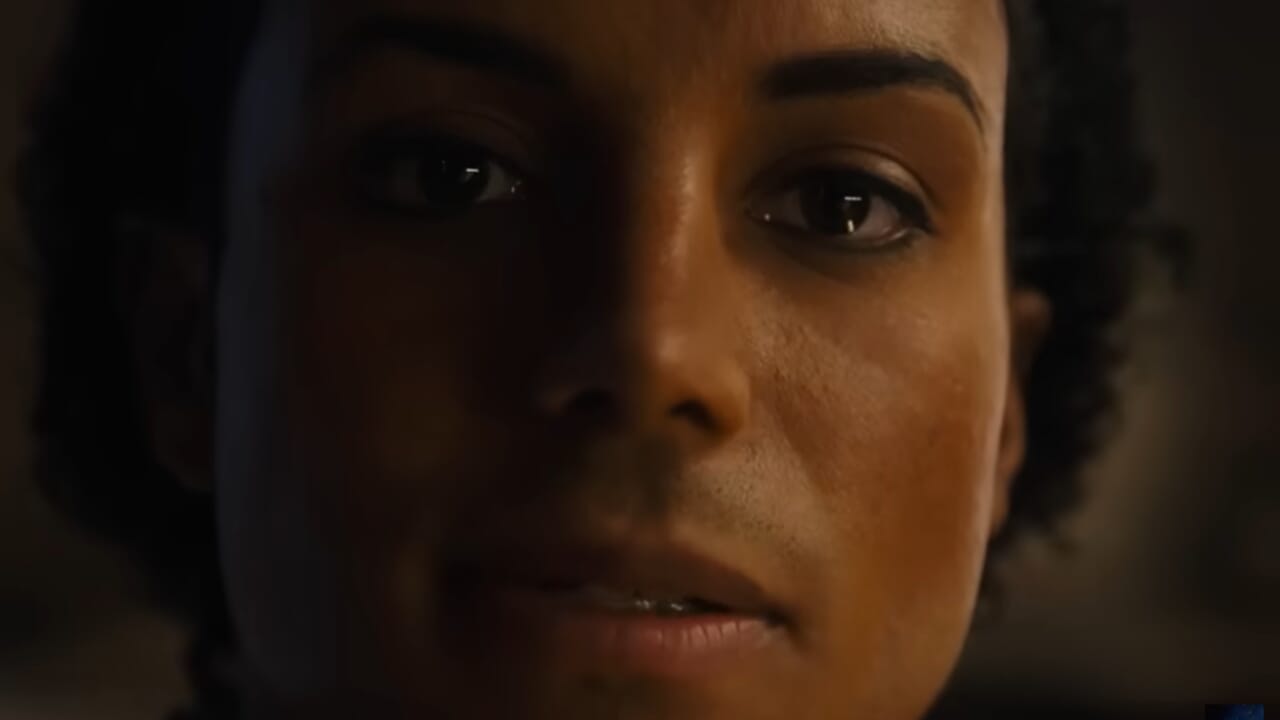
Michael Jackson cannot be told. And the film proves it
Before even talking about the film Michaelpremiered for the press last Monday, in Italian cinemas from this weekend, we need to talk about who isn’t in the film. Janet Jackson, Michael’s younger sister and perhaps the person most connected to the pop star, refused any involvement with the film. She did not want to be present, and refused to be represented in any way. They offered her a boatload of money: and she simply said no, even refusing to explain why: “I don’t want to talk about it and that’s it…”, the Control singer – who is about to return on tour with some dates in Japan – cut short when some journalists asked her why.
Paris, Michael Jackson’s daughter, said publicly that the film is aimed at those who live in fantasies: “There are many inaccuracies and some lies” said Paris while deserting the premiere. The second son, Prince, involved as an executive producer, was present. Also absent is the youngest of the three, Blanket, nicknamed Bigi, whom Michael Jackson had not with his second wife Debbie Rowe but as a surrogate mother.
In short, the Jackson family is split – and this split is the most honest review that exists of Michael, Antoine Fuqua’s biopic.
A broken family
It should be underlined that this fracture did not exist when the musical MJ was presented in London in 2024, where all three children were present. Just like on the occasion of the release of the film This is It when the three were on the red carpet together, very young (Bigi was only five years old, now he is 22), together with his grandmother and all his uncles, Janet included.
This is not a marginal biographical detail. Indeed, it is the key to everything. Because Michael Jackson is perhaps the only artist of the twentieth century for whom the people who really knew him – who loved him, lived him and defended him – cannot agree on what his story really was. We don’t talk about how it should be told: but about what the story is in reality. This should be a unique and mandatory condition for the creation of a biography: even if in some cases cinema doesn’t know what to do with it and prefers to ignore it. And not because cinema is lazy or cowardly in the abstract, but because it is uncomfortable. And in the specific case of Michael Jackson everything escapes any existing narrative category.
The family as a battlefield
Janet Jackson is the sister with whom Michael built some of the most important pages of black music of the 1980s. Scream, the 1995 duet, was one of the most expensive video clips in history and one of the few moments in which Michael showed himself angry in public – but seriously angry and not for performance reasons. Janet was not a decorative presence in his life. She was the central witness, his accomplice and confidant. His absence from the film is not a whim: it is a judgment of merit.
Paris Jackson said that the film is aimed at a very specific segment of fans, those who still live in the world of fantasy. And it is a heavy sentence, because it comes from the daughter, from someone who has no interest in demolishing her father’s memory. Yet Paris has chosen to distance herself. When those who have the strongest reason to defend a narrative and choose not to do so, something doesn’t add up.
On the other hand there is Prince Jackson, the eldest son, who has accepted the role of executive producer. And there is the summer of Michael, a colossal intellectual property that has been raking in billions since MJ died. Paradoxically, Michael Jackson’s end was the real fortune of his personal company which was submerged in debt when he was alive.
The Estate of Michael Jackson invested in the project, controlled its contents, paid 15 million dollars just to produce the reshoots and eliminate any reference to Jordan Chandler – the child who had accused him of sexual harassment. His deal with the pop star included an explicit ban on him being mentioned in any film. Today he is 46 years old and is a director: he makes advertising and commercial videos, commercials and short films.
A long preamble to clarify that the family is not simply divided on a detail but on a fundamental question: who Michael Jackson was, and who has the right to tell it.
At the moment the film responds by choosing the version of whoever controls the rights. A legitimate answer but it is not the only possible answer.
Michael Jackson, the impossible subject
All great music biopics have dealt with contradictory artists. Ray Charles was a drug addict who systematically cheated on his wife. Johnny Cash had years of self-destruction and heavy addiction to alcohol, psychotropic drugs and drugs behind him. Same thing for Elvis, Elton John (Rocketman) or Mötley Crüe whose film The Dirt is as sincere as it is extreme. The Freddie Mercury of Bohemian Rhapsody (same producers as Michael) is very toned down with respect to a private life that his family preferred not to see represented. Yet even in those cases it was possible to construct a narrative that contained both light and shadow, which showed the artist in his entirety without the complexity becoming impossible to manage cinematically.
With Michael Jackson it’s different. Not because the accusations against him are more serious – there are artists definitively condemned to whom cinema has dedicated celebratory films without anyone being scandalized. It is different because the accusations against him exist in a space of legal and documentary uncertainty that cannot be closed, that cannot be resolved, and that divides his audience with a radicality that has no equivalent in the history of popular music.
Leaving Neverland, the 2019 documentary, reopened wounds that many thought were now healed. Many networks didn’t want to broadcast it. The BBC chose to air Legacy: Michael Jackson – three episodes of reconstruction of the accusations, the 2005 trial and new testimonies – exactly to coincide with the release of Fuqua’s film. It’s on the schedule right now.
Even in this case it is not a coincidence: it is a very specific editorial choice, a clash between narratives that fight to occupy the same space.
In this context, coming out with a Michael Jackson biopic is not simply like producing a film like any other. It’s taking a stand in an open conflict. And Fuqua’s film took a stand — clearly and unambiguously, on the side of Summer and the fans. The problem is not this choice in itself. The problem is that the film presents itself as the story of Michael Jackson, not as one of the possible stories. And this lack of awareness is its deepest limit.
What the film manages to do
Within these structural limitations – which are partly Fuqua’s and screenwriter John Logan’s – Michael still manages to produce moments of authentic cinema. Little Jackson watching children play in the snow from the window, with his father – a despot who was among the causes of his traumas – calling him to order, is an image that needs no explanation. The Who’s Lovin’ You scene recorded at Motown, with the voice of a ten-year-old child carrying the weight of an already adult pain, is among the most beautiful in the film. And Colman Domingo in the role of Joe Jackson builds something rare: a villain who doesn’t scream, doesn’t exceed, doesn’t act out as evil. Absolutely check. And it is in the control, in the manipulation – in that look that weighs every gesture of the son as if it were an investment – that the whole root of the story lies.
Jaafar Jackson, the nephew who plays the uncle, deserves a separate discussion. He is twenty-nine years old, he had never acted, he is the son of Jermaine, Michael’s older brother.
He is predestined, the only one of his grandchildren to demonstrate true artistic talent. He spent years preparing with the choreographers who had worked with his uncle, studying every gesture, every vocal inflection, every static before exploding into a movement. The result is not a simple imitation. It’s something harder to define: let’s call it a transition. As if the body has a memory that the script cannot control. When Jaafar moonwalks in the reenactment at Motown 25, there’s a second where you forget you’re watching a movie. This is a rare gift, and it belongs to him, not to the project that contains it. Jafaar is worth the film and the role he plays.
The film that doesn’t exist yet
As for the rest, which is what is most interesting – namely the true story of Michael Jackson, the one that contains the absolute genius with all its gray areas, the devastating loneliness and the still open accusations, the stolen childhood and the responsibilities of a now adult man – it has not yet been told. Not because no one has tried, but because the system that controls the rights to his music, his image and his memory have no interest in allowing it. And without that music, without those images, any film about Michael Jackson becomes a film about a ghost.
Janet Jackson knows it. Paris Jackson knows it. Fuqua probably knows this too, as he declared in Berlin that the world needs love right now and that Michael Jackson represents it. It’s a beautiful phrase but also extremely evasive.
Unfortunately, the world also has an extreme need for sincerity and not pre-packaged love. Michael Jackson deserves a film that treats him as a human being who has made an indelible mark for better and perhaps for worse – with all that entails – rather than as a monument to be polished.
Michael is not this kind of film, nor was Leaving Neverland, which was intended to be a summary trial. In the meantime we are content with Jaafar Jackson dancing to Beat It with breathtaking precision, and Colman Domingo who says more with just one look than the entire screenplay can say in two hours. It’s not a little. But it’s not enough. Michael is in Italian cinemas from April 24th.
