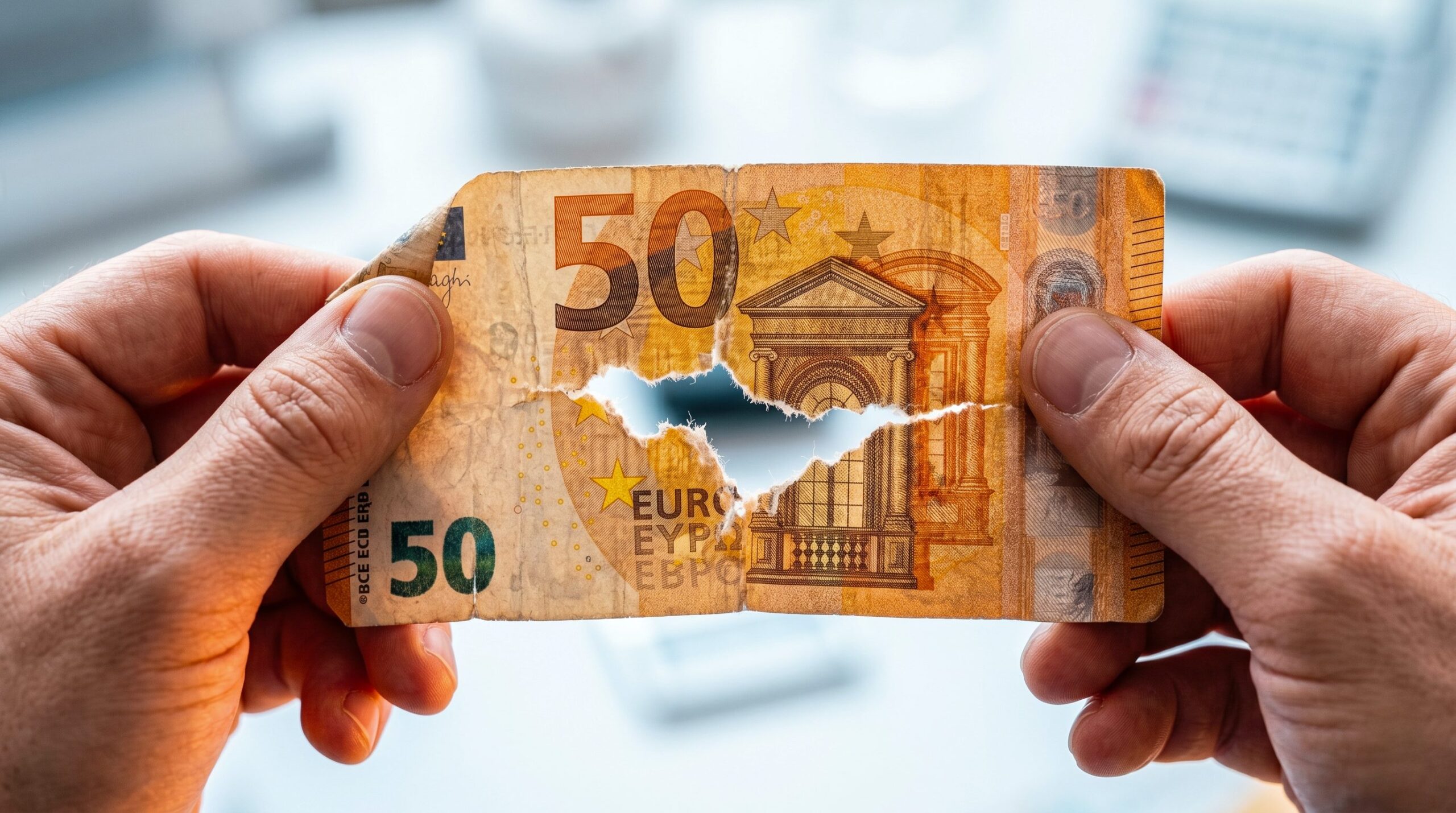
It has happened to many of us to find ourselves with one ruined banknotemaybe slightly tornaccidentally ended up in the washing machine or faded after having remained in the wallet for too long: at that point, no shop or trader accepts it anymore and, therefore, it is put aside. But what to do in situations like these? Perhaps not everyone knows that, in reality, that money is not lost.
In Italy there is in fact a precise procedure, managed by the Bank of Italywhich allows you to change free damaged banknotes (provided certain essential requirements are respected). This is because euro banknotes, produced in pure cotton paperinevitably suffer the deterioration due to use or factors such as humidity.
The same happens for coins that perhaps they have become unfit for circulation due to defects or accidental events that have altered its size, shape, weight, color or edges.
Ruined or “mutilated” banknotes: how to exchange them at the Bank of Italy and the exception of intentional damage
The Bank of Italy distinguishes the banknotes ruined into two categories: those damagedi.e. when cash is dirty, stained or discolored due to accidental events (such as, for example, humidity, fire, chemicals, washing in the washing machine), and those “mutilated“, which are physically missing a part or piece.
In both cases, the reference point is the same Bank of Italy: if you have a worn banknote, you can go to the counter of one of its branches, hand over the cash and wait for the evaluation. Also banks and post offices they can change a damaged banknote, but they are not obliged to accept the request, unlike the Bank of Italy.
If the tickets meet the requirements for refund, they are replaced immediately and free of charge with new banknotes. However, if there are doubts, the branch sends the material toCentral Administrationwhere a special commission of experts will decide on the reimbursement.
More specifically, in the case of a banknote mutilated the general rule states that this can be changed if he remained more than 50% of the original banknote. If you are below that threshold, a refund is only possible by proving that the missing part was accidentally destroyed. In this regard, a practical piece of advice could be to keep all the fragments (even the smallest ones), avoiding adhesive tape and glues which could compromise the evaluation.
Replacing damaged banknotes is almost always free: the only exception concerns banknotes intentionally damaged, which are not replaced, but withheld without refund. Even in this case, however, there is an exception if the person showing the banknote is recognizably in good faith or if the damage is modest, as in the case of small writings, numbers, notes.
A separate chapter, however, for the cash stained by anti-robbery devices (the so-called Intelligent Banknote Neutralization Systems, IBNS), which release ink on money when they are broken into ATMs or other protected containers: these banknotes are never accepted for replacement, since it is likely that whoever holds them is not the rightful owner.
How it works for damaged coins
The procedure for damaged euros also applies to coinsalthough there are some specific differences. In this case, the exchange is allowed when the currency has become unfit for circulation due to prolonged wear, manufacturing defects or accidental events that have significantly altered its size, shape, weight, color and edges.
Just as with banknotes, replacement is not permitted if the damage is intentional or has been caused by processes that foreseeably cause damage, such as car scrapping. Also in this case the official channel is Bank of Italy, where the coins must be delivered closed in one plastic bag. If the damage is clearly attributable to wear and tear from prolonged use, the refund is free and takes place immediately. If, however, the origin of the damage is uncertain, the coins are sent toState Printing Institute and Mint (the body that mints them) for an assessment of their refundability.
