
For many people the punctuality represents one form of fundamental respect: arriving at the appointed time, especially in formal settings, demonstrates reliability, education And Attention towards the other people’s time. However, this idea it is not universaljust as the conception of time is not. In many cultures around the world, in fact, show up exactly at the indicated timeor even in advance, may result inappropriate or create embarrassment for those who host.
Delay and punctuality: Edward Hall’s studies on monochronic or polychronic cultures
One of the first scholars to systematically analyze the cultural differences in time management it was the anthropologist Edward Hallwhich introduced a distinction between cultures mono-chronic and cultures poly-chronic.
In “at one time” cultures, also called mono (a) chronic (from Khronos, i.e. time), the time is conceived as linear and unidirectional. The activities are organized in sequence and each commitment has a well-defined time space.
The times they must be respected with precision because they represent an essential element ofsocial and economic organization. Consequently, social norms revolve around respecting other people’s times, in an orderly sequence, without overlapping.
On the contrary, the poly-chronic societies they perceive time more flexible, multidirectional and not linear, but circular. People can carry out multiple activities at the same time and social events tend to adapt to relationships and circumstances. In this context, the priority is not strictly respecting timetables but maintaining social harmony and relationships. In a certain sense, this means that the relationship that is being experienced in the here and now dictates the time of the activity being performed.
This distinction, according to Hall, does not mean that some cultures are more organized than others, but rather that they attribute different meanings to time and the way in which it structures daily life. Typically, Northern European and North American societies can be categorized as monochronic cultures, while those of the Mediterranean basin, Latin America and the Middle East are among those polychronic.
When arriving too early is rude
In many cultures around the world, those falling within polychronic societies, there is a sort of “implicit social time” That differs from the official time indicated in the invitation. In several countriesLatin Americashowing up exactly at the appointed time for a dinner or party can in fact result uncomfortable or even offensive for the organizer.
Arriving too early can in fact mean surprising those organizing the event while they are still busy preparing. In these contexts, it is often expected and almost required a socially accepted delaywhich can vary from ten to thirty minutes.
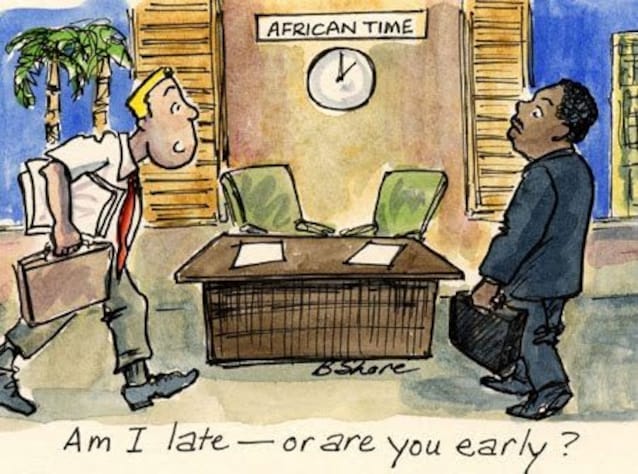
A particularly interesting case concerns many African societiesin which the time it is often conceived differently than Western watch-based models. In other words, it is not necessarily organized according to rigid schedules, but it is often structured in relation to social events and collective activities.
In these contexts we sometimes speak of “African time”an expression indicating a more flexible management of appointments and life in general.
This does not mean the absence of organization, but a different way of punctuating activities. For example, a community meeting or event may be scheduled “in the morning” or “in the afternoon”but the actual start is when most people have arrived. Expectations are not experienced with nervousness or frustration, but with peace and serene tranquility.
Often even public transport is not available set times: in this sense you can spend hours at the bus stop, without knowing when exactly it will pass, in peaceful waiting that generates opportunities for conviviality with other people.
This conception of time is closely linked to the importance of community relations. In many societies, the value of meeting and collective participation is more relevant than precise respect for time. The daily activities tend to adapt to social interactionsgarlic unexpected and at need of the community.
This difference in living time represents a different system of cultural priorities, in which the relational dimension has a greater weight than the temporal rigidity.
Cultures of rigorous punctuality
At the other extreme are societies in which punctuality represents a very strong social value. Countries like Germany, Swiss And Japan in fact, they are often cited as examples of cultures in which respecting time is considered essential.
In these contexts, get in delay it can be interpreted as a sign of unprofessionalism, disorganization or lack of respect for other people’s time. Time is in fact perceived as a limited resource that must be managed efficiently.
This approach is closely linked to the economic development of these societies. In the era of industrial revolutionwith the affirmation of the clock as an instrument that marked the days, the precise coordination of activities, from factories to public transport, required strong temporal disciplinewhich still remains in the mentality of the most industrialized societies today.

An emblematic example is represented by Japanese railway systemknown globally for its extreme precision. Delays of a few minutes can be considered extraordinary events and occur frequently official apologies from national transport companies.
The Italian case: between flexibility and punctuality
There Italian culture occupies an intermediate position between the models monochronic And polychronic. There punctuality is generally required in formal contextssuch as work meetings, professional appointments or institutional events, where arriving late can be perceived negatively.
However, in the social and informal life there is a greater tolerance for delay. A dinner with friendsespecially if you are in Southern Italy, set at 8.30pm can easily start at 9.30pm without this being perceived as problematic.
This behavior reflects a culture in which time is important, but not necessarily dominant over the relational dimension. The value of familyof the long ones lunchesfrom the Sundays in the kitchentone down the Nordic rigidity a bit, making social gatherings not just moments to plan, but opportunities for conviviality that develop with a certain flexibility.
There geographical and cultural position of Italyhistorically influenced by both the continental European world and the Mediterranean, contributes to this ccombination of formal punctuality and informal flexibility.
Sources
Hall E.T. (1959). “The Silent Language”
Hall ET & Hall MR (1990). “Understanding Cultural Differences: Germans, French and Americans”
Adam B. (1995). “Timewatch: The Social analysis of time”
Gell A. (1992). “The Anthropology of Time: Cultural constructions of temporal maps and images”
