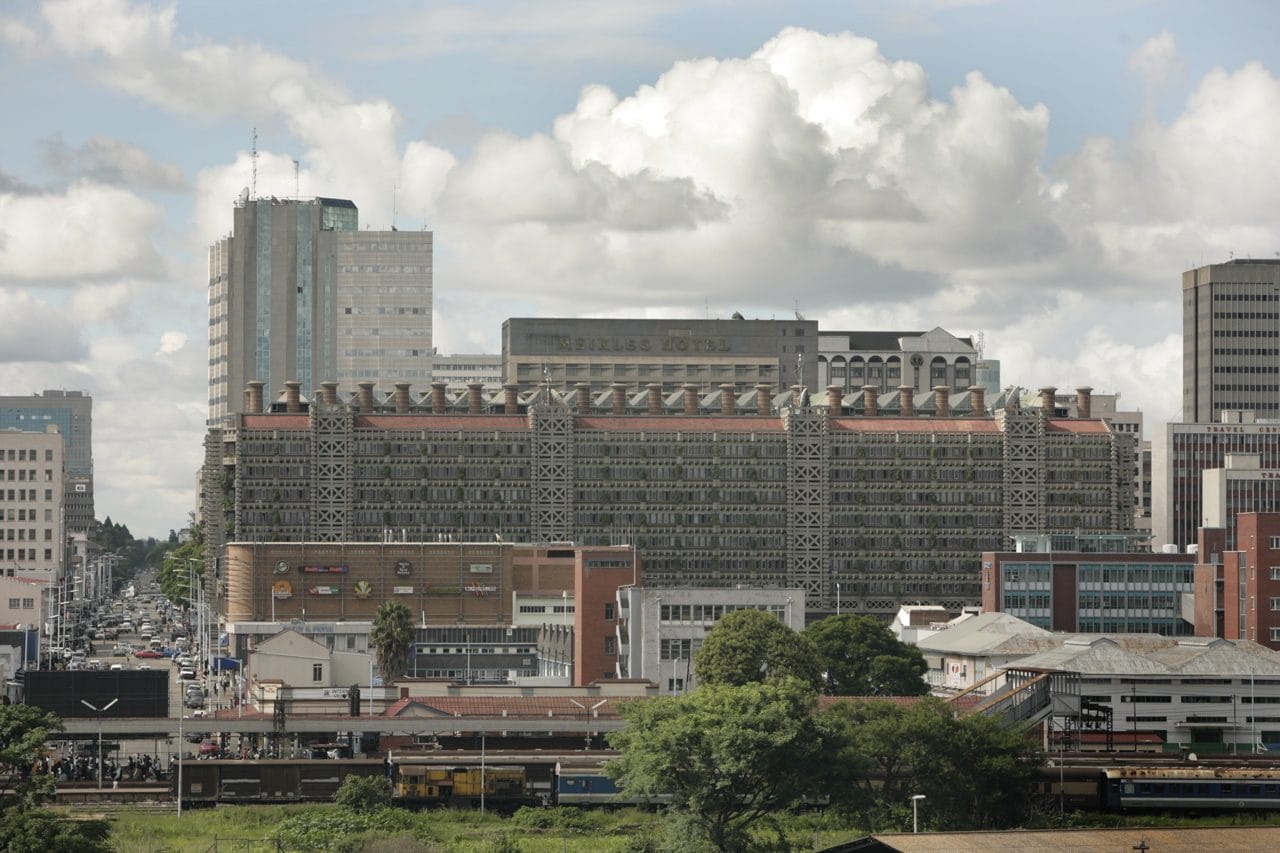
Created by architect Mick Pearce in collaboration with the engineering firm Arup, theEastgate Centre of Harare is among the most important examples of applied biomimetic architecture to energy efficiency. In fact, the building demonstrates how the observation of natural systems – in particular that of African termite mounds – can translate into a structure capable of guaranteeing environmental comfort with minimal use of energy, while hosting functions with high energy requirements such as offices and commercial spaces. Almost thirty years after its construction in 1996, the Eastgate Center continues to be a fundamental reference for sustainability in construction, having anticipated many of the principles now associated with Nearly Zero Energy Buildings (NZEB).
African termite mounds as a design reference for the building in Harare
The principle behind the Eastgate Center design draws inspiration from African termite mounds: natural structures capable of maintaining stable internal temperatures even in the presence of strong forces external temperature variations. Termite mounds work thanks to a sophisticated tunnel system who act like chimneys regulating air flows. These ducts promote natural ventilation, allowing hot air to rise and disperse spontaneously towards the outside, with a consequent reduction in the internal temperature. This mechanism has been reinterpreted in an architectural key through a network of shafts, ducts and ventilation chimneys: the fresh air enters at the lower levels, while the warm, less dense air naturally tends to rise upwards and then be expelled, essentially exploiting the same principle of draft and smoke migration of a traditional fireplace. The result is a predominantly passive cooling system, which drastically reduces the use of air conditioning.

In fact, the Eastgate does not completely renounce the systems: large low consumption fanslocated in the lower levels, support and regulate air flows when necessary. According to Arup, this system allows the energy used for heating and cooling to be reduced by up to 90% compared to conventional buildings equipped with air conditioning, with extremely low construction and management costs.
Adaptive biomimetic architecture of the Eastgate Centre
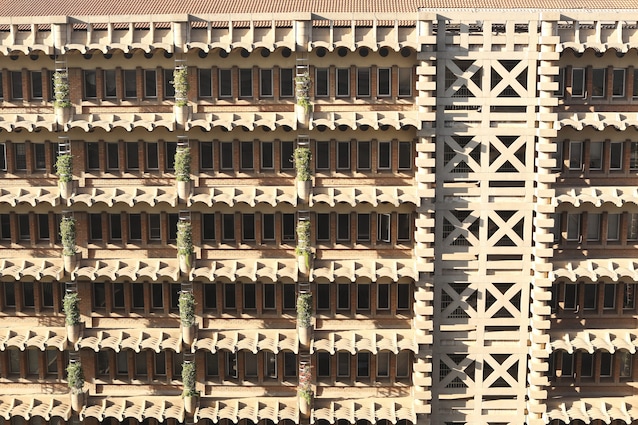
Although without sensors or smart materials, the one at the Eastgate Center is one of the first examples of biomimetic adaptive envelope. The adaptivity of the building lies in fact in its architectural configuration and in the implementation of a series of design features, including shading, wall thicknesses, air cavities and chimneys which contribute to continuously responding to external climatic conditions, working as an integrated system. There relatively narrow plant it also allows natural light to penetrate deeply, while artificial lighting is automatically adjusted based on external brightness, helping to further reduce energy consumption.
From a structural point of view, Arup highlights solutions oriented towards reduction of embodied carbonsuch as the walkway suspended over the central atrium, created with a cable system that minimizes the use of steel and facilitates any future replacements. Finally, the Eastgate Center not only relies on natural ventilation, but also on the ability of the walls to absorb heat during the day and release it at night, just as happens in termite mounds.
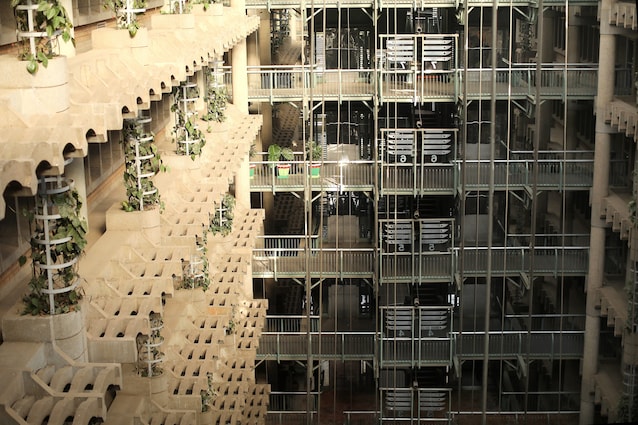
The adopted approach demonstrates that energy efficiency is not necessarily linked to high technology, but can result from climate-conscious design and intelligent use of shape and materials. A particularly relevant aspect in contexts, such as that of Zimbabwe, characterized by unstable electricity networks and limited resources.
Other similar structures around the world
The Eastgate Center is often compared to other symbolic buildings of contemporary biomimetic architecture. Among these is the 30 St Mary Axe, Londonalso known as “The Gherkin,” which uses a double skin and ventilation wells to promote natural ventilation and daylighting, achieving significant energy reductions in a high-density urban context. Another notable example is the Shanghai Towerwhich adopts a double skin facade and a aerodynamic cylindrical spiral shape which reduces wind loads and improves overall energy performance. Compared to these technologically advanced buildings, the Eastgate stands out for its essential and passive approach.
