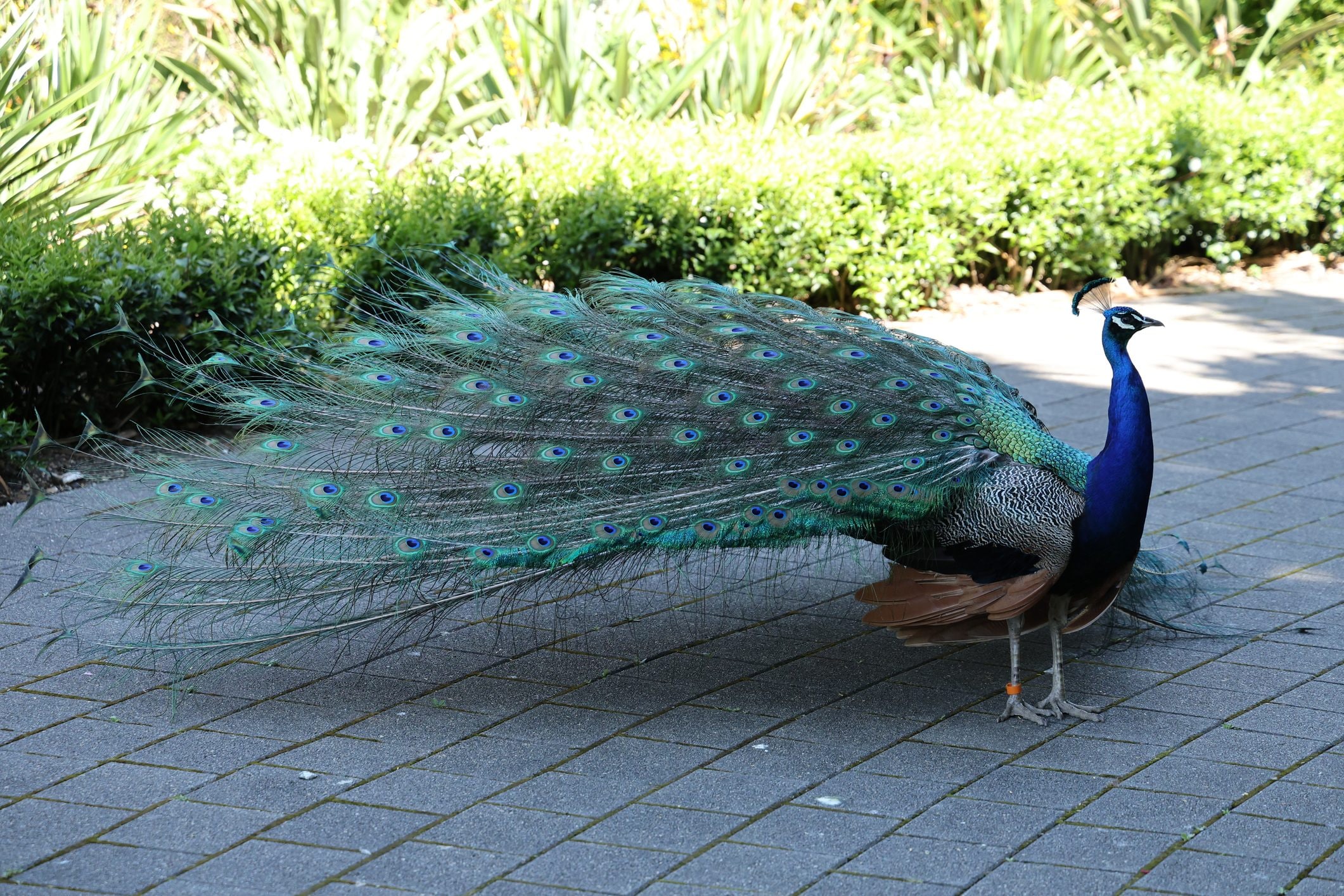
There are those who leave the house in the morning and find them in the garden or on the roofs. Who stopped sleeping because of their nocturnal cries, very loud and repeated. Who instead stops in the street to photograph them. Punta Marinaa small seaside resort in the province of Ravennahas become the center of an unexpected national debate in recent weeks. There are peacocks that have been living there freely for over a decade, in fact they are estimated to be longer 100 specimens, which, thanks to the mating season and the clamor on social media, ended up in all the Italian newspapers. If on the one hand the peacocks walking around the city represent an attraction, on the other they risk being a somewhat cumbersome and unusual presence for an urban area.
The Peacock (Pavo cristatus) it does not belong to the native wildlifebut it has been widespread and appreciated in Europe for its appearance since Roman times. For this reason it is also currently bred and kept in parks and gardens such as ornamental species. It can be considered a companion animal or rather a farmyard animal, like geese and turkeys.
The Punta Marina case: where they come from and why it is not an “invasion”
The story of the peacocks of Punta Marina probably begins beyond that 12 years agowhen some ornamental specimens, probably escaped from private properties or abandoned, began to frequent the area – until limit of 50 itemsthe owner is not obliged to register them in the National Database of the Ministry of Health as a real poultry farm. Today, according to initial estimates, there are approximately 100-120but a systematic census has not yet been carried out.
As rather rustic and adaptableevidently they found it in Punta Marina optimal conditions for reproductionbut certainly the term “invasion” is a bit risky for these birds, considering that technically a alien species (i.e. found in a territory other than its natural range) is defined invasive when it is able to expand into the wild with populations so large as to become a threat to other species in a place. This is not the case with peacocks which, however, in an urban environment and in large numbers can create a disturbance due to the noisiness of their calls and the abundant excrement they produce. Furthermore, it is quite a bird long-livedcapable of laying 3-5 eggs for each clutch, has been multiplying numerically over the course of a few years.
Sometimes, they can hire apparently aggressive attitudes to defend their territory. In fact, the peacock is a bird not very sociablewhich can compete with other farmyard animals, but also with dogs and cats. The free specimens in Punta Marina they should absolutely not be approached and fed to perhaps take a “souvenir photo” because these behaviors unfortunately make animals excessively confident towards humans.
The Municipality of Ravenna has started the procedures for a census and only afterwards will it decide which measures to adopt. In the meantime, the situation has generated an unexpected wave of solidarity with the Safari Ravenna zoo which has offered to welcome 20 peacocks and several celebrities have come forward on social media for possible “adoptions”. It should be emphasized that these transfer procedures will also have to follow very precise protocolsboth for the well-being of the animals which will be moved to suitable places and for mandatory health checks.
The peacock: one of the most appreciated ornamental birds
The common peacock (Pavo cristatus) is considered one of the most showy ornamental birds thanks to the display of the male with his wide tailhence also the origin of the term “strut” to indicate a vain attitude. In India, the area of natural presence of the species, it has been declared representative animal of the Nation since 1963 and for the Indian people it is a true “symbolic animal” from a traditional and historical point of view.
It belongs to the Phasianidae family, the same as pheasants, turkeys and quails and is native to the Indian subcontinent where it lives in forest environments with large clearings and water points in the area that includes India, Sri Lanka, Pakistan and Nepal. It is considered one of the largest birds capable of flying as it can reach up to 1.95 – 2.25 m in total length (including the tail) and weigh between 2.7 and 6 kgwith a wingspan of 1.4-1.6 meters. The peacock, however, tends to cover short distancespreferring to run and hide in vegetation when it senses danger.
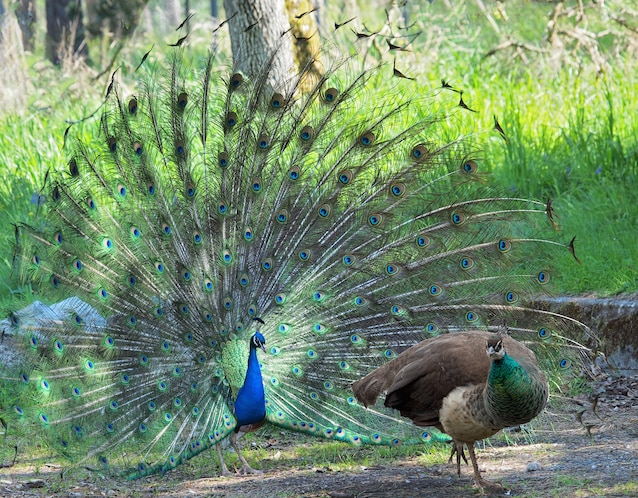
The sexual dimorphism it is among the most marked in the animal kingdom. The male has the neck and chest of a intense metallic bluei golden hips and the feature showy tail. The female, on the other hand, is significantly smallerwith predominantly brown, gray and cream plumage, devoid of conspicuous ornaments. The male peacock displays his magnificent tail and uses loud calls to attract a harem of three to five females. The female builds the nest by digging a cavity in the ground with her legs in a hidden area and lays 3-5 eggs in late spring.
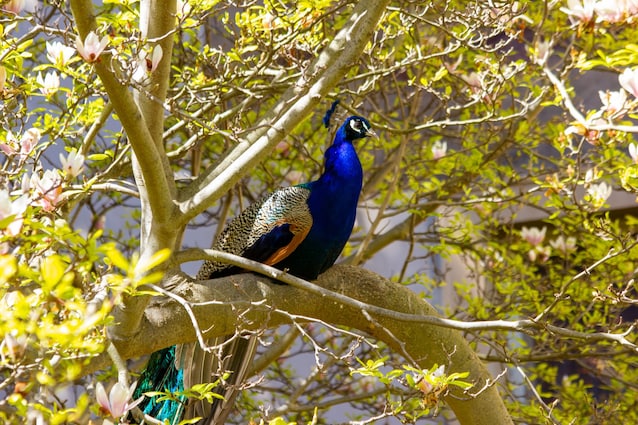
It is a rather long-lived animal and can live up to 25 years. AND omnivorous and feeds on insects, earthworms, lizards, frogs, snakes, but also on shoots, seeds, grains and flowers. This varied diet makes it flexible in environments different from its original habitat even if it needs a lot of water to survive. It is a behavioral bird daytime and at night it rests in groups in perches in the trees, the so-called roost.
The queue and the courtship ritual
The real tail of the peacock is not the one we see open. Those are the tail covering feathers (train), long on average 1.2 meterswhich grow between June and January and are lost and regenerated every year. It’s 100 to 150 upper caudal coverts highly specialized. They are in fact covered with colored structures to form a sort of ocelli (the characteristic iridescent circular “eyes”) produced by micro-structures that they diffract the lightnot from colored pigments as one might think.
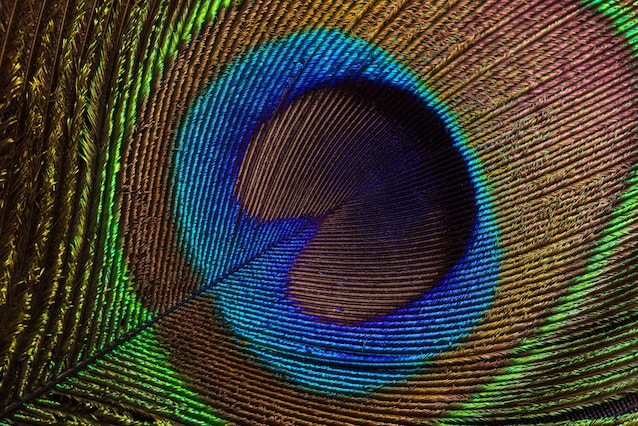
These structures are fanned out and tilted towards the sunlight and are very important moles courtship rituals. As documented by a study published on Journal of Experimental Biologythere would be one significant positive correlation between the number of ocelli and the reproductive success of the malefemales choose males with the highest number of ocelli because this parameter could reflect the individual’s health status. The male’s long tail feathers develop only after the second year of life.
The male does not limit himself to visual display but also emits specific remindersand research suggests that i you vocalize with more than five notes are sexually selected by females. This explains why at this time of year (la mating season is in spring between March and June) the peacocks of Punta Marina are particularly noisy. Their calls, described as “extremely loud and often unpleasant”, are an integral part of the reproductive strategy. The noise and comings and goings of males looking for females were probably also there in previous years, but this year the impact was perceived as greater by the population.
