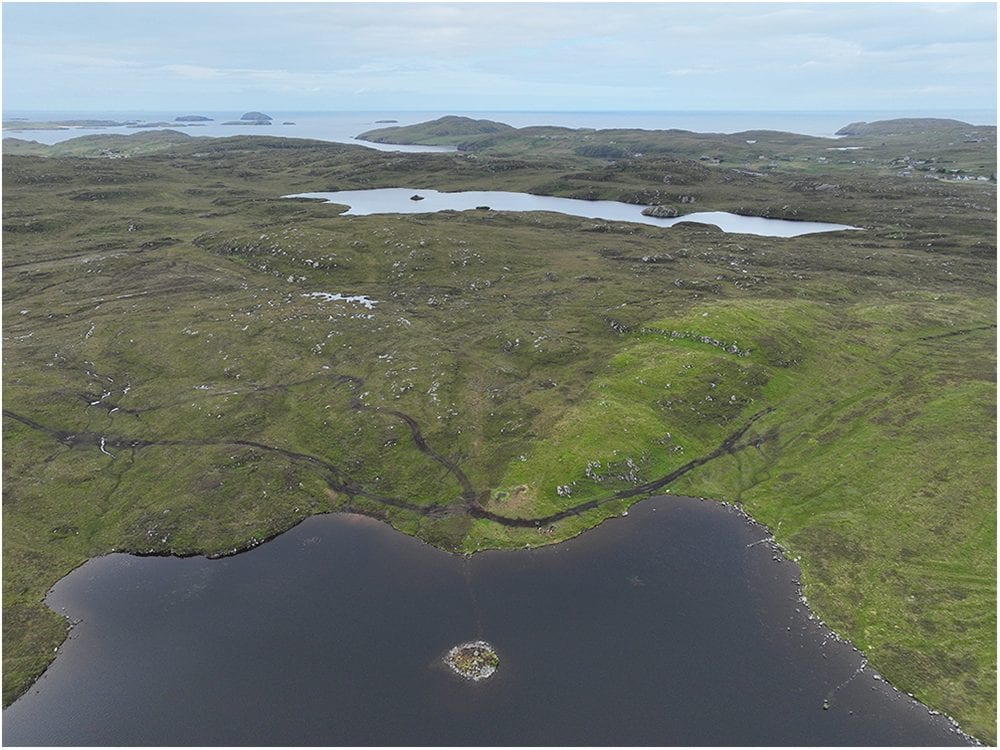
In the Loch Bhorgastailon the Isle of Lewis in the Outer Hebrides, in Scotlandthere is a small island that at first glance seems like a natural accumulation of stones. It is instead a so-called “crannog“, aartificial island built by man beyond 5,000 years agoIn the Neolithic. The archaeologists ofUniversity of Southampton and of theUniversity of Readingin England, have reconstructed its history and developed a new underwater survey technique in shallow water. The results were published on Advances in Archaeological Practice.
The crannogs (from Old Irish “crannoc“, “tree“, due to the material with which they were made, wood) are structures widespread in the lakes of Scotland and Irelandsimilar to the stilt houses of the Alpine pile-dwelling villages of the Neolithic. They differ from these because they were built directly in the lakes, without any access from the mainland, resulting in them being real artificial islands. It was long thought that they were built mainly between the Iron Age and the post-medieval period, but recent research has shown that some date back as far as the Neolithic, a period between 3800 and 3300 BCmaking them contemporary or even prior to monuments such as Stonehenge.
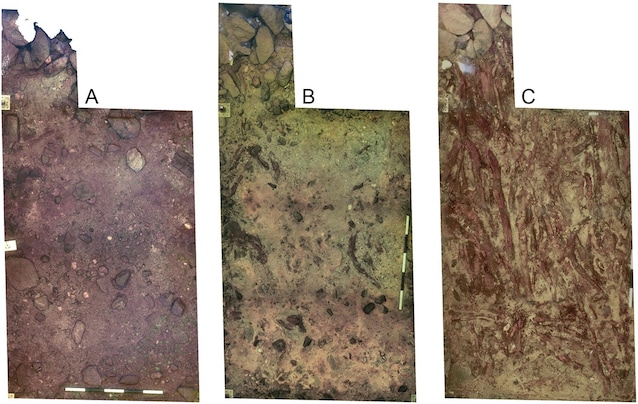
The excavations in Loch Bhorgastail, conducted in several campaigns through stratigraphic excavation, core sampling, surveys and radiocarbon dating, revealed a structure that developed in three distinct phases. The first, beyond 5,000 years agowas a circular wooden platform about 23 meters in diameter topped with branches. In the Middle Bronze Ageabout 2,000 years latera new layer of branches and stones was added. A third phase of activity is documented inIron Age (2,800-2,000 years ago). A stone road now submerged connected the shore of the loch to the island.
Hundreds of Neolithic ceramic fragments belonging to vases and bowls of various types have been recovered over time in the surrounding waters, some even with food residueswhich suggest using the site for social activitiessuch as cooking food or banquets. The resources and coordination needed to build a facility of this size imply the presence of well-organised communitiesalthough the precise reasons for their construction remain unknown.
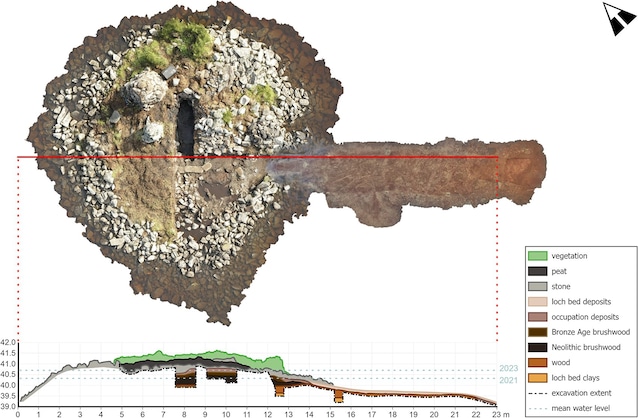
The methodological contribution of the study concerns photographic survey in shallow water. There stereophorogrammetry It creates three-dimensional models from two-dimensional photographs and is effective at depth, but below one meter sediment, floating vegetation and distorted light compromise the images.
The team mounted two fixed-distance waterproof cameras on a rigid frame: the stereo setup ensures precise overlap while compensating for gaps in the data. A diver operated the system with centimeter positioning, obtaining a level of precision comparable to an aerial drone. The result is a continuous digital model of the island above and below the water surface, a perspective that is impossible with separate surveys.
