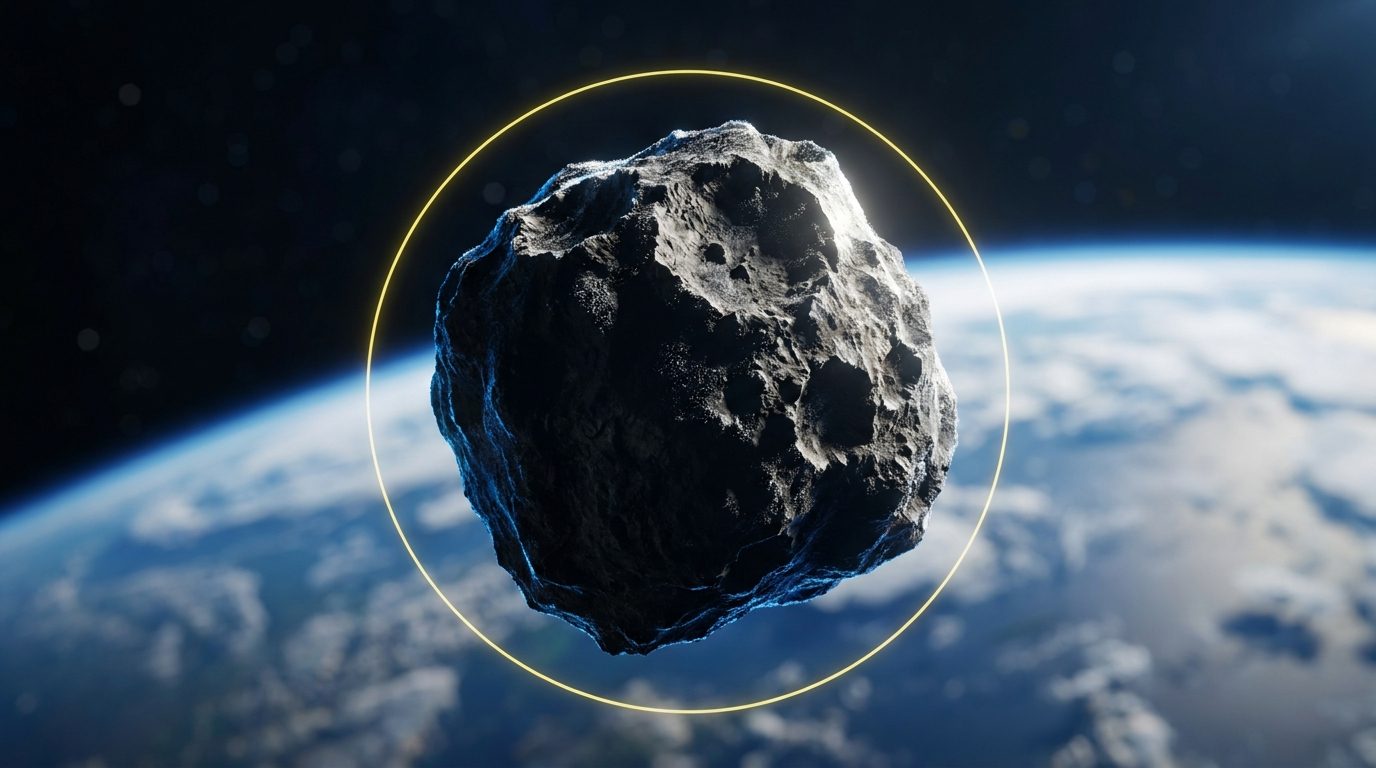
Currently, the record for the highest probability of impact between an asteroid and the Earth goes to 2010 RF12a small “space rock” near-Earth of the Apollo group already passed 79,000 km from Earth in 2010 and which has 1 in 10 chance to hit the Earth the 5-6 September 2095. Fortunately, even in the event of an “impact,” the asteroid is too small to cause any damage: with an estimated size between 6 and 12 meterseven if it were to enter a collision course with our planet it would be completely (or almost) disintegrated by friction with the atmosphere, causing a very bright fireball in the sky and probably an explosion which, although important (we are talking about 8.6 kilotons estimated, about half of the atomic bomb on Hiroshima) would occur too high altitude (approx 40km) to have any effect.
NASA manages asteroid impact risk monitoring through the CNEOS (Center for Near Earth Object Studies), which updates the page daily Sentry Risk Tablea list of asteroids that have a non-zero probability of colliding with Earth in the next few centuries. Currently 2010 RF12 is at the top of the ranking with a probability of 10% to hit the Earth. An already high number in itself in this context, but even more remarkable if we think that this is not a cumulative probability over all the possible impacts of the asteroid (which are estimated at 70) but only compared to the possible collision of 2095.
The probability of impact is calculated based on the knowledge we have of the asteroid’s orbit. For 2010 RF12 we have 339 observations accomplished within 12 yearsbut there is always a degree of uncertainty. The data we have collected allow us to calculate that the September 2095 flyby will occur at a distance of only 52,000 km from Earthless than an eighth of the average Earth-Moon distance. This number, however, has an uncertainty of 180,000 km about. Which is no small thing: it is in fact believed that the asteroid could have non-gravitational thrusts due to the release of volatile materials, a bit like what happens with comets. This means that our planet is on the band where the small celestial body will transit between 5 and 6 September 2095. The possibility of an impact, in fact, is estimated by NASA at 1 in 10.
Now comes the part that scales everything. 2010 RF12 has a diameter estimated between 6 and 12 meterswith a central estimate of approximately 7 meters and a mass of approx 500 tons. It is extremely unlikely that an object of this size, if it entered the Earth’s atmosphere, would reach the ground. Friction with the air would cause it to overheat and fragment rapidly, generating a fireball spectacular. On the ground they could reach the maximum tiny fragmentsthe size of pebbles, which would reach the surface without any danger.
To give you an idea: the Chelyabinsk meteoritewhich in February 2013 exploded above the Ural Mountains in Russia causing over 1500 injuries (mainly due to window glass shattering due to the shock wave) had a diameter of approximately 17 meters and its explosion produced an energy of 440 kilotonsmore than 50 times greater than that expected for 2010 RF12. Furthermore, the event had the “misfortune” of happening over an inhabited area, a rather unlikely circumstance given that approximately 90% of the Earth’s surface is made up of oceans, deserts or otherwise uninhabited. In short, even if the asteroid “impacted” the Earth and produced a fireball, it is likely that no one would see or hear it.
In short, the fact that an asteroid has a relatively high probability of impact does not necessarily mean that it should cause concern. However, it is not excessive to keep track of a small 7 meter “stone” in deep space: small celestial bodies such as 2010 RF12 constitute in fact a test bed for orbital prediction models in the field of planetary defense. Being able to predict decades in advance the behavior of an object of such modest dimensions, subject to non-gravitational forces that are anything but easy to model, is useful for refining the tools to be used in the event of truly dangerous asteroids.
