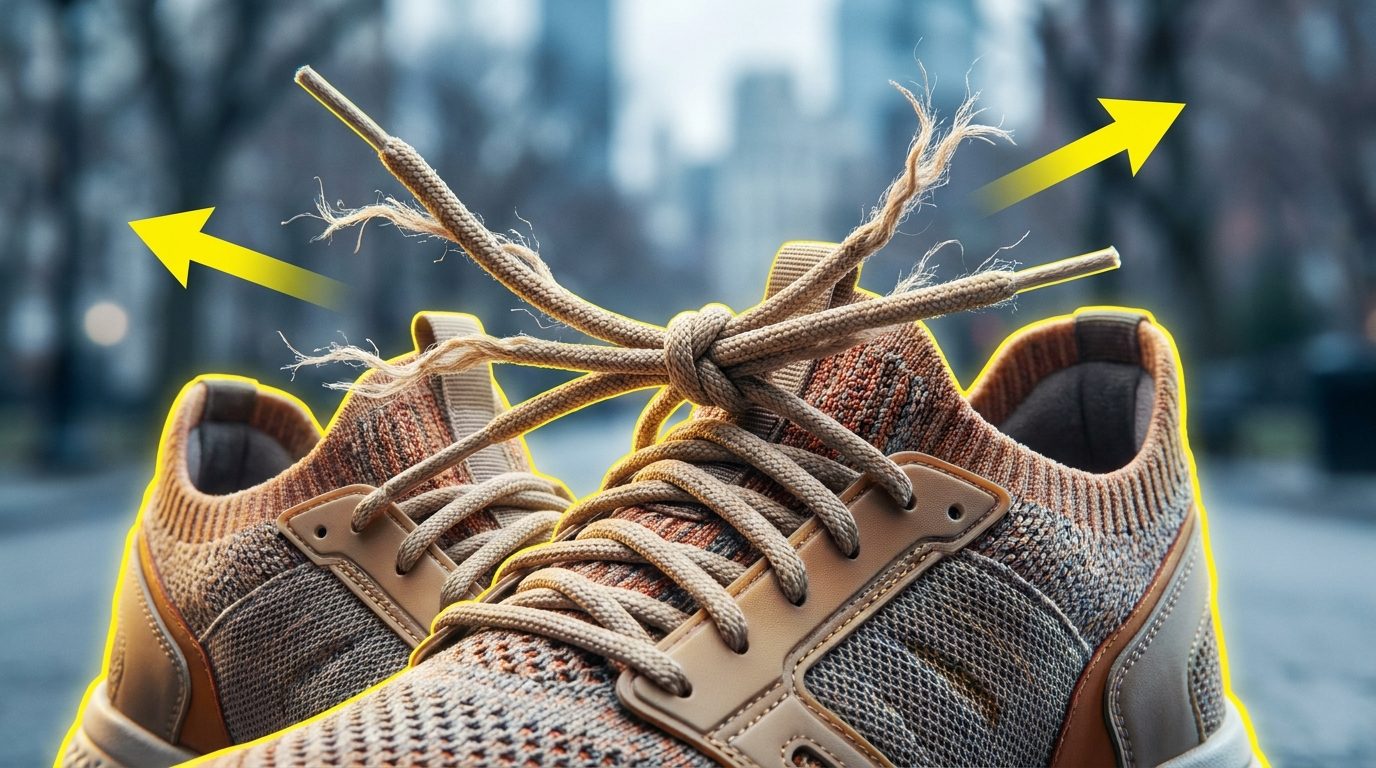
Unless you only wear sandals and loafers, you will have countless memories of yours shoes that untie themselves even if you had fastened them with care and attention. But why does this happen, and how? The first to systematically study the physical mechanism that leads to bow knots to spontaneously dissolve were researchers from the University of Berkeley, who in 2017 published the results of their research in Proceedings of the Royal Society. The result: knots untie due to the combined effect of two forces: the impact of the shoe on the ground, which loosens the knot with each step, and the swing of the leg while the shoe is raised. It might seem like a frivolous question, but it isn’t. Understanding how knots fail under dynamic forces may have applications for other knotted structures of far greater importance, such as the DNAi microtubules and the surgical sutures.
The “grandmother’s” knot and the “square” knot: the experiment
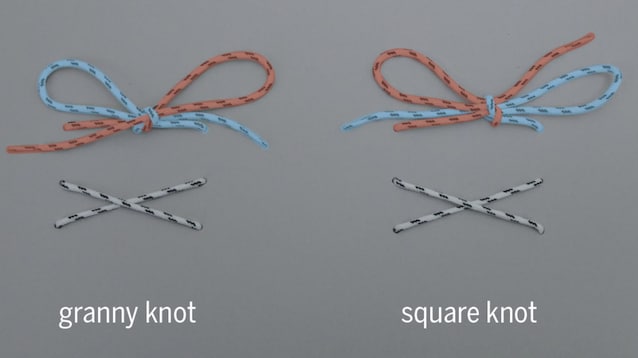
To study the problem, the researchers used a treadmill, a high framerate camera, and of course sneakers with accelerometers mounted on them. The shoes were laced with the so-called granny knot (“grandmother’s knot”in which the two crossings of the bow have the same orientation and tend to rotate on one side instead of remaining flat) and with the square knot (“square knot”in which the two crossings have opposite orientations and the flake remains flat). The experiment involved analyzing the behavior of the nodes both during walking and running.
What they saw is that the node fails within seconds, triggered by a combination of two distinct mechanisms. During running, when the foot impacts the ground the knot of the shoe undergoes an acceleration equal to 7 times that of gravity. This impact “stretches” the knot and then lets it relax: each time this cycle is repeated the knot loosens slightly. But alone, this is not enough to untie it completely, and this is where the second mechanism comes into play. This works when the shoe is lifted: the movement of the leg gives acceleration to the free ends of the laces, which then “flap” back and forth.
Researchers have shown that none of these two forces, taken individually, causes the knot to untie, but their combination does so. To do this, the team analyzed the behavior of the nodes when they stamp their feet on the spot without walking (therefore eliminating the second mechanism), or yes legs swing sitting on a table without impacting the ground (thus eliminating the first mechanism). In both cases, the knots held. Only the two mechanisms together could untie them.
The square knot is more stable
There is one interesting detail that the 2017 study left open, namely why the square knot is more resistant. Berkeley researchers had discovered that the two knots untie with the same mechanism, without being able to explain why one holds more than the other.
The answer came three years later, in 2020, with a study published in Science by a group of mathematicians and engineers at the Massachusetts Institute of Technology. Using fibers that change color based on tension (and therefore make the distribution of forces within the knot visible) the researchers developed a theoretical model of knot stability based on three topological parameters: the number of crossings, the direction in which the segments twist when the knot is pulled, and the presence of stretches where two parallel segments slide in opposite directions.
The key is in twist. If adjacent segments rotate in opposite directions, friction is created which stabilizes the node; if they rotate in the same direction, the thread tends to slip. The square knot has more “twist fluctuations” than the “granny” knot, which is why it holds up more.
