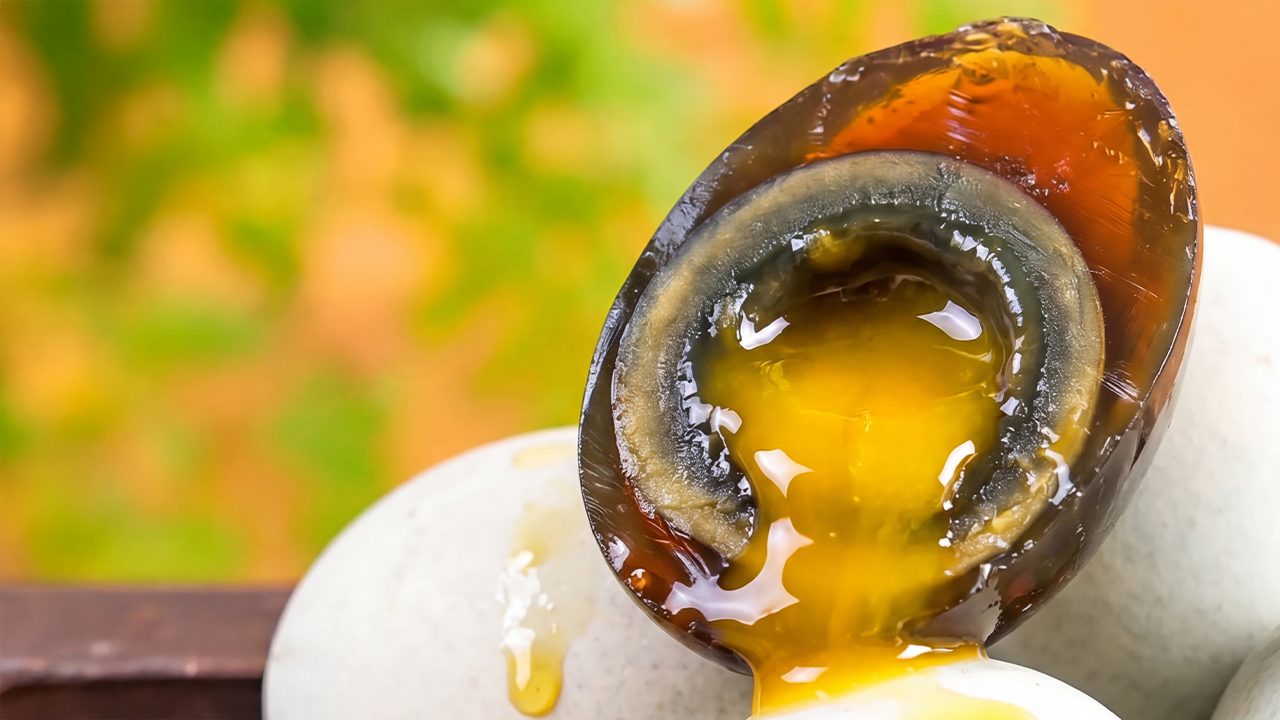
They call himcentenary eggrotten egg, putrefied egg or fermented egg: the pidan it is a traditional Chinese dish made with a preservation method that has a history of over five hundred years, which makes the egg a very dark color and with a very strong taste. Let’s immediately dispel two things: it doesn’t take a hundred years to produce it, nor does it remain edible for a hundred years (as the term centenary might make you think) e it is not fermented. At least not in the traditional sense of the term, because bacteria are not used as is done for all types of fermentation. It is obtained from “alkaline fermentation (better call it alkaline treatment) of fresh duck, chicken or quail eggs, a method developed from the need to store large quantities of eggs in times of plenty. Thanks to the action ofsodium hydroxide (NaOH), which “breaks down” the egg proteins, during the treatment a gelatinous eggwith brownish albumen and greenish yolk. Ferrous sulfide is also formed, ammonia and hydrogen sulfide, responsible for the dark color, penetrating aroma and complex flavor of the dish. The preparation process must last at least 20 days to obtain an optimal product, but it can take up to two months!
The Chinese Pidan tradition: from the Ming dynasty to today
Pidan appears in Chinese written sources around 1600, during the Ming Dynasty, but tradition has it that its preparation had already been widespread for centuries, before anyone bothered to put it on paper. The term pidan derives from pi, “hard or rubbery” and dan, “egg”: literally “rubber egg”, recalling its gelatinous consistency.
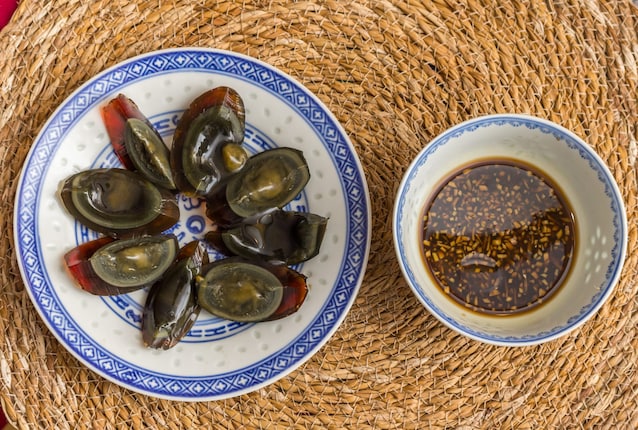
Legend has it that a farmer from Hunan province discovered duck eggs in one lime puddle turned off used for construction and decided to taste them! Having remained there for two months, they had transformed into something edible and surprisingly tasty and decided to try to reproduce the process again. Regardless of the veracity of the story, reported by a BBC article, the centenary egg is today one of the most loved snacks in China, which connoisseurs accompany with a Bordeaux or a Champagne! In addition to being eaten as a cold dish, it becomes part of the preparation of soups, dishes with rice or vinegar.
Thanks to the chemical-physical transformations that occur during preparation, it can be stored for up to over 200 days at room temperature.
How the centennial egg is produced: calcium oxide and sodium carbonate
Eggs are used for the traditional production of pidan duck fresh, and sometimes chicken or quail, carefully selected and cleaned. A batter is prepared with boiling tea water, quicklime (calcium oxide, CaO), sodium carbonate (Na₂CO₃), sea salt, wood ash, tea leaves and clay. The eggs are covered first with this batter, then with rice, to prevent them from sticking together, and finally they are left to “ferment” in covered barrels or baskets.
There are actually multiple preparation methods: the order in which the ingredients are mixed, the method of “wrapping/dipping” the eggs changes and in some cases they are added accelerants as lead oxide (PbO) or zinc (ZnO). But the basic concept is the same, with preparation times varying between 20 and 50 days. The eggs are then rinsed, dried and ready for consumption.
Unlike many other fermented foods, for the preparation of pidan no microorganisms are used that guide the fermentation. In fact, even in alkaline fermentations, that is, which produce an environment with a basic pH (above 8, so to speak), bacteria such as Bacillus subtilis. In the centenary egg, however, the absolute protagonist is the chemistryno external agents.
The biochemistry behind it: protein gelation and a rotten taste
The heart of the process lies in the reaction between calcium oxide (CaO) and sodium carbonate (Na2CO3) present in the coating paste, in the presence of water:
Na₂CO₃ + CaO + H₂O → 2 NaOH + CaCO₃
Sodium hydroxide (NaOH), also known as caustic sodathus produced, slowly penetrates through the porous shell of the egg and reaches the interior, raising the pH to values between 9 and 12. Today, knowing the chemistry of the phenomenon, industrial methods involve immersing the eggs directly in an alkaline solution containing approximately 4–5% NaOH and 5–10% NaCl.
The gelation of proteins
Once inside, NaOH acts on the proteins present, in particular ovalbumin, the main protein of egg white, denaturing them, i.e. breaking their three-dimensional structure, but only partially. This leaves exposed hydrophobic protein fragments that act as adhesive “patches” that allow the proteins to bond with each otherforming a stable and transparent gelatinous networkas reported by a 2018 study published in PubMed Central on the molecular structure of pidan. In practice, sodium hydroxide initially liquefies the egg white which then recoagulates in the form of a gel when the proteins bind together again in the new conformation.
The transformation of the yolk and the rotten smell
After having changed the characteristics of the egg white, sodium hydroxide continues its journey towards the yolk where it finds, in addition to lutein, lipoproteins such as livetinewhich have a high sulfur content, thanks to the presence of the amino acid cysteine. The degradation of proteins under the action of sodium hydroxide releases hydrogen sulfide (H₂S) e ammonia (NH₃), from which the typical acidic and rotten egg smell derives. They are the same molecules responsible for the pungent aroma of surströmming, but here they originate not from bacteria but from pure alkaline chemical hydrolysis. The degradation of fats produces instead free fatty acids which contribute to the flavour umami and the creaminess of the yolk.
Factors influencing the process
It’s a delicate balance: a concentration of NaOH that is too low does not trigger gelation, while one that is too high completely breaks down the proteins, causing the egg white to re-liquefy. Likewise, fermentation times that are too short leave the egg liquefied. But if it is fermented for too longgelled proteins can liquefy again, ruining the final product.
Temperature also plays an important role. The perfect temperature is between 15 and 25 °C: below, the egg white proteins are too compact and the yolk remains transparent. Above the egg white sticks to the egg shell which can even explode in a stinking cloud of hydrogen sulfide.
Because the egg white is brown and the yolk is green
The characteristic colors of egg white and yolk derive from two different processes. For egg white, some of the color also appears to be due to presence of tea in the “batter” in which the egg is wrapped. But the most important reaction is an unsuspected old acquaintance: the Maillard reaction! Get used to hearing about this reaction in the centenary egg on cooking shows occurs between the amino acids released by protein degradation and glucose present in the albumen. The same chemistry that forms that beautiful brownish coating on a steak produces the typical brownish color of pidan egg white here.
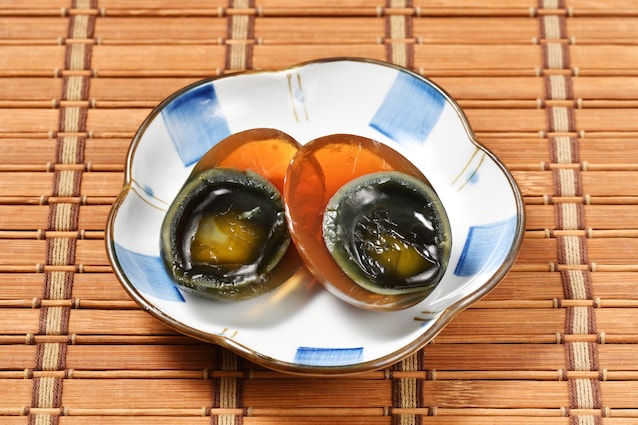
The yolk, however, takes on the characteristic green-grey or green-blackish shade due to the formation of ferrous sulfide (FeS). As anticipated, livetins are rich in sulfur and when they are hydrolyzed by sodium hydroxide they release sulfide ions (S2-), which reduce with the ferric ion (Fe3+) naturally present in the ferrous ion yolk (Fe2+). At this point, the residual sulfide combines with the ferric ion to form FeS, with its typical dark green color.
Is it safe to eat it? What the BCCDC says
Despite the repelling appearance, it is quite safe to eat the pidan. Thanks to High pH and low percentage of free water (aw <.092) an environment hostile to the proliferation of bacteria is obtained. In fact, the British Columbia Center for Disease Control states that under these conditions the presence of is not even detected Salmonellaone of the most dangerous and common pathogenic bacteria of fresh eggs.
The main problem lies in the possible presence of lead!! Yes, because to speed up the reaction, several industries had started to introduce lead oxide (PbO), which helps check diffusion and penetration of sodium hydroxide through the egg shell, reducing the formation of sediment that could block the micropores. Its use, therefore, served to make the whole more reproducible and controllable process on an industrial scale. For health safety reasons and public health However, many companies have begun to replace it with zinc oxide (ZnO) or with processes that do not include the addition of accelerators.
Sources:
Century Egg – Overview Eiser, Erika & Miles, Caroline & Geerts, Nienke & Verschuren, Peter & Macphee, Cait. Molecular cooking: Physical transformations in Chinese ‘century’ eggs. Soft matters 2009 Wang, J., & Fung, D.Y.C. (1996). Alkaline-Fermented Foods: A Review with Emphasis on Pidan Fermentation. Critical Reviews in Microbiology Cai, J., & Sweeney, A. M. (2018). The Proof Is in the Pidan: Generalizing Proteins as Patchy Particles. ACS central science BBC – the 500-year-old snack Xu, Lu, Yan, Si-Min, Cai, Chen-Bo, Yu, Xiao-Ping, Nondestructive Discrimination of Lead (Pb) in Preserved Eggs (Pidan) by Near-Infrared Spectroscopy and Chemometrics, Journal of Spectroscopy, 2014 N. Parto (author) Section 3.14 Pidan century egg. In McIntyre (editor) and the Fermented Foods working group. (2024). Safety of fermented foods. Assessing risks in fermented food processing practices and advice on how to mitigate them. Environmental Health Services, BC Center for Disease Control. December 2024
