Juve who are ashamed of themselves
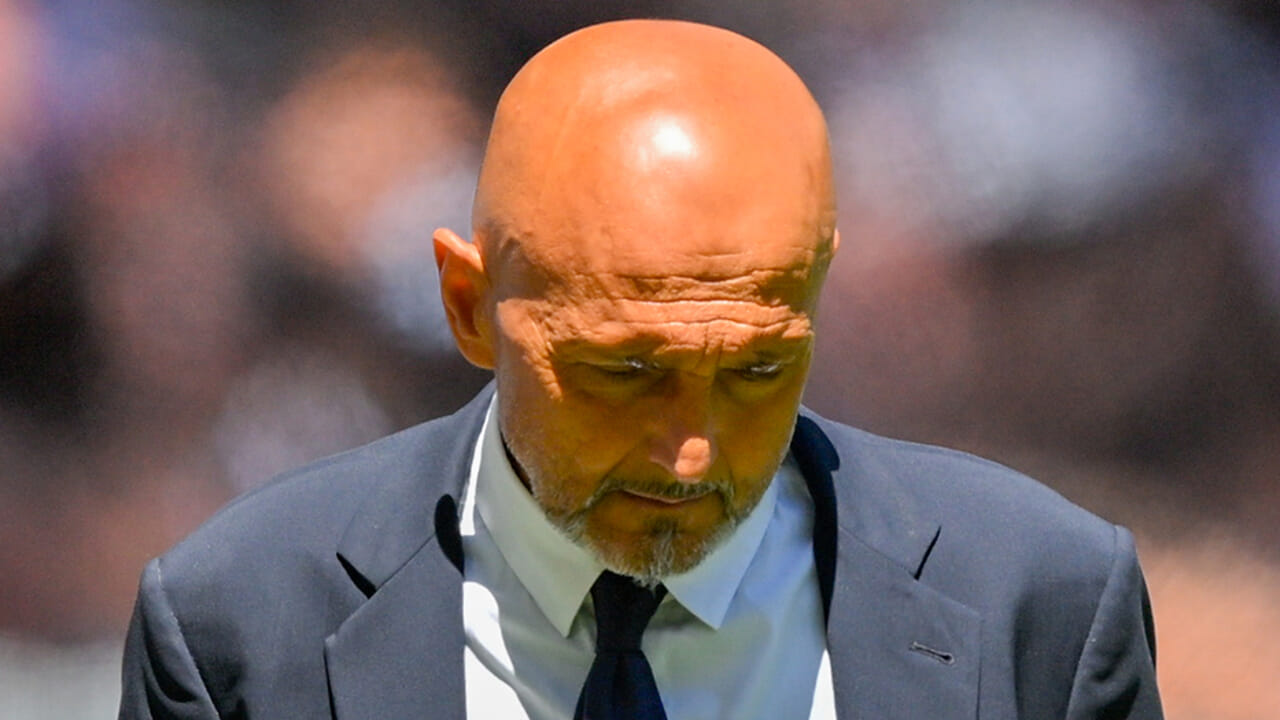
Seeing Luciano Spalletti with teary eyes almost seeming to have to defend not himself but the Juventus club from faults that are far from being solely and simply his is one of the most bitter and eloquent images of yesterday’s dramatic defeat against Fiorentina.
Let’s be clear, it wasn’t just a setback: it wasn’t simply a banal football match lost, and lost badly. It was a meltdown, total and definitive. A surrender without discounts and without excuses for which everyone has more or less evident responsibilities. Even if the heavier ones are, as they usually say, in the handle. Which is not that of Spalletti: and perhaps not even in some of the players. Even if those who were used to Buffon and Szczesny may not think of Di Gregorio as an upgrade. And those who have seen, not just Baggio, Platini and Scirea, but at least Di Livio, Torricelli, Tacchinardi, Conte or Montero – people who left the pitch angry and motivated even when they won – cannot tolerate insignificant matches like yesterday’s.
Once upon a time there was the Juventus Style
The Juventus fans still evoke him, with that slightly tired devotion of those who know they are defending something that no longer exists. The Juventus Style: victory as a habit, suffering as a method, superiority as a fact. Well. Today that style is a corporate PowerPoint that no one opens anymore, a logo on a t-shirt to be seen at the end-of-season outlet that covers a team incapable of beating Fiorentina at home when the entire championship is at stake. Zero to two. With the defense giving away the first goal as if it were a welcome gift, Di Gregorio’s attempted save was truly unfortunate, and Koopmeiners – paid like a champion, but for performance below a Cagliari reserve – forgot to mark Ndour, a twenty-one year old worth one million euros gross per year in his first start in the most important match of the year. Welcome to the Juventus of 2026. Or rather: welcome back. Because this is not an accident. It has become the norm.
The defeat against Fiorentina should not be read as a bad evening. It should be read as the perfect photograph of a club that has lost everything: identity, direction, credibility and, above all, the ability to cause fear. And now, to crown a season to forget but which unfortunately will be impossible to forget, comes the derby against Torino. A match that brings the witches to the edges of the pitch: and not for what could happen in the stands or outside, but for what it represents: the symbolic closure of a failed year, the seal on a season that said everything there was to say about this Juventus but above all and about who (NOT) governs it. Losing this derby, at this moment, would not be a defeat within a defeat. It would be a gravestone. The perfect storm
Let’s start from the top
… Because it is always from above that you can see everything much better. John Elkann has demonstrated a rare talent in recent years: he has monetized a sea of money by valorising an empire in personal terms to take it beautifully outside and far from its historical roots. I don’t dare talk about economics, even if those who understand it – especially abroad – I also read.
At Juve he expressed the uncommon talent of systematically choosing the wrong people. All. He didn’t get one right.
It’s a sequence that almost makes you laugh, if it didn’t make you cry. Arrivabene, Paratici – the one who bought De Ligt for 90 million (including price tag and additional costs) and Vlahovic for 85 (always all inclusive). Then Scanavino, a Torino fan placed to be the man of accounts in the Juventus house, then Giuntoli, who did not carry out the signing campaign to delegitimize Allegri who in his opinion was not suitable. Better “the man who had to solve everything”, Thiago Motta, who spent over one hundred million on three midfielders considered among the club’s worst investments ever. And finally Tudor, called to operate on the patient with an open heart armed with… nothing. And finally, as if that wasn’t enough, Comolli. Damien Comolli, the algorithm man, arrived from France with his wealth of predictive analysis to buy attackers who make us regret Pacione, Zavarov and Briaschi. Six coaches in five years. Six. An average that has no equal among clubs that think they are great.
Comolli equaled Giuntoli in the art of failure, which is not easy. At least one coach out of two has made a mistake – and the story of this season with Spalletti is there to prove it – he has built a squad without character, without hierarchy, without soul. Technical director François Modesto, who arrived in July, left no recognizable trace. The management, on the whole, did only one thing consistently: not protect those who worked under them. Neither the coach, nor the players, nor even the fans. “You go ahead…” they seem to say in turn. And Spalletti in front of the cameras with teary eyes – poor guy – goes there. And what should he say? Does the algorithm bother him?
The target coach
So we come to Spalletti. Which is the most convenient target, and therefore the least interesting to shoot at and blame for everything. Of course, it has its limits: edgy communication, tactical readings that are sometimes wrong, an obvious difficulty in managing the emotional fragility of a group that never really became a group. But Spalletti’s problem isn’t Spalletti: someone who knew how to win well in places that didn’t know how to win. And who has healed small sporting tragedies (a relegation with Sampdoria, failure in the national team), putting his face to it.
Spalletti, since we’re talking about automotive empires, had a Duna. And they asked him to do the Dakar: best wishes. He was presented as the man of the turning point and then left alone to explain the defeats in front of the microphones. In today’s Juventus, the coach is not a resource to be defended: he is the first name to be sacrificed when things don’t go well. It always works like this, it will always be like this. They pay him a lot for that.
As for who plays
The case of Locatelli and Yildiz says much more than it seems. Both have signed and made official long and important renewals. Both were unable to make a difference in this final phase of the season. It’s not necessarily an explicit calculation, I don’t even want to think so: but the signal that a locker room sends in which the players are no longer able to express themselves as a group is that they fail as individuals. The Juventus Style, the real one, was made up of people who got hurt just to win. Today’s world is made up of people who preserve themselves for the future. There’s a difference.
The feeling is that in Juventus any player is simply thinking of himself and of the least possible (personal) harm. Koopmeiners who today is offered at half of his market value of three years ago, but one could say of Bremer – expendable axis for a decent market – or Vlahovic, who would leave on a free transfer, are probably at this moment thinking about how to make the moment of the season as less dramatic as possible: not Juve’s, but theirs. Economically speaking.
The bill
Failure to qualify for the Champions League is worth between 60 and 70 million in lost revenues, including participation bonuses, sponsors and European box office. In six years the club has spent around 875 million on the transfer market. Result: a team that doesn’t beat Fiorentina at home when they have to and looks to Turin like PSG. Every failed season doesn’t end in May: it drags the next one along like a debt. And Juventus has been repeating it for years, with the same liturgy – new management, new coach, new beginning – without ever learning anything from anyone.
“¡Hacha, Toro!”
Torino is on Sunday. Losing this derby, in this state, would be the definitive manifesto of the Juventus drift. Not a sporting defeat: the certification that this club has stopped being an idea and has been reduced to a sum of failures. The Juventus Style. It’s almost tender, hearing him call upon you again.
But style is also important. Which are excel sheets and not brands to be shot on a graphic. Juventus has already closed financial years at a heavy loss in recent years, with dizzying numbers also fueled by their dependence on Champions League revenues. And now he is preparing to start the next cycle again – assuming he finds a coach, a management team and a project – with less money, less credibility and less bargaining power.
Every alleged re-foundation opened a chasm of three or four seasons before the results returned to being decent. This refoundation, that of Comolli and associates, seems to follow the same script. Actually: it’s worse, because this time the context doesn’t even help. The 2025/26 Serie A is a mediocre championship, technically inferior to the major European tournaments, and Juventus cannot help but dominate it. But not even being in the top four.
If you can’t speak up in a championship like this, the problem isn’t external. It is inside the walls of the Juventus Stadium, inside the management offices, inside a locker room that has stopped believing in anything.
On the fans’ side
The fans know it. They say it clearly, on social media, in stadiums, in bar conversations which are the true temperature of a club. There is no longer that silent superiority, that underlying certainty that made the Juventus fan impervious to criticism. Today the comments on the Juventus posts are a sample of desperation: “Send them all to dig up”, “shut everything down”, “you don’t deserve the shirt”.
It’s not the outburst of episodic defeat. It’s something that has broken down in the relationship between this team and its people. Juventus has always polarized: either you love them or you hate them, and in both cases you can’t ignore them. Today there is a third option that never existed: you can even start not considering it anymore. You can go to the lake, to the sea: even to watch amateurs.
Torino has the priceless dream of making the nightmare even worse with a day that would become a nightmare for years to come.
And the good thing – so to speak – is that there isn’t even a clear solution on the horizon. Spalletti with full powers? Only if society decides to stop treating it like a disposable lightning rod. Count? It would be shock therapy, the necessary shock, but it would impose another total restructuring in a club that already has too many restructurings in its curriculum. Another new name? Yet another illusion, destined to be swallowed up by the same environment that has already consumed six coaches in five years without learning anything from anyone.
The truth, the one that no one at Juventus has the courage to say out loud, is simple and brutal: the problem is not the coach. It’s not the single player. It’s not the defeat against Fiorentina. The problem is that Juventus has stopped being an idea. It has become a sum of failures, of money badly spent, of bad choices accumulated one on top of the other like layers of paint on a wall that is giving way. And when a club like this ceases to coincide with the image it has built of itself over decades of history, we are no longer faced with a crisis of results. We are faced with something deeper and more difficult to heal.
Juventus is a pile of very expensive high-sounding positions that justify a role and an acronym for managers who today should not have a job, an office, a salary and perhaps should be queuing, like thousands of forgotten employees, in front of a temporary agency.
