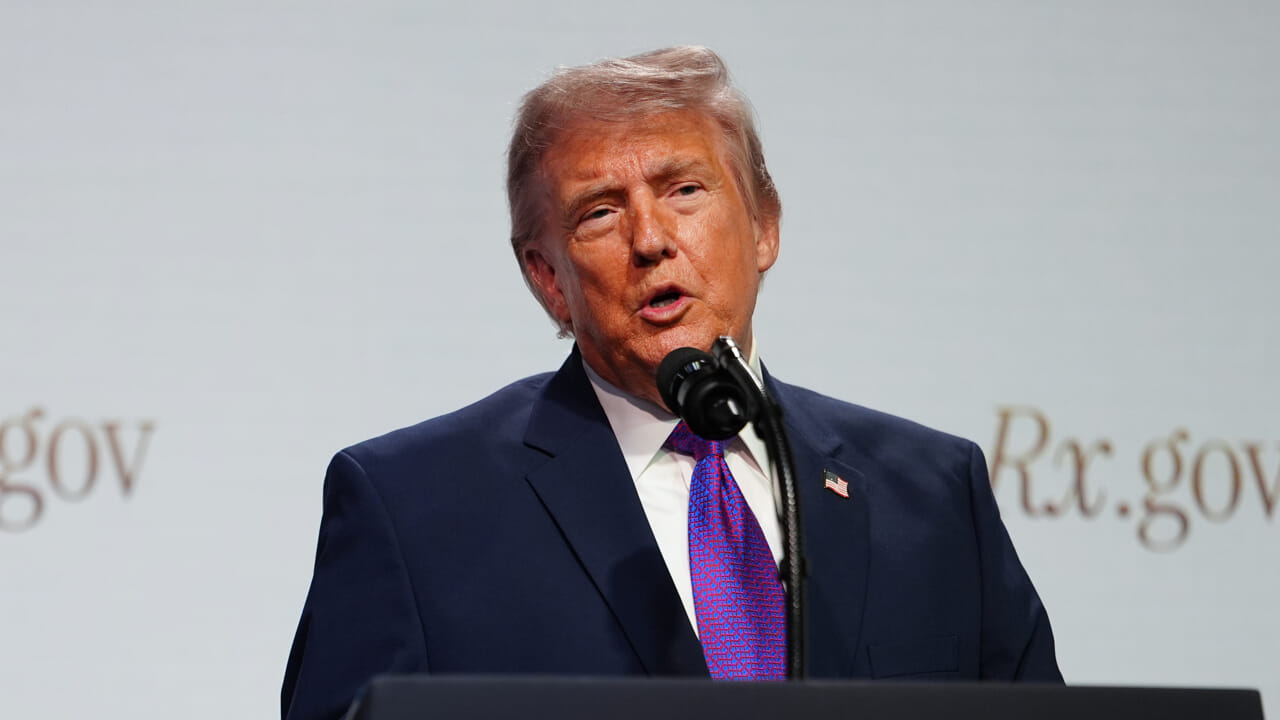
The European Parliament and the EU Council have reached an agreement on legislation aimed at abolishing import duties on US products, a key element of the trade agreement concluded with Donald Trump last July, in a move that should avoid the introduction of higher tariffs by the United States on EU products.
Based on the agreement reached last July in Turnberry, Scotland, between the US president and Commission President Ursula von der Leyen, the EU agreed to eliminate import tariffs on US industrial goods and to grant preferential access to US agricultural and fisheries products. In exchange, the United States will impose tariffs of just 15 percent on most EU goods, much higher than the 2.5 percent that averaged before Trump’s election, but better than the threatened 30 percent rate.
15% duties, billions in purchases of LNG and US weapons: what is in the agreement between the EU and Trump
However, it took almost a year for the EU to approve the agreement, because in the meantime in January, Trump had threatened to annex Greenland, a Danish territory, and because then again in February the US Supreme Court annulled a large part of Washington’s tariff program. After months of controversy and clashes, Trump, exasperated by the wait, had threatened to impose a 25% duty on European cars starting from July 4th.
The agreement reached by Parliament and the Council comes after long negotiations, with the Community Assembly pushing to insert a whole series of safeguard clauses to prepare for the now famous changes of mood and ideas of the US president, clauses which however the member states did not want to insert for fear of annoying the tycoon.
The agreement
The agreement concerns two regulations. The first, and main, eliminates most residual tariffs on American industrial products and opens preferential access to the European market for some US fisheries and agricultural products. The second extends the suspension of duties on lobster imports until 31 July 2030, with retroactive effect from 1 August 2025. However, the agreement introduces a series of protection clauses desired above all by Parliament: an automatic expiry in 2029, a safeguard mechanism for the European industry, a strengthened suspension clause and a specific rule on steel and aluminium.
“I welcome the agreement reached,” because “this means that we will soon follow up on our part of the EU-US joint statement,” von der Leyen wrote on X, arguing that together “we can ensure stable, predictable, balanced and mutually beneficial transatlantic trade.”
“This agreement represents an important step towards greater predictability in transatlantic trade relations. By introducing the sunset clause and a solid suspension clause, Parliament has significantly improved the Commission’s proposal”, claimed the chief negotiator for the Chamber, the German socialist Bernd Lange.
“It was necessary to reach this agreement to make trade with the United States ‘Trump-proof’ and avoid an unnecessary trade war,” added Swedish liberal Karin Karlsbro.
The ‘sunset’ clause
First of all, Parliament obtained the approval of the so-called ‘sunset clause’, i.e. an automatic expiry clause. The main regulation will cease to apply on 31 December 2029, one year after the end of Trump’s mandate, unless it is decided to renew it with a new vote of the EU Parliament and Council.
Before that date, the European Commission will have to present an overall assessment of the trade effects of the pact on EU industry, agriculture and small and medium-sized enterprises, as well as changes in trade flows with other third countries. On the basis of this evaluation, a legislative extension may possibly be proposed. Parliament had pushed for an even more stringent clause expiring in 2028.
Steel and aluminium
One of the most controversial issues concerns steel and aluminum derivatives. In August 2025, i.e. after the pact with von der Leyen, the United States had added 407 new categories of products derived from these metals to the list of those subject to duties. The European Parliament considered this move a violation of the spirit of the Turnberry Understanding and insisted that the issue be addressed directly in the main regulation.
The compromise reached provides that the European Commission is authorized to suspend the tariff preferences granted to American products if, by 31 December 2026, the United States continues to apply a rate higher than 15 percent on steel and aluminum derivatives imported from the EU as had been established. Washington therefore has eighteen months to return to that limit; if it doesn’t, Brussels will be able to freeze concessions on the American side. Furthermore, by 1 December 2026, the Commission will have to present to Parliament and the Council a report on the tariff treatment reserved by the USA for these products, so as to have an updated picture before any decision.
The suspension clause
Alongside the specific steel rule, the agreement strengthens the general standstill clause, which works as an early warning mechanism. The Commission can suspend, in whole or in part, the application of the regulation in several circumstances: if the United States does not respect the commitments undertaken in the joint declaration or if it adopts measures that compromise the objectives of the agreement or disrupt trade and investment relations with the EU, including through discrimination against European economic operators. The suspension can also occur simply if there are “sufficient indications” that such actions are imminent, without waiting for them to occur.
This last aspect significantly broadens the scope of the clause compared to the Commission’s original proposal: it is not necessary to wait for clear damage to intervene, but a well-founded suspicion of risk is sufficient. The EU Council in a note speaks of “strengthened conditions” that offer the EU “flexibility to protect its economic interests if necessary.”
The safeguard mechanism
The agreement also establishes a safeguard mechanism designed for situations in which tariff concessions granted to the US generate a sudden and massive increase in imports such as to cause or threaten to cause serious damage to European producers, including industry and agriculture.
The mechanism can be activated in three different ways: on an autonomous initiative by the Commission, on a duly motivated request from at least three Member States or on a report from European industry or trade unions. Once the request is received, the Commission launches an examination to verify whether the conditions are met.
If the analysis confirms this, it may decide to suspend the application of the regulation. It is therefore not an automatic tool, but a procedure with precise thresholds and checks, which requires a formal investigation before any intervention. The Commission will also have to update Parliament and the Council every three months on the trend in the volumes and values of American exports to the EU of goods covered by the legislation.
The next steps
The agreement reached is still “provisional”: the texts must be finalized at a technical level and then formally approved by both institutions before publication in the Official Journal of the EU. The European Parliament’s International Trade Committee is expected to meet in an extraordinary session on 2 June, while the final vote in plenary could take place on 16 or 17 June.
