Everything is fine immersion underwater it forces our body to operate in physical conditions far from those for which it evolved, and the deeper we go, the more the behavior of the gases distances itself from what we are used to on the surface. The reason is that the more we dive the more we pressure external increases (1 atm every 10 meters of depth), and this has very important effects on the most basic vital activity: breathe. In fact, gases, including the mixture that divers breathe, are compressed at high pressures (i.e. at depth) and expand at low pressure. This simple fact heavily influences the activity and also the safety of those who dive. To understand this we turn to two physical laws fundamental for gases: the Boyle’s law and the Herny’s law.
How pressure works underwater
Our body constantly experiences pressure, that is, it is the atmospheric pressurewhich is worth approx 1 atm. It means that the air, due to its weight, presses every square centimeter of our body with a force comparable to the weight of 1 kg. It is not a negligible pressure, but it is perfectly balanced by the pressure of the fluids inside our body and for this reason we do not notice it.
Things change underwater. When we dive, in addition to the weight of the air, the weight of the water above us also weighs on our body. The further we go, the more this weight increases and consequently the pressure we are subjected to increases. Water is over 800 times denser than air, and this means that 10 meters of water above us is enough to equal the atmospheric pressure. In other words, the pressure increases by 1 atm every 10 meters of depth. To be clear, at 30 meters our body experiences a pressure of approximately 4 atm (1 atm of atmospheric pressure + 3 atm due to water), i.e. quadruple the pressure for which our organism is adapted.
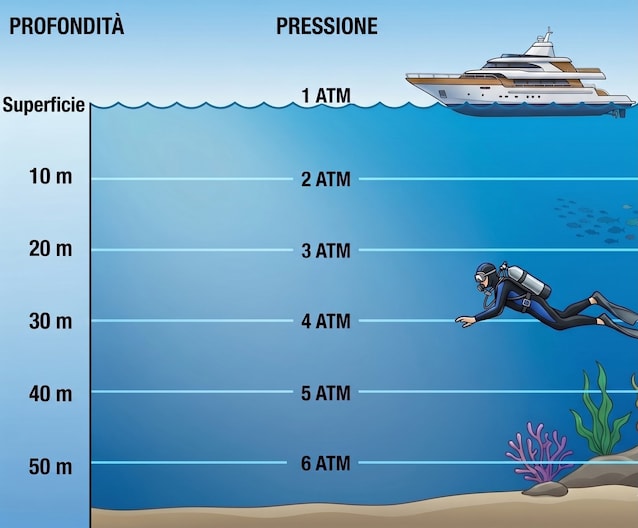
This is not a problem for the solid and liquid components of our body, such as muscles or blood. The reason is simple: solids and liquids are incompressible, they do not vary in volume with pressure. The problem is the gaseswhich instead they are highly compressible: their volume depends significantly on the pressure, and this is what makes them so difficult to manage while diving.
Gases compress at depth: Boyle’s law
A gas subjected to ever-increasing pressure does exactly what one would intuitively expect, i.e it compressesas long as its temperature remains constant. This fact is known as Boyle’s law: as long as a gas neither heats nor cools, when the pressure doubles its volume is halved; when the pressure triples, its volume is reduced by a third, and so on. The opposite is also true: if the pressure of a gas halves (and the temperature does not change), its volume doubles and so on.
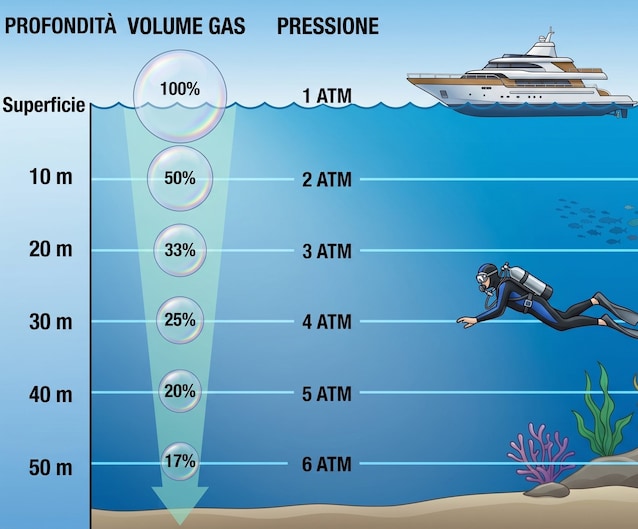
Now let’s imagine holding our breath and diving in. The further we descend, the more our body – and consequently also the air in our lungs – is subjected to greater pressure. According to Boyle’s law, the air we have retained must reduce in volume, and with it our lungs.
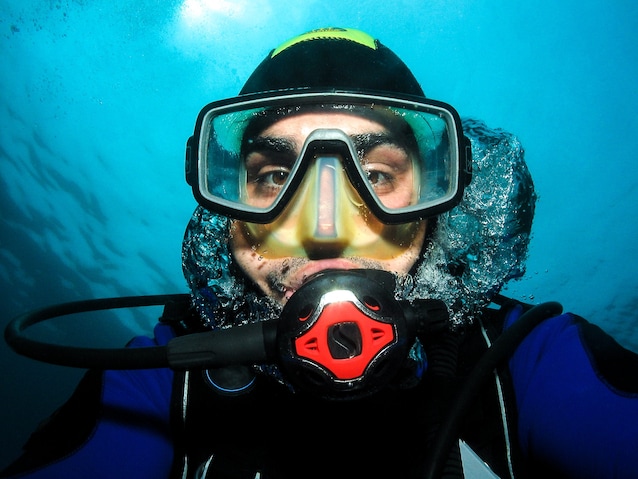
This is why divers must breathe gas not at atmospheric pressure, but at the same pressure as the depth they are at. This is precisely the task ofdispenserthat is, the device that divers keep in their mouths. Thanks to a pressure regulator, the regulator collects the mixture from the tank and brings it to the required pressure so as not to cause imbalances in the diver’s lungs.
Let’s always assume that we are a 30 meters deepthen subjected to a pressure of 4 atmthe same as the gases we breathe. Looking back at the diagram above, this means that the gases we breathe are compressed relative to the air we breathe at the surface. Specifically, they are 4 times denser. With each breath we let the same volume of gas enter our lungs, but the amount of gas we are breathing in is 4 times greater. This means that the cylinders, even if they are filled with highly compressed air, they wear out much more quickly at depth.
The opposite happens when we go up. Gases are subjected to increasingly lower pressures, so they expand. If an unfortunate diver were to hold his breath while ascending, and ascended too quickly, the air in his lungs would expand to the point of tearing them open, with imaginable consequences. This is the reason behind one of the fundamental rules in diving: never hold your breath while ascending.
Nitrogen dissolves in the blood: Henry’s law
The pressure of the gas we breathe has another important effect on the divers’ organism, and to understand it we need to resort to another physical law on gases: the Henry’s law. This states that – always assuming that the temperature remains constant – the quantity of gas that dissolves in a given volume of liquid is higher the higher the partial pressure that the gas exerts on the liquid.
Translated into our context: the higher the pressure of the gases we breathe, the more these gases tend to dissolve in the blood.
If we talk about air, we are talking about a mixture composed largely (78%) of nitrogen. Our body is perfectly adapted to the amount of nitrogen dissolved in the blood at 1 atm. But the deeper we go, Henry’s law means we find more and more nitrogen dissolved in the blood. This extra nitrogen does not cause problems as long as we are at depth, but it can be dangerous when you go back up.
In fact, as the external pressure decreases, the partial pressure of nitrogen also decreases in parallel, and consequently – according to Henry’s law – also the maximum quantity of nitrogen that can be dissolved in the blood. In other words, as we ascend the blood ends up with more nitrogen than it can keep dissolved. The body restores balance by eliminating excess nitrogen, and it does this through exhalation: nitrogen migrates to the lungs and from there exits the body. So far so good, as long as the ascent isn’t too rapid.
If a diver returns to the surface too quickly, the excess nitrogen does not have time to escape with exhalation. It tends to return to the gaseous state and form bubbles in the blood. Do you know when we open a bottle of carbonated water very quickly and lots of bubbles form? Well, it’s the same thing. By opening the bottle, the pressure on the water suddenly drops and the quantity of carbon dioxide that the water can keep dissolved collapses: CO2 then it organizes itself into bubbles that come out quickly to restore balance. However, a diver’s circulatory system is not like a bottle of carbonated water: Having gas bubbles in your blood can be very dangerous and cause the so-called decompression sicknesswhich can cause pain, paralysis, embolisms and in the most serious cases even stroke or death.
To avoid ascending too quickly, the ascents include some stops of a few minutes at shallow depth to allow excess nitrogen to escape safely and return to optimal concentrations in the blood.
