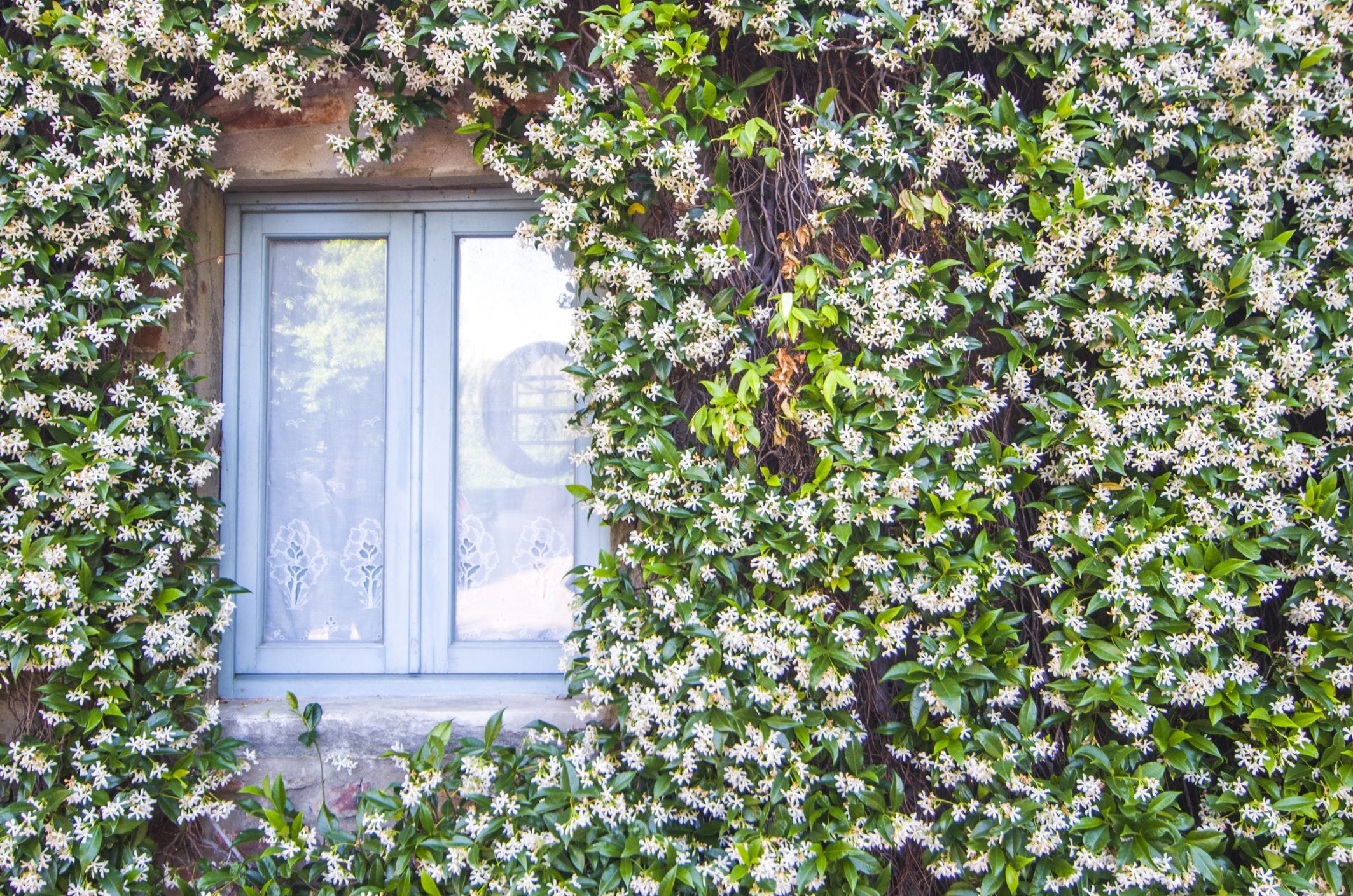
Heady explosions of white and green surround gardens and adorn terraces throughout Italy, spreading their sweet, fresh scent to anyone who passes by. Let’s talk about jasmine. Or maybe not? There is a big chance that what you have in your house or garden is actually the false jasmine (Trachelospermum jasminoides), a plant that resembles the jasmine (Jasminum officinale), but which in reality does not even belong to the same family. Beyond different flowering periods (jasmine lasts much longer), a careful eye can distinguish them from flowers and leaves, and a trained nose will pick up the more complex notes of jasmine, which distinguish it from the fresh and “clean” ones of Trachelospermumand which made him the protagonist of famous perfumes like Chanel n°5. Very widespread, false jasmine is reputed to be toxicbut in reality it is less so than other plants, such as wisteria, and only if they are ingested large quantities of leaves or flowers. However, if cut, it produces a white latex that can give skin irritations.
Different families and flowering periods
Despite the similarity, the two plants they are not even distant relatives. False jasmine, also called Rincospermo, is a climbing plant of the jasmine family Apocynaceaewhich also includes oleander, a plant that we often find along the edges of roads and highways; while true jasmine belongs to the genus Jasminumfamily of Oleaceaethe same as the olive tree and the ash tree. Both originating from the Asian continent, they have adapted well to our climates. In particular, the Trachelospermum jasminoides tends to be more resistant to prolonged and intense cold compared to Jasmine and requires less attention: this is probably also why it is easier to find it in our gardens. Furthermore, false jasmine is evergreen, while the Jasminum it is either evergreen or semi-deciduousthat is, in too cold climates it loses its leaves in autumn and then puts them back in spring, while in temperate climates it keeps them all year round.
A first method to distinguish them is flowering period: False jasmine flowers from May to June. Officinal jasmine, on the other hand, cheers us up with the scent of its flowers from April until September. If you come across a flowering plant that looks like a jasmine on August 15th, then it will almost certainly be a Jasminum officinale.
The secret to recognizing them: observe leaves and flowers
If you want to impress with a botanical fun fact, demonstrating that you know how to recognize a false jasmine, here’s what you need to note. First, look the leaves. The shape is similar, both lanceolate, but those of the Trachelospermum they are more “shiny”, waxy and leathery. Jasmine, on the other hand, has more delicate and lighter leaves
Now let’s move on to the flowers. The first important thing to know is that there are some variations jasmine can have flowers yellow or pale pink: so, if you see a plant similar to jasmine, but with yellow flowers, you can already rule out that it is a Rhyncosperm, whose flowers can only be white! But the main difference lies in how petals grow: those of officinal jasmine have a shape tubular with open and soft petals, while false jasmine produces flowers a propellerwith petals slightly rolled inwards, and resemble a small star. Hence the English name “star jasmine”.
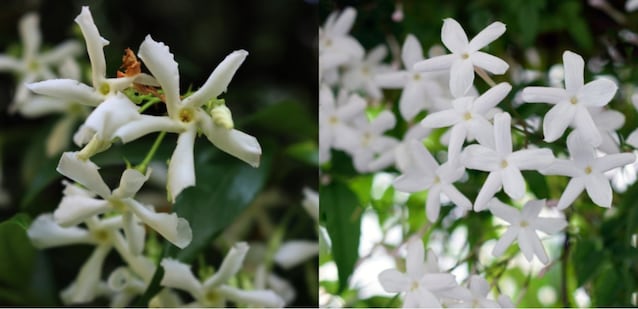
On the right, the flowers of the officinal jasmine, with a chalice shape and with petals arranged in a more regular manner
The chemistry of their perfume
Both exude an intense aroma, especially in the evening and early morning. Chemically, however, they are not identical. True jasmine contains aromatic molecules highly appreciated in perfumery, such as benzyl acetate, linalool and indole compounds which contribute to its more sensual and enveloping note. False jasmine, on the other hand, has an aromatic profile perceived as cleaner and greener: A 2017 study using gas chromatography mass (GC-MS) highlighted that its scent lacks the strong indole note typical of many Jasminum.
False jasmine has low toxicity
False jasmine is often listed as a toxic plant, as reported by Acta Plantarum and many blogs and magazines. Its toxicity, however, is not as high as that of other plants that you can find in the garden, for example wisteria: the Irish National Poison Information Center includes it, in fact, in the list of plants mild toxicity and what they could cause gastric disorders if ingested in large quantities. In short, no Rincospermo salad!
However, special attention should be paid to white latex that comes out if you cut a branch of Trachelospermum jasminoidesa typical characteristic of Apocynaceaewhich is instead lacking in officinal jasmine. Latex, for plants, is a defense mechanism to prevent the “wound” from becoming infected and to speed up “healing”. Although there is no specific clinical data for false jasmine, the latex produced may result irritating to the skin in sensitive subjects, as happens for many species of the same family.
And our four-legged friends? We shouldn’t be particularly alarmed. We have seen that, although there are few specific studies for this species, it is considered a plant low toxicity and in general also associations such as the American Society for the Prevention of Cruelty to Animals consider it non-toxic for animals. Obviously, when in doubt, always contact your trusted veterinarian.
Despite this, the whole plant is attracting research attention due to the presence of some compounds (lignans, triterpenes, flavonoids and alkaloids) which have shown anti-inflammatory and antioxidant action. In traditional Chinese medicine it is used precisely thanks to these activities, but it is important to distinguish between traditional use and modern clinical validation: many activities have been observed in vitro or in animal models, while clinical evidence in humans is still limited.
Sources:
Acta Plantarum Trachelospermum jasminoides Acta Plantarum Jasminum officinale Britannica Jasmine Plant Ayyaswamy, P., Thamaraiselvi, S., Ganga, M., Sharathkumar, M. Unlocking Jasmine’s aromatic potential: Advances in breeding, genomics, and molecular insights into fragrance biosynthesis. Scientia Horticulturae. 2026 Freitas CDT, Demarco D, Oliveira JS, Ramos MV. Review: Laticifer as a plant defense mechanism. Plant Sci. 2024 Zhao Z, He X, Zhao Y, et al. Phytochemistry, Pharmacology and Traditional Uses of Plants from the Genus Trachelospermum L. Molecules. 2017 Schuhfried E, Biasioli F, Mark TD, et al. Withering of plucked Trachelospermum jasminoides (star jasmine) flowers – Time-dependent volatile compound profile obtained with SPME/GC–MS and proton transfer reaction-mass spectrometry (PTR-MS). Postharvest Biol Technol. 2017 National Poison Information Center of Ireland American Society for the Prevention of Cruelty to Animals
