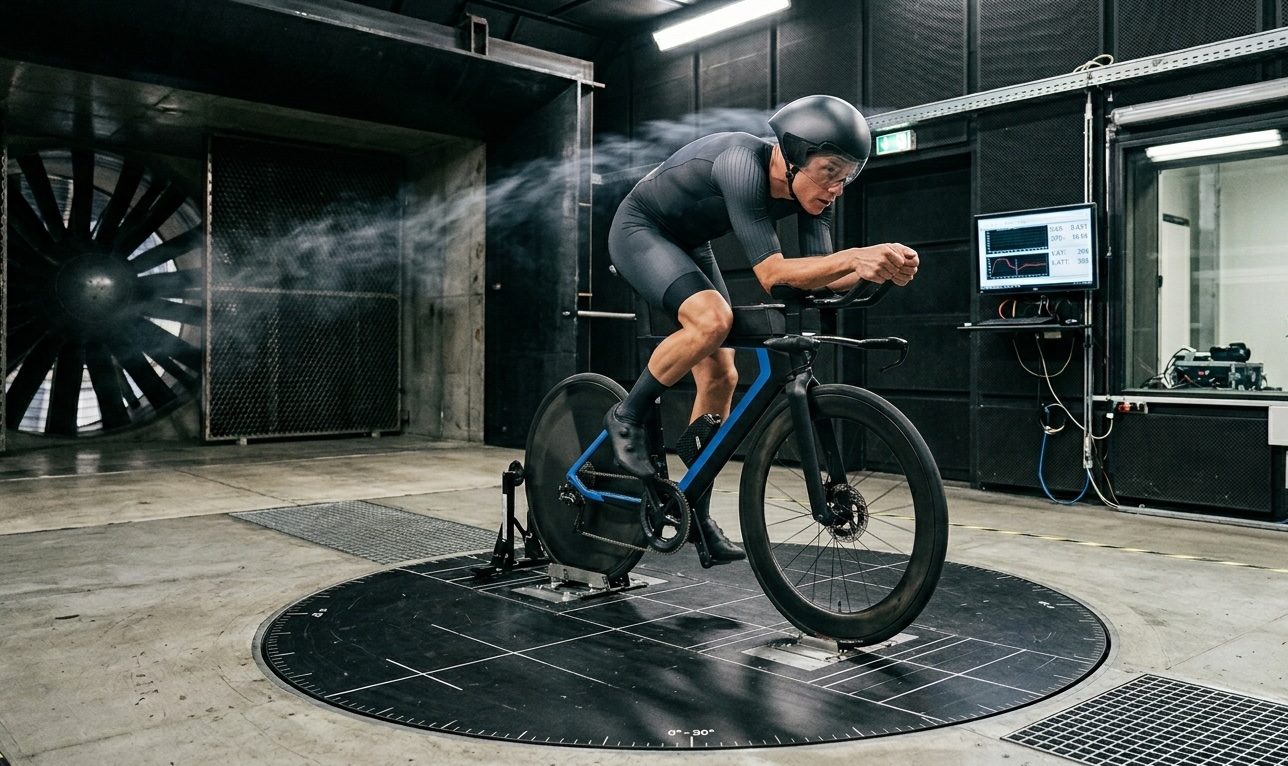
In modern cycling, average speeds above 45 km/h on the plains they are now normal. Paris-Roubaix 2026, for example, was the fastest ever, with 258 km routes at an average of 48.91 km/h. At that speed, a good part of the energy expended by cyclists is not used to move their legs, nor to overcome gravity: it is all invested in “breaking” the air. This is the fundamental problem of aerodynamics in cycling, a discipline in which physics is often more important than muscular power. It is no coincidence that professionals spend hours in the wind tunnel to refine even the smallest detail of their riding position, or that teams have engineers on their staff dedicated just to this.
But what exactly happens when a cyclist moves through the air? And why can posture make a difference?
The invisible force that stops every cyclist: aerodynamic resistance
When an object moves in the air, it opposes resistance: it is the so-called drag forceor aerodynamic drag. It arises from a difference in pressure: a high pressure area is created in front of the cyclist (the air is “compressed”), while a low pressure area is formed behind, a sort of vacuum that tends to suck the cyclist backwards. The sum of these two forces generates the so-called aerodynamic brake.
The most important feature is that this resistance does not grow linearly with speed: it grows with the square of speed. Translated into simple words: if the speed doubles, the air resistance does not double, but quadruples. This means that at the pace of the Roubaix won by Wout Van Aert in April, aerodynamics becomes a dominant factor, clearly more important than the mechanical friction of the chain or the weight of the bike.
Body position: the most important parameter
If the cyclist’s body is the primary source of resistance, responsible for approximately the 60-70% of the resistance total aerodynamics of the bike+athlete system, then changing the position in which you sit on the saddle becomes the most powerful lever for improving performance. Go through one upright position (hands on the handlebars, back high) to one lowered positionwith your hands on the bottom of the handlebars of the racing bike and your arms bent, you can reduce the air resistance of even 20%. A huge gain, obtained simply by changing how you sit. But the most striking result concerns the stopwatch position: the one in which the cyclist is stretched out almost forwards, with his arms resting on special extensions that allow him to tighten his elbows and lower his torso. In this configuration, the reduction in resistance compared to the standing position can be up to 35%.
To understand what this means in practical terms: optimizing the position of the arms alone in a 40 km time trial covered at an average speed of 50 km/h can save about a minute and a halfwithout expressing an extra watt of power on the pedals.
The wind tunnel: the secret laboratory of cycling
How do you study and measure all this? The main tool is the wind tunnela structure in which large fans push air at a controlled speed over a stationary object (or athlete). The physical principle that makes this simulation possible is the so-called principle of reciprocity: the aerodynamic forces are the same both when the body moves in still air and when the air moves around a stationary body. The wind tunnel exploits this principle, allowing you to comfortably and safely study scenarios that would be too complex to control on the road.
In the case of cycling, the athlete is placed riding his bike on precision scales that measure the force that the air exerts on him. By changing your position, clothing or bike components, changes in aerodynamic drag can be quantified with great precision.
Staying in the group: the racing tactic that has roots in physics
However, aerodynamics does not only concern individual athletes, but also profoundly influences race tactics. When a cyclist pedals immediately behind another, they enter their wake, an area where the air has already been disturbed by those in front, and benefit from a drastic reduction in aerodynamic drag. The cyclist who follows immediately behind saves up to 25-30% of energy compared to when he pedals with the wind in his face. But the truly surprising fact concerns those who find themselves in the “belly” of the group, that is, surrounded by dozens of cyclists on all sides. Here the advantage is enormously greater, because the cyclist faces only 5-10% of the resistance encountered by those in the lead who “pull” the group.
To put the idea concretely: in a group traveling at 50 km/h, the effort of those in the center is equivalent to what it would take to pedal at just 15 km/h alone. The explanation lies in the “depression” of air generated by the athletes at the head and on the sides: those in the center of the platoon are literally dragged and sucked in by the movement of the group.
This explains a phenomenon that those who watch cycling know well: solitary escapes or those of a few runners on the flats rarely manage to reach the end. The fugitive, alone, must expend all his energy against the air, while the platoon behind him, with several cyclists taking turns pulling the group, can maintain very high speeds with much less individual effort.
Helmet, suit and bike: the details that make the difference
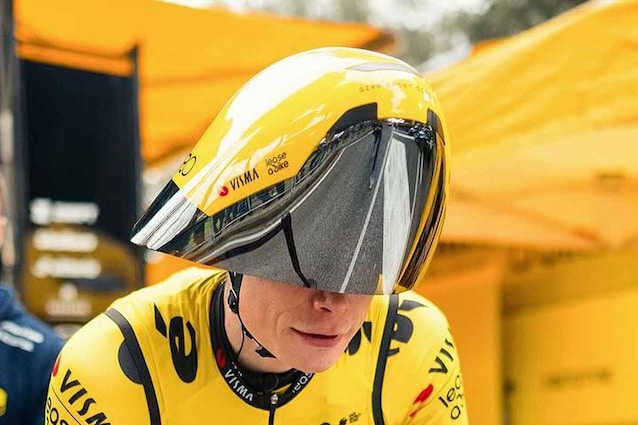
The riding position is the main factor, but not the only one. Each element of the bike+cyclist system contributes to the final result. THE aerodynamic helmets They have a smooth, elongated outer surface that guides airflow more neatly, reducing turbulence. Traditional helmets, with open vents to ventilate the head, are less aerodynamic because they literally “capture” air, increasing resistance.
Technical suits instead exploit a principle counterintuitive: a smoother surface is not always faster. The texture of the fabric can influence how the layer of air forms near the body, reducing turbulence. This is why the aerodynamic suits developed in recent years have a clearly visible pattern made up of many raised lines, parallel to each other. It’s the same principle that makes dimpled golf balls faster than smooth ones.
On the bicycle side, modern racing frames have tube sections designed to cut through the air better than a traditional round tube.
However, despite all these technological advances, the bike remains responsible for only 30-40% of the total resistance: the cyclist it is and remains the decisive component.
However, there is one aspect that makes everything more complicated: the most aerodynamic position is not always the one that allows you to pedal with the most power. The time trial position, for example, constrains the pelvis and legs differently than the standard riding position, making more difficult for muscles to develop maximum strength.
To find their sweet spot, athletes use pedal-mounted power meters combined with wind tunnel sessions: this way they can precisely quantify how much they earn in aerodynamics and how much I forgive in power for each variation in posture.
