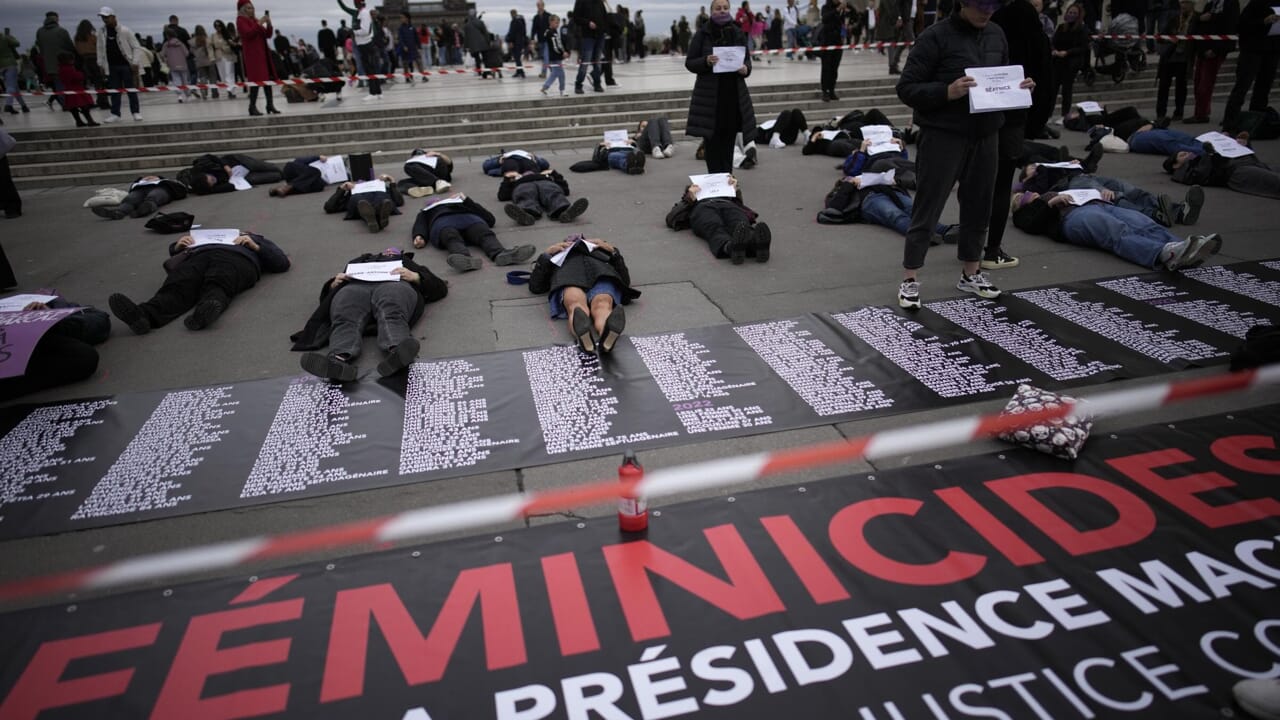
Every year more than a thousand women are killed in the European Union, in most cases by a partner or family member. And despite the measures adopted in recent years to combat gender violence, the phenomenon does not seem to be decreasing, on the contrary.
To combat this massacre, Italy approved last November 25, the international day against violence against women, a law that introduces femicide as an autonomous legal case in the penal code. The law has been criticized from many quarters and, especially online, the thesis has circulated that our country is the only one in the EU to have introduced this specific crime, almost as if to suggest a national anomaly.
On the merits of the law, the most widespread criticism among jurists is that the new rule was essentially superfluous. The first statement is false: several countries before us had already introduced femicide into the penal code. The second would be denied by various experts and studies. The European Parliament itself has asked the Commission to recognize femicide as an independent crime at EU level, arguing that a shared legal definition would improve regulatory clarity, comparability of data and the effectiveness of prevention measures.
The numbers
The United Nations estimates that in 2024, approximately fifty thousand women and girls around the world have lost their lives at the hands of an intimate partner or family member. In Europe the rate is 0.5 victims per one hundred thousand inhabitants per year, a figure lower than that of Africa (3 per one hundred thousand) or the Americas (1.5), but still worrying. In 2023, the most recent year for which aggregate data is available, there were 1,432 murders of women in the 24 Member States that provide data to Eurostat.
Germany, France and Poland lead the list in absolute terms, but the situation is especially serious in Italy, with 118 cases, practically one woman killed every three days.
The term femicide indicates the intentional killing of a woman “for misogynistic or gender reasons”, according to the definition adopted by the United Nations Office on Drugs and Crime. Despite its consolidated use at an international level, the term still encounters resistance in being integrated into the official legal terminology of many countries.
At European level, violence against women is already regulated by existing rules, but none of them recognize femicide as a distinct case. The 2024 EU directive on combating violence against women includes important measures, including individual risk assessment, emergency protection orders and specialized support services, but does not name femicide as a specific crime.
Because a specific law
As an analysis by the European Parliamentary Research Service recognises, the legal recognition of femicide is not just a symbolic issue. Having a dedicated rule would produce concrete effects on at least three levels: data collection, prevention and judicial treatment of cases. On a statistical level there is currently great fragmentation.
In 2024, only seventeen Member States provided data on femicide by partners or family members to Eurostat, while twenty-four reported data on homicides disaggregated by the sex of the victim. In the absence of a common definition, collection criteria vary from country to country, making reliable comparison impossible and hindering the evaluation of the effectiveness of each country’s policies.
A 2025 European Institute for Gender Equality study warned that data based on family relationships alone “understates the true scale of femicide, hiding gender-based killings outside of these relationships.” In terms of prevention, a specific law on femicide would oblige institutions to equip themselves with dedicated tools: registers of protection orders, specialized training for the police and judiciary, permanent observers, annual reports on the causes and effects of the phenomenon.
This is the approach adopted, for example, by Belgium, which in 2023 approved a law on femicide without amending the penal code, focusing instead on prevention, data collection and scientific research, and establishing a permanent scientific committee for the analysis of cases. On a judicial level, introducing femicide as an aggravating circumstance or as an independent crime allows the courts to impose more severe sentences and to correctly characterize the nature of the crime.
The European framework
As a study by the European Parliament reports, several member states approved laws on femicide before Italy, with very different legislative solutions. Malta was among the first, in June 2022, to recognize femicide as an aggravating circumstance of murder. The amendment to the penal code, approved unanimously by Parliament, requires the courts to ascertain whether the murder of a woman presents the characteristics of feminicide, including violence by a partner, misogynistic motivations, reasons linked to the victim’s honor or sexual orientation.
Cyprus, again in 2022, has chosen a clearer path: femicide has become an independent crime, punishable by life imprisonment. The law includes as aggravating circumstances intimate partner violence, torture for misogynistic reasons, violence for reasons of honor or gender identity.
Belgium has adopted a different approach in 2023, not punitive but monitoring the situation. The Belgian law does not intervene on the penal code, but establishes a structured system of prevention, data collection and scientific research. Distinguishes between intimate femicide (committed by a partner or family member), non-intimate (linked to sexual violence, trafficking or power relations) and indirect (unintentional death resulting from harmful practices). A scientific committee is responsible for analyzing the cases and the Belgian Institute for Equality between Women and Men must publish statistical reports every year and studies on the causes and effects of the phenomenon every two years.
Croatia, in March 2024, introduced the crime of “gender homicide” into the penal code, with minimum sentences of ten years, while Italy followed in 2025. The new article 577-bis of the penal code defines femicide as the murder of a woman committed as an act of hatred, discrimination or abuse of power, as an act of control or possession, in connection with the victim’s refusal to establish or maintain an emotional relationship, or as an act that limits her freedom individual.
Romania legislated in March 2026, with a law that does not create an independent crime but extends the scope of aggravated murder, already sanctioned more severely, to murders motivated by control over the victim, gender discrimination or the woman’s refusal to enter or remain in a relationship. It also provides for harsher penalties for non-lethal violence, threats and harassment in the same circumstances, and introduces prevention measures, data collection and equality education in schools.
Spain has instead limited the intervention to the sexual sphere: the 2022 organic law on sexual freedom introduced the crime of “sexual femicide”, referring to the murder of a woman connected to acts of sexual violence defined by the same law.
The roots of the problem
Understanding the causes of feminicide is essential to prevent it. According to a recommendation from the United Nations Committee on the Elimination of Discrimination against Women, gender-related factors leading to femicide include “the ideology that men have rights and privileges over women, social norms relating to masculinity, and the need to assert male control or power, to enforce gender roles, or to prevent, discourage or punish what is considered unacceptable female behavior.”
The European Parliament study recalls a model developed by the World Health Organization which analyzes risk factors on four levels: individual, family, community and structural. At the individual level, factors associated with the commission of crime include unemployment, alcohol and drug abuse, controlling behavior and jealousy. Among the vulnerability factors for victims are economic dependence on the partner, pregnancy and a low level of education.
At a structural level, what counts is social tolerance towards domestic violence, the lack of protection structures and impunity for crimes of violence within the family.
Scientific research identifies three recurring profiles of perpetrators: people with serious psychiatric disorders, individuals with a history of violence and, in the most widespread profile, “socially conventional men whose violence is driven primarily by attitudes of control, jealousy or patriarchy”. A fact that resizes the idea of feminicide as an extreme and anomalous case, and instead traces it back to much more ordinary cultural and relational dynamics.
The position of the European Parliament
In its resolution of November 2025, the European Parliament called on the Commission to recognize femicide as “a distinct and autonomous crime”, underlining that understanding the phenomenon as “the killing of a woman or girl because of her gender” is crucial to addressing its root causes related to discrimination and power imbalances.
It also called for improved data collection on the prevention, prosecution and punishment of gender-based violence, including femicide. In a recommendation to the Council in February 2026, the assembly reiterated that femicide “represents a serious violation of universal fundamental rights” and called for its global recognition.
