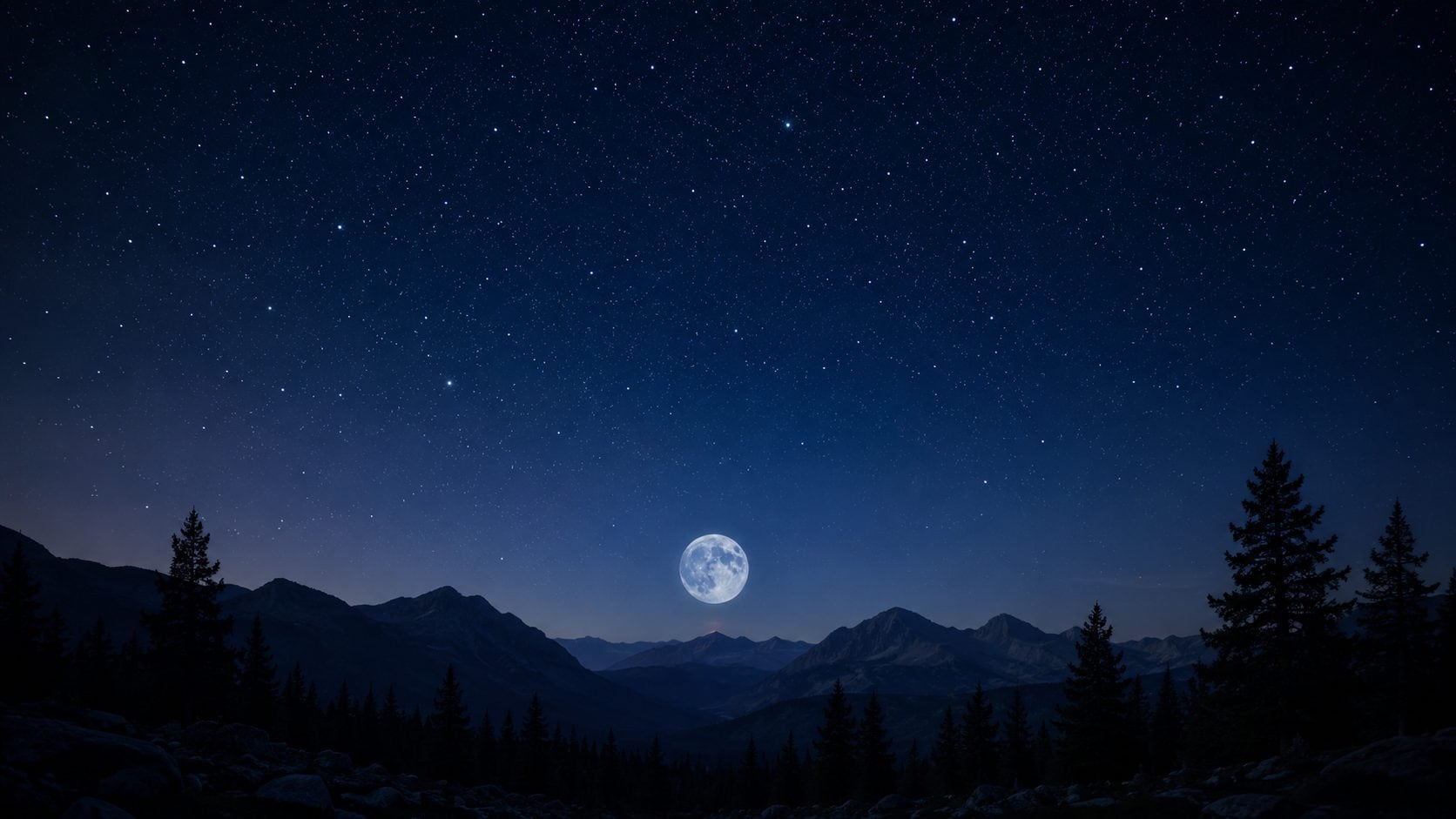
The month of May ends with a somewhat astronomical event rareone “Blue Micromoon”. Contrary to what the name suggests, our natural satellite it will not be dyed this shade. The term “blue” Moon, of Anglo-Saxon derivation, refers in fact to the second full Moon which happens in a month solar. Among other things, contrary to what some media reported, it is not correct define this event “mini moon” since, in astronomy, a mini moon is a small one natural satellite which is temporarily captured by the orbit of another celestial body.
In May this event will happen Sunday 31stwhen the Full Moon phase will be reached at 10:45 Italian time. To make this (already rare) event even more special, the orbital position of the Moon during its full phase: our satellite will in fact be near the furthest point of its orbit from Earth, causing the Moon to appear between the 5.9 and 6.9% smaller of a normal full Moon and well the 30% dimmer than a “supermoon” which instead occurs when the full Moon occurs at perigee. The event is observable with the naked eye from all over Italy, but unless you compare photos of the Moon taken at different times but in the same phase, it will be very difficult to notice the difference with a normal full Moon with the naked eye.
What is a micromoon, the smallest of the year
Although we are used to associating a full Moon with each month, the lunar month does not coincide exactly with the solar month: the first has an average duration of 29.5 dayswhile the second of 30/31 days. Every 2 or 3 yearslast time in the summer of 2023, there is a time window in which it is possible to have two full Moons in a single month. In May, the first full Moon occurred on the first of the month, while the second, the “blue” Moon, will occur Sunday 31 May, at 10:45 Italian time to be precise. As anticipated, “Blue” moon has nothing to do with coloring of our satellite which will appear in its usual color. The term is of Anglo-Saxon derivation and given the rarity of the event it gave rise to the expression “once in a blue moon” which indicates an event that occurs very rarely, a bit like our way of saying “every death of a pope”.
The already rare event will combine with a second particular orbital configuration. The second full Moon of the month of May will in fact occur when our natural satellite will be in furthest point of its orbit elliptical around the Earth (apogee). To be precise, the Moon will reach the maximum distance from Earth the June 1st at 6:32 amlocated approximately 406,366 km from our planet.
This event is known by the journalistic term of “Micromoon” and, as mentioned, it is not correct call this configuration “mini moon” since this expression refers to a small natural satellite (even an asteroid) temporarily orbiting another celestial body.
There “Micromoon”is opposite to “Supermoon” which instead occurs when the Moon enters its full phase at closest approach to the Earth. The Earth-Moon distance will cause the “Blue Micromoon” to appear between 5.9 and 6.9% smaller of a normal full Moon and the 30% dimmer than a “Supermoon”. It’s about little significant differences if you observe to the naked eyebut which can instead be appreciated by taking photos of our satellite in the same phase, perhaps with another object in perspective to realize the variation in relative dimensions.
When and how to observe the full moon in May
There “Blue Micromoon” it is nothing more than one Full moon in an orbital configuration rarerso it can be observed with the naked eye from any part of Italy like any other full moon. The totality phase will be reached at 10:45 Italian timewhen the Moon will have already set for a few hours. To be able to observe it in all its splendor we will therefore have to wait for thelunar dawn scheduled for 9.17pm. At that time the Moon will rise oversouth-east horizon escorted by the star Antares in the constellation of Scorpius. The best time to carry out the observation is in proximity of sunrise and lunar sunset (around 5 o’clock) since the low height from the horizon gives the Moon a reddish totality due to the refraction of the blue component of light in the atmosphere. The Moon will appear anyway how full for about three days, so there will be a way to appreciate the celestial event.
