The Musée d’Orsay in Paris, which houses the world’s largest collection of impressionist and post-impressionist art, has inaugurated a new room dedicated to works of art stolen by the Nazis during World War II and never claimed. And there are so many of them: this is because during the Second World War, for all the years in which the Nazi party was in power in Germany, they were perpetrated in all the countries of Europe the so-called “Nazi spoliations”, that is, the systematic theft of works of art. In rotation, the museum will display the 225 works it holds as part of the exhibition “Who do these works belong to?”.
According to the Jewish Claims Conference, the Nazis seized approx 650,000 works of art and religious objects belonging to Jews and other victims. Of these, more than 30,000 works are still missing: some may have been destroyed, others just hidden. Among the works never found again there are some very precious ones: Italy, for example, has yet to recover over a thousand works of art from Germany, including paintings by Michelangelo, Perugino, Marco Ricci, Titian, Raphael, Canaletto, Greek and Roman sculptures, violins by Stradivari, furniture, manuscripts.
The history of the “Monuments Men and Women”
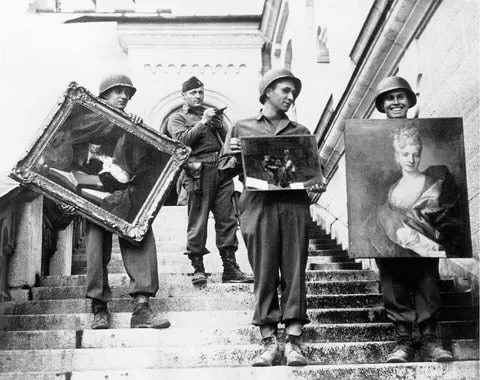
The allied forces attempted to oppose the systematic theft of works of art: in particular, there was a group of around 345 men and women of 13 different nationalities, mostly intellectuals or artists recruited from museum directors, librarians, art scholars and architects, who were part of the Monuments, Fine Arts, and Archives program (whose exploits inspired the 2014 film Monuments Men). These “agents” recovered many European art treasures stolen by the Nazis during World War II.
Among the works they managed to save is the famous painting In the greenhouse Of Édouard Manetwhich depicts a woman with a blue dress and an umbrella closed in her lap, relaxing on a bench in a park, a very famous Self-portrait Of Rembrandt, the portrait of Doctor Paul Gachet by Vincent van GoghAnd The art of painting Of Jan Vermeera work purchased personally by Adolf Hitler in 1940 and recovered by the Allied forces in 1945.
The gallery of works stolen by the Nazis at the Musée d’Orsay
France, for its part, did a great job in the years following the war to track down the owners of the works collected by the Nazis on its territory. According to a report published by a working group established by the French government in 1997around 100 thousand works of art were looted during the war in France alone: around 60 thousand of these were recovered in Germany and Austria at the end of the war, and three quarters were returned to their legitimate owners (or their descendants); around 15 thousand works have never been returned because the identity of the original owners and heirs could not be ascertained.
The gallery of the French museum now hosts an exhibition entitled “Who do these works belong to?”: will present a rotating selection of the 225 works currently held by the museum. Twelve paintings and one sculpture are currently on display, including a work by Edgar Degas, and the museum has commissioned a team of researchers specializing in the provenance of artworks to reconstruct history of these unclaimed works, with the aim of being able to return to the rightful owners.
The new hall of the Musée d’Orsay is conceived as an exhibition space dynamic and not permanentdesigned to highlight a selection of works currently classified as unattributed or awaiting return. The exhibition does not follow a chronological or stylistic logic, but one documentary structure: each work is presented as an individual case, accompanied by information on its known provenance, gaps in its history and any attempts to identify the owners. In fact, the objective is not only expository, but also informative, with digital and archival media that allow access to additional information on the provenance of the works, on known changes in ownership and on data still missing, with continuous updating of the information, in line with the idea that the collection is not static but subject to revisions as new evidence emerges, open to possible future developments.
