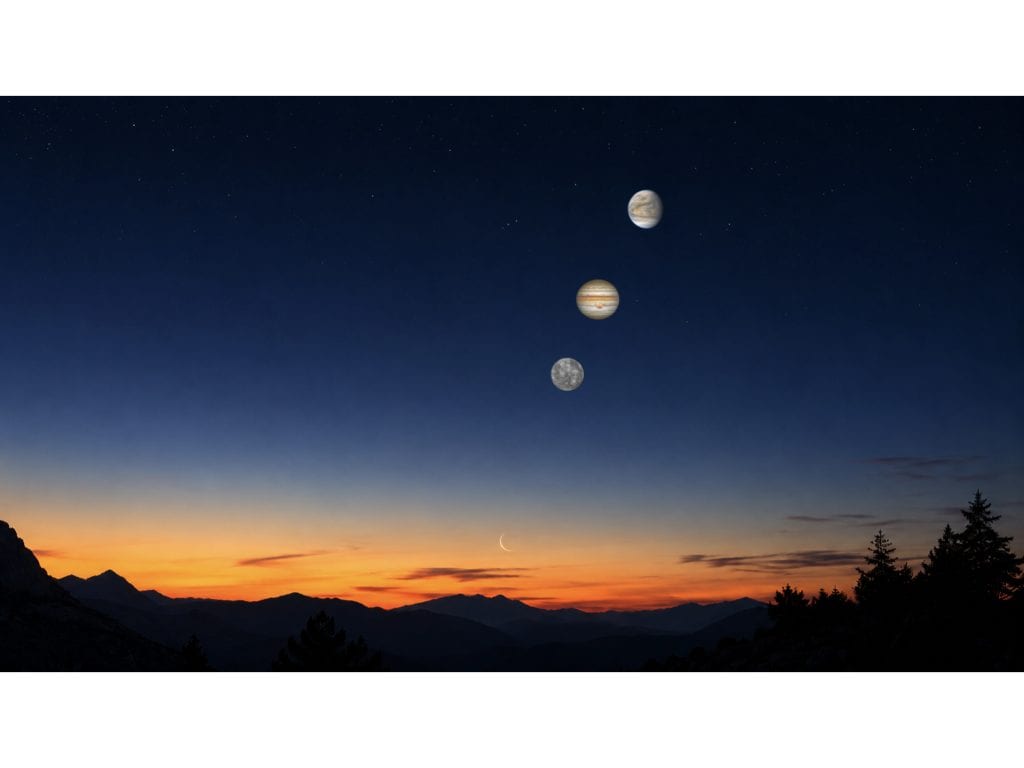
Summer will open with a month full of astronomical events not to be missed, all observable with the naked eye from any part of Italy. It starts with “heavenly kiss” among the brightest planets in the sky, Venus and Jupiter, shortly after sunset on June 9th. Then follows in the middle of the month a planetary alignment which involves the two aforementioned stars and the planet Mercury, with the best visibility expected for June 15th when Mercury will be at its maximum elongation from the Sun. We then continue with the summer solstice The June 21st which marks the beginning of this season in the Northern Hemisphere to end with the “Strawberry micromoon” of June 30th, without forgetting the meteor showers of Tau Hercolides and of June bootids active for almost the entire month.
The celestial kiss between Venus and Jupiter on June 9th
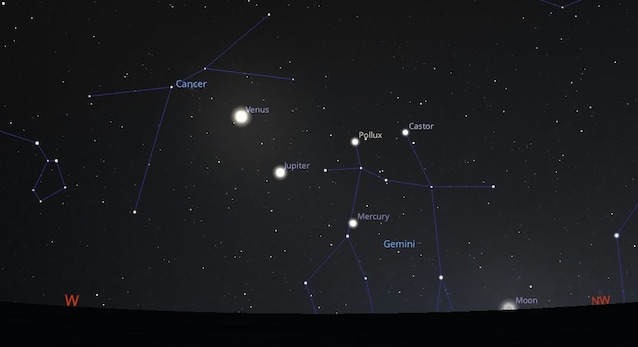
For much of June, the two brightest planets in the sky Venus and Jupiter they will accompany each other in one celestial dance shortly after the sunset of the Sun. The two stars will reach the minimum angular distance on June 9thideally joining in a “heavenly kiss” to one distance of just over one degree. To keep them company on their right there will also be the stars Castor and Pollux of the constellation Gemini. The June 9th the Sun will set at 8.44pm from the coordinates of Rome and given the brightness of the two stars, Venus and Jupiter will be almost immediately visible to the naked eye in west direction to one height of approximately 27/28 degrees. The event will end with sunset of the two stars between 10.30pm and 11pm.
The alignment of planets in mid-June
Venus and Jupiter will not be alone in the June sky. A third wheel it will join the two bright stars shortly after sunset. We’re talking about the planet Mercurywhich will give life with Venus and Jupiter to a planetary alignment around the middle of the month. The event it is not easy to observe since Mercury, due to its position as the closest body to the Sun, always has a fairly small angular distance from our star, which makes it most of the time bathed in the glow of sunset or sunrise. The best time to observe the alignment of this trio is therefore when Mercury is located at maximum angular distance from the Sunwhich will happen on the evening of June 15th. That day, the Sun will set at 8.46pm from the coordinates of Rome, offering a contemporary visibility window of the three stars on the west/southwest horizon of about two hours. Mercury will set at around 10.30pm, followed by Jupiter at 11pm and Venus at 11.20pm. A fourth inconvenience, a thin crescent moon, will keep the trio company at sunset on June 16th and 17th.
The “Strawberry Micromoon” of June 30th
The astronomical events of the month will close with the Full moon on June 30th. Our natural satellite will reach the 100% illumination phase at 1:56 a.m. on June 30. The Full Moon on June 30, 2026 will be one “Strawberry Micromoon”. The first term, of non-astronomical journalistic origin, refers to the fact that the full Moon in June will occur almost in conjunction with maximum distancing of the Moon from the Earth, which falls on June 28th at 9.10am in the morning when the distance between the two bodies will be approximately 406.265 km. The Moon will then appear smaller and dimmer than a normal full Moon. The term “strawberry”instead, refers to Native American traditionresulting from the relatively short strawberry picking season in the northeastern United States. Although the exact moment of the Full Moon technically lasts an instant, that is, when the Moon is directly opposite the Sun from the Earth, it is possible to observe the fully illuminated lunar disk either a day before or a day after.
The Tau Hercolids and Bootids meteor showers of June
Waiting for the big summer meteor showers like that of Perseids (“tears of San Lorenzo”), the month of May alone holds for us two minor meteor showers Class III. Let’s talk about swarms of Tau Hercolides and of June bootids. The first is the result of the debris left by the periodic comet 73P/Schwassmann-Wachmann, a comet which in 1995 during a very intense disruptive activity fragmented into five pieces. The Tau Hercolids are active from 19 May to 14 Junewith the peak expected around June 2 when approximately two meteors per hour can be spotted in the direction of the constellation Hercules. The June bootids they are active instead from June 11th to July 2ndwith the peak scheduled for June 21st. This shower is also not very active, with an hourly rate of meteors of about two at the shower’s maximum. The June Bootids are generated by the debris of comet 7P/Pons-Winnecke and despite their low activity they show a tendency to produce meteors with flares, i.e. with sudden increases in brightness.
The summer solstice on June 21st
We conclude the roundup of astronomical events for the month of June 2026 with the exact date and time of summer solstice. This year the astronomical event will fall Sunday 21 June, at 10.24am Italian time, marking the start of summer in the Northern Hemisphere.
