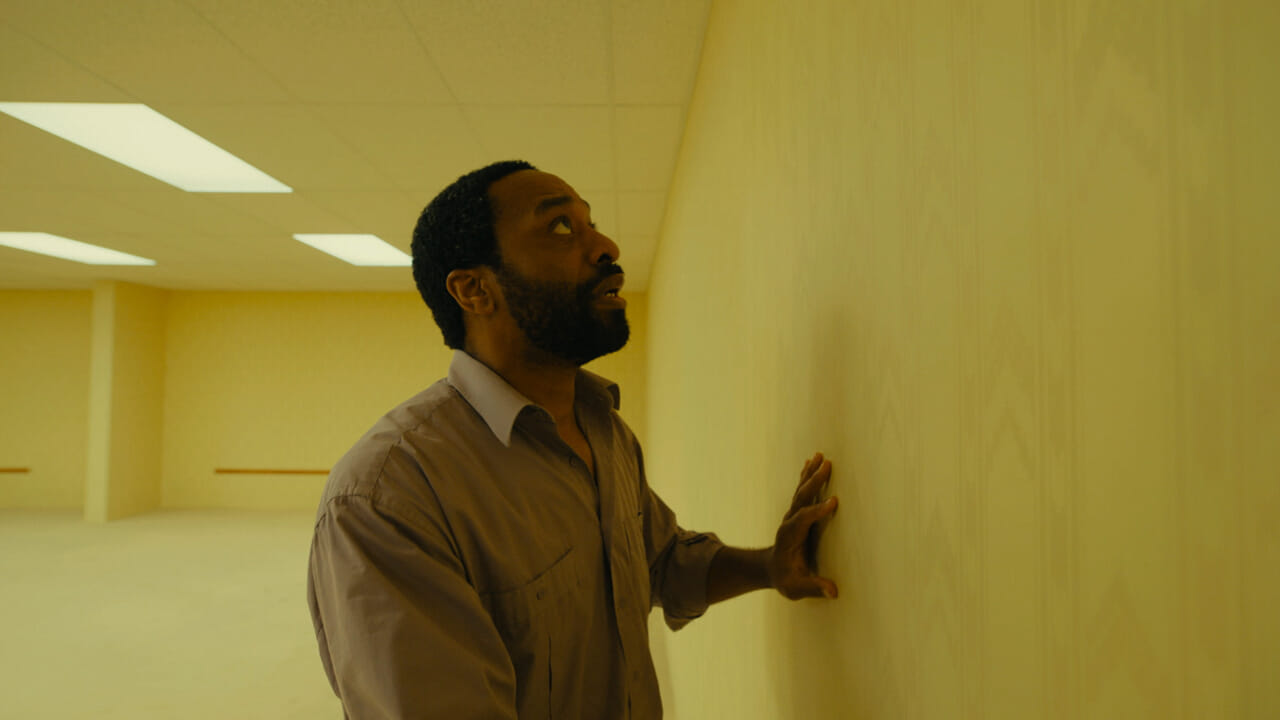
The mazes of “Backrooms” arrive at the cinema and are scary (even though they have a few too many directions)
To understand what “Backrooms” is, you must first understand what backrooms are. Imagine then the image of a corridor with carpet and yellow wallpaper that opens into an empty room with the same colors, then into yet another room, and then again and again and again. Something familiar but out of place, which repeats itself. Something known but not fully aligned with the expectation we have of that place.
Backrooms are the excellent and most paradigmatic example of the so-called “liminal spaces”, representation of large places used for the presence of people (such as offices or shopping centers) which however are dramatically devoid of them, creating a mental short circuit that causes an epidermal and spectral reaction. What’s wrong here? The phenomenon was born as a cyber-urban legend in online forums thanks to a photo published on 4chan in 2019 and which hypothesizes the existence of levels of reality hidden beneath our reality, becoming, not long after, a very famous series of paranormal-themed videos spread on YouTube by Kane Parsons, a teenager at the time.
And Parsons himself, just born in 2005, was then hired to make Backrooms, his debut and film adaptation (in cinemas from 27 May) with which to capture the original spirit of his series, and therefore of that subculture of horror myths proliferated on the internet.
What Backrooms is about
Backrooms – the film – is, in short, based on a codified and highly sophisticated imagery (which has grown and expanded over the years thanks to the contributions of entire online communities) which makes its aesthetics a very specific tool for arousing very specific sensations. Disorientation, nausea, terror. A world of nightmares and perditions already intuited in an embryonic way by the genius of David Lynch, who in his last film, Inland Empire in 2006, practically systematised the cinematic representation of the labyrinthine lands of the internet.
Because when we talk about backrooms we are basically talking about the internet. Of its infinite and cunicular vertigo, of a reality outside of reality, where you slide from page to page, from site to site, from virtual room to virtual room. It will have happened to you at least once that you click from item to item on Wikipedia, ending up from point A to point Z without realizing it, but above all with that irrepressible urge to want to go on and discover that similar but alien world at your fingertips. It’s the concept of the “rabbit hole”, the rabbit hole, which goes down, down and even further down.
A space into which Clark (Chiwetel Ejiofor), a failed and frustrated architect, owner of a furniture store submerged in debt, also trespasses. Tired of the constant power blackouts, he goes down to the basement and here he accidentally finds an invisible threshold in the wall. It is an entrance to an endless place that seems to resemble our world, but which, due to the way it is configured, does not follow any logical motivation. Which seems uninhabited, but ultimately isn’t really.
He talks about it to his therapist, Mary (Renate Reinsve, protagonist at Cannes 2026 with the Palme d’Or film Fjord and not her best performance here), a woman herself with an unresolved past, who at first doesn’t believe him before she too is sucked into it when Clark suddenly disappears.
An idea of rare charm, but with an unsophisticated interpretation
Parsons does his. With a similar setting (applause for the scenography) the disturbing atmosphere comes almost naturally, the disturbances of which the director knows how to describe well especially with wide and extended shots, working by contrast to amplify the nauseatingness of these claustrophobic rooms as much as possible, also recalling in short shots the ‘found footage’ feel characteristic of his videos on YouTube, made as if they were shot with old digital cameras.
However, the disorienting discharge ends up losing power when the need for a narrative framework is shouldered on the suggestion. There isn’t too much to navigate in the imagination as to why these two professions were chosen for the protagonists, the architect and the psychologist, around whom Will Soodik’s screenplay develops a metaphorical scaffolding that must be said is rather exposed, almost affected.
That the levels of the backrooms are the levels of the psyche, the subconscious into which we sink to face the distortions that are generated by the clash between what we are and how we imagine ourselves? You just need to put two and two together to understand what the film is getting at, where the aesthetic monotony of this place is translated into an exasperating ordinary that carries out the assault on reason, which disintegrates it at the moment in which the risks of blind adherence to a pre-established existence (study, find a secure job, settle down for life) explode in the instant in which its failure is realized.
The “noclip” – an expression of a videogame nature which indicates going off the rails of the game due to glitches or bugs not foreseen by the developers – of Clark and Mary becomes the synthesis of a mental and late-capitalist derailment without particular flashes, which leaves the film in a middle ground. The existence of this other place is not really contextualised, as it should be, although a very clear metaphorical motivation is assigned to it. Therefore depriving the possibility of getting to the bottom of the thrill that sprouts from the imponderable of aimless trajectories, but at the same time delivering, or rather imposing, a reading of events that is too obvious, sketchy and not fully satisfactory.
Nothing more and nothing less than the consequence of the passage into the hands of Hollywood (the rampant production and distribution house A24) of a strong and already solidified imagery, extracted at zero cost from its context of origin (and here we would have to discuss at this point whether the container, the internet, makes up a large part of the substance) and in fact regulated for a taste, the cinematographic one, which calls for clearer, more exact, narratively traceable definitions.
Where the mystery that hovers – the presence of the company A-Sync is also called into question, a company introduced in Parsons’ videos which is linked in some way to the existence of the backrooms – serves no purpose other than leaving open in a slightly too brazen way the possibility of future serial expansion. The idea is strong and of rare charm, but the specific merit of the film is rather relative.
Rating: 6
undefined
