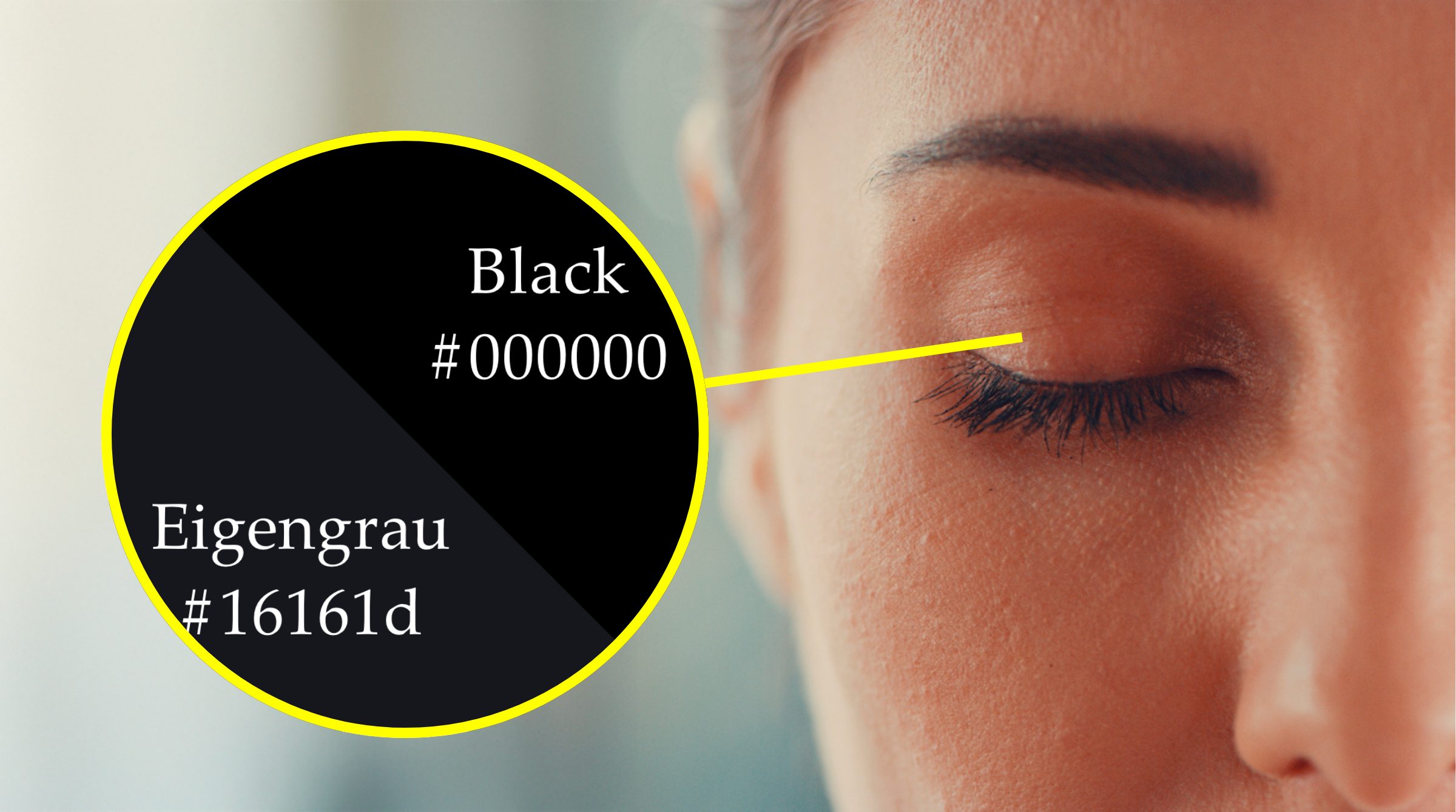
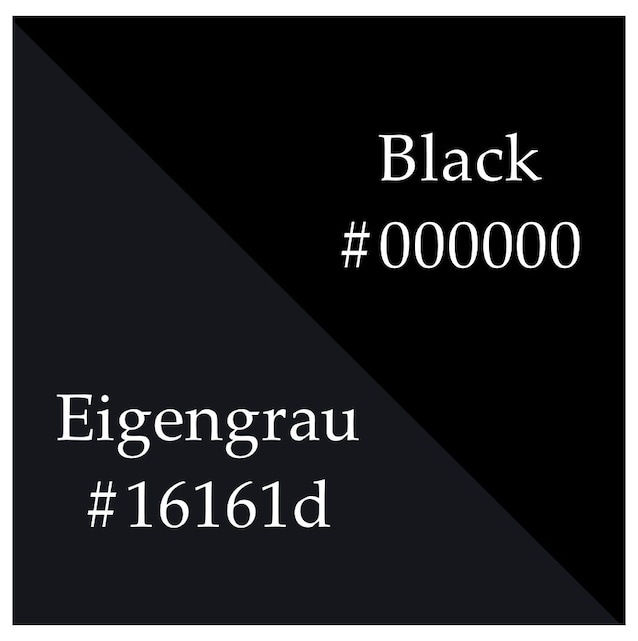
When we close our eyes, that “dark” we see is not black. It seems to be, but if you really pay attention what you perceive is a dusty dark greycrossed by small light dots that come and go. It even has a name, Eigengraua German term literally meaning “intrinsic grey“. It is the color that our visual system “manufactures” when it does not receive any light from the outside, and that is lighter than the black we see in bright light looking at a black object. The reason is that “true” black (hexadecimal code #000000) we perceive it by contrast with what surrounds it. In total darkness, without reference, the brain has no contrasts to be processed and gives us this slightly bluish grey, today conventionally associated in the digital world with the hexadecimal code #16161D. This is the result of thespontaneous activity of the retina and visual cortexor the background noise that the nervous system produces even when there is nothing to look at.
The term Eigengrau it was coined in the mid-19th century by the German psychologist and physicist Gustav Theodor Fechneramong the pioneers of psychophysics (the discipline that studies the mathematical relationship between physical stimuli and subjective perceptions). He described it in his Elements of Psychophysik of 1860. In English there is no equally effective translation and in scientific literature expressions such as visual noise (“visual noise”) o brain gray (“brain gray”). They all try to describe this visual perception that persists in the absence of a light stimulus.
There are two causes. The first is in the retina, where our photoreceptors (the cells that capture light) never turn off completely and continue to “download” electrical signals even in the dark. This phenomenon is called dark noisenoise in the dark, and is caused by simple human warmthwhich spontaneously activates some molecules of rhodopsinthe same ones that are activated when light arrives, a mechanism described already at the beginning of the nineties in a study published in Nature. This creates a constant false alarm which the brain still interprets as visual information.
The second cause is even more interesting and comes from visual cortexthe first area of the brain that processes what we see. A 2014 study published in PNAS by New York University and fromPeking Universityled by the neuroscientist Dajun Xingrecorded the activity of neurons in the visual cortex of macaque monkeys as they alternately looked at black squares and white squares. When the animal looked at the blackthe neurons continued to fire in the same way supported for the entire duration of the stimulus, while when he looked at the whiteafter an initial discharge the neurons were almost silenced by inhibitory circuits. In other words, for our brain the darkness is not “no signal”but a very specific state of neural activity, indeed louder of seeing a clear surface. According to the authors, at least part of theEigengrau it could derive precisely from this spontaneous activity.
Perception is not a simple photograph of the world, but one active construction of the brain, also made up of noise and spontaneous activity. When we close our eyes, therefore, we are not staring at “nothingness”: we are literally observing our brain at work.
Sources
Xing D., Yeh C.-I., Gordon J., Shapley RM – Cortical brightness adaptation when darkness and brightness produce different dynamical states in the visual cortex. PNAS, 2014 Fechner GT – Elemente der Psychophysik, Leipzig 1860 (Encyclopaedia Britannica) Oxford Reference – Eigengrau IFLScience – Eigengrau: the shade you see when you shut your eyes isn’t perfect black Barlow, R., Birge, R., Kaplan, E. et al. On the molecular origin of photoreceptor noise.
