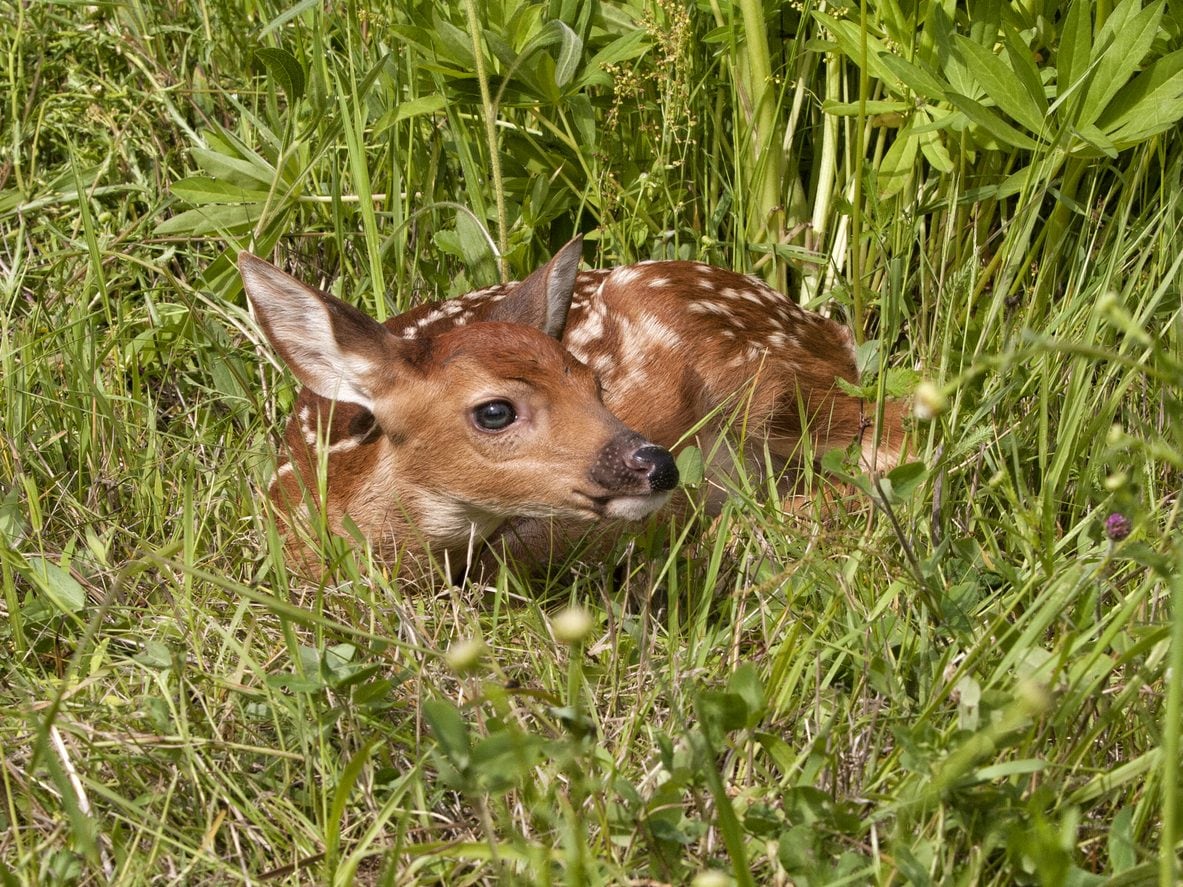
We are walking in the countryside and, in the middle of the tall grass, we notice a fawn crouched down and absolutely still: a real Bambi, so alone and so defenseless that we are immediately induced to approach to catch it and take it to safety. Nothing more wrong to do: his mother didn’t abandon him, but just moved away strategically. Several studies such as one published in Royal Society Open Science, confirm that our smell, transmitted when we touch them, could make vulnerable to predators as well as stressing him out. Hiding the puppy in a safe place and then walking away is a peculiar behavior of some species of mammals, especially ungulates which are very common in Europe, such as the red deer (Cervus elaphus) and roe deer (Capreolus capreolus) who, not having real dens in which to keep their puppies sheltered, adopt this strategy. Mothers clean them carefully as soon as they are born eliminate any odorthey hide them in the tall grass where they are very little noticed thanks to their camouflage coat and they move away for reduce the risk of predationreturning to them only to nurse them.
The human scent can attract predators to the puppy
Among the factors underlying good mimicry of cubs in Cervidae is the olfactory mimicrythat is, the almost total absence of odor. Human odor, on the other hand, is easily perceived by a predator that could get closer. Our smell could also stress both the babies and the mother upon her return and removing them from their refuge carries the risk that the mother will no longer be able to find them. For this reason, touch them or move them to a place considered safer based on human criteria can sentence them to death.
There is no scientific evidence to document voluntary abandonment of mothers of roe deer or fawns touched by humans, also because the abandonment of puppies generally occurs in rare cases and in conditions of high stress, but the disturbing factors related to our presence may be different. A roe deer stolen from its mother must be weaned in wildlife recovery centers and, often, once it becomes an adult it will not be able to integrate well with its peers. In general, the best way to help wild animals is to keep a safe distance from them and possibly report to the emergency number 112 only in any obvious dangerous situations.
Why mothers leave fawns hidden: the hider strategy
Deer and roe deer puppies, but also fallow deer puppies (Dama dama), moose (Alces alces) and other Cervidae, are extremely vulnerable to predators in the first weeks of life. The only strategy that allows its survival is a high degree of mimicry: coloration that blends in with the surrounding environment, ability to remain crouched and still for a long time without following the mother and, above all, almost total absence of odor. This strategy, widely known and also described by the World Union for Conservation of Nature, is called hiderthat is, “of the one who hides”: the mother just after giving birth, licks and cleans the little one thoroughlyeats its feces and urine to eliminate signs of presence and keeps away as much as possible in order to reduce any odorous trace around the offspring, precisely so as not to attract predators.
Fawns and young roe deer have not yet developed odor glands and have a slowed metabolism and breathing, precisely to reduce the emission of odors to a minimum. Some studies have even shown that mothers hide their puppies also taking into account the places and times in which the presence of predators is less likely. Mothers must select a habitat that simultaneously satisfies their own high energy requirement during breastfeeding and minimize the risk of predation for yourself and your offspring. The distance between mother and child increases day by day immediately after giving birth and up to the thirtieth day of life thereafter the rapprochement begins when the little one becomes more agile and autonomous.
In agricultural areas, the only major risk that puppies can run is that of being left in a cultivated field: in this case they could fall victim to the mowing machines used in agriculture. Mowing isin fact, as reported in a 2025 study, a major cause of fawn mortality in cultivated landscapes. For this reason, in areas where these ungulates are present, farmers are advised to use “scare bars”, i.e. mechanical devices mounted in front of the mower blade or electronic acoustic devices, which are used to raise and move away the little ones hidden in the tall grass.
