If Wi-Fi slows down for no apparent reason or unknown devices appear while sharing content, for example on Smart TV, there may be an intruder connected to our Wi-Fi network without authorization. Understanding this is important not only to prevent some neighbor from “stealing” our Internet connection by increasing the bandwidth – i.e. the maximum amount of data that can be transferred through a connection in a given period of time – but it can also affect our IT security. Unauthorized access to our home network could expose files, credentials, etc., to potential risks. In this study we will see how to identify any Wi-Fi intruders using both empirical and slightly more technical methods, and above all how to reduce the probability of this happening.
How to protect your home Wi-Fi
How to understand if there are intruders on your Wi-Fi and block them
A first check, within everyone’s reach, to understand if there are intruders on our Wi-Fi consists ofobserve the LEDs on the router. These lights reflect network activity on your device: a rapid, continuous flash suggests that data traffic is currently occurring. If we temporarily disconnected all the devices in the house and the router continued to show activity, we could assume the presence of external access. It must be said that this is a simple method to implement but it is far from “scientific”, given that many devices can generate traffic in the background without us realizing it.
For a more reliable verification it is necessary log in to the router administration paneli.e. the interface that allows you to manage the settings of your network. This step requires knowing therouter IP addresswhich represents the access point to its configuration. The most common addresses are 192.168.0.1, 192.168.1.1 or 192.168.1.254. Try inserting these “codes” one at a time into the address bar of the browser and press Sending on the keyboard. If one of these works, you should be able to see a screen asking you to access the router panel by entering username And password. At one time many manufacturers used torque admin And admin or admin And passwordbut since more and more providers use personalized usernames and passwords, we suggest you Check the label on the back of your router to know what data to enter in the fields in question. Clearly, if you have changed these settings using the router’s default username and password will not work.
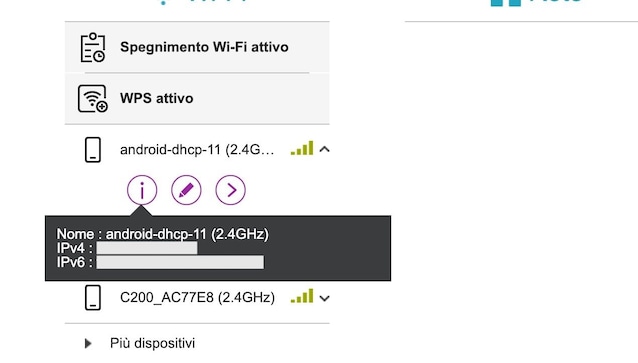
Once logged in to the panel, go to the section dedicated tolist of connected devices (its name varies depending on your provider and/or router in use) and check if this includes any that are unknown to you. If so, change your Wi-Fi password immediatelyso as to block it and lose access to the unauthorized device.
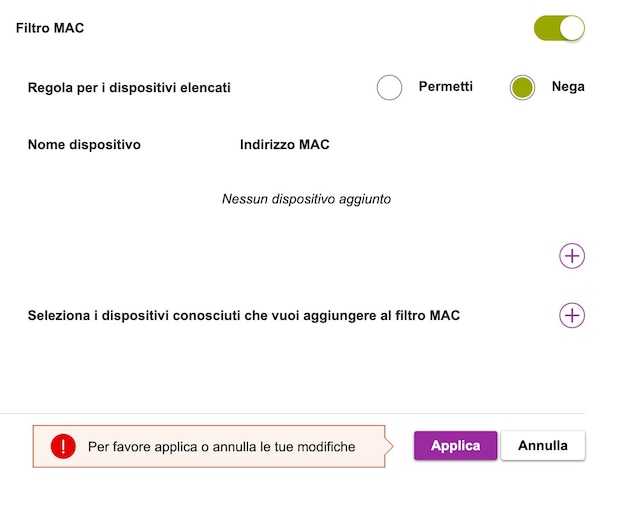
After that, you may decide to click on device name unknowngo to the section dedicated to MAC Address filteractivate it and specify one by one all the devices authorized to access the network by manually typing their address MAC (Media Access Control), a sort of identification “plate” made up of 12 digits, divided into pairs, which serves to uniquely identify each network card, be it Ethernet or wireless. Typing all these characters can be cumbersome, it’s true, but if you have detected an intruder in your Wi-Fi network, taking such a measure could be absolutely necessary.
5 tips to protect the internet from unwanted access
Once you understand how to monitor the network, it becomes essential to understand how to prevent unwanted access to your home Wi-Fi. Here you are 5 precautions to take into account.
Place the router in a central location in your home
There location of the router has a direct impact on signal propagation. Placing it in a central area of the home (in addition to improving the coverage of the Wi-Fi network in the home) reduces the dispersion of the signal towards the outside, limiting the area in which the signal is accessible to potential attackers. Radio waves, in fact, propagate in all directions and can overcome walls and obstacles, making the network visible even outside your home.
Use advanced security settings
Also use advanced security settings it is essential to avoid Wi-Fi intrusions. This practically translates into changing the Wi-Fi name and password set “by default” by choosing a complex access key, which is long, not based on personal data and also composed of special characters (e.g. !, ?, &, etc.). It is also important to activate the firewall from the router settings and the encryption. The firewall is a system that filters incoming and outgoing traffic, blocking suspicious connections. Wi-Fi encryption, on the other hand, protects transmitted data by making it readable only to authorized devices. The latest protocol is WPA3evolution of the previous WPA2, and introduces more robust algorithms for protecting communications. If your router only supports WPA2, you may want to consider a hardware upgrade.
Create a “Guest” network
A further measure consists in create a separate network for guests. This way we isolate external devices from the main network, reducing the risk of any vulnerabilities propagating. This approach is especially useful for devices IoT (Internet of Things), home automation ones so to speak, often less protected at a software level.
Use a secure VPN
Using a VPN safe (Virtual Private Network) adds an extra layer of privacy by masking your IP address and encrypting your traffic. Although its use is more relevant when connecting to unsecured networks, it can help strengthen overall security.
Disable remote access to the router
Finally, we also advise you to disable remote access to the routera function which, although useful in some contexts, can increase the attack surface. Also in this case, you can proceed with the modification by acting from the router settings panel.
