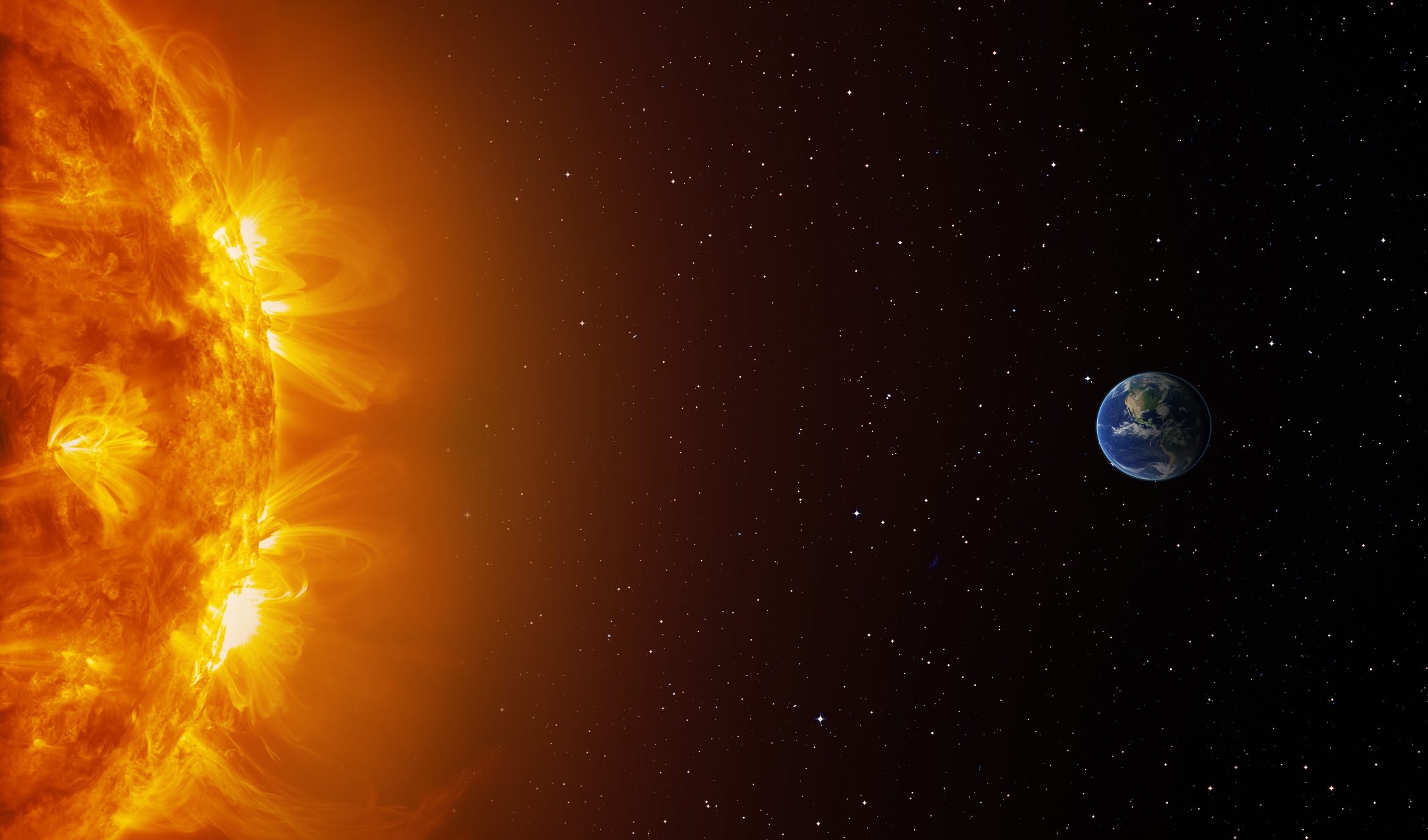
A category G3 geomagnetic stormclassified as “strong” (on a scale ranging from G1 to G5) could affect the Earth between today, June 4, and tomorrow, June 5, 2026. This is confirmed by NOAA’s Space Weather Prediction Center (National Oceanic and Atmospheric Administration) based on Three coronal mass ejections (CME, Coronal Mass Ejection) started from the sunspot region AR4455 last June 2nd.
At the moment, NOAA’s forecast models indicate the possibility that the three coronal ejections merge just before reaching Earth, with the last one, despite having started later, moving more rapidly: if this were the case, the combined arrival could give rise to what is called a “cannibal storm”.
Despite the classification as “strong”, however, there is no reason to be alarmed. The effects (such as possible disturbances to electrical networks or the operation of satellites) will most likely be limited and temporary, while the possibility of observing remains uncertain Northern Lights in our latitudes.
Predictions for this type of phenomenon, however, are quite complex and It is not certain that they will turn out to be correct: So we just have to wait and see if we’ll be lucky!
What caused the possible geomagnetic storm: NOAA forecasts
In recent days the region has been active AR4455a group of sunspots visible in the image below, it generated several solar flaresthat is, sudden releases of energy (previously stored in the magnetic field of the Sun) in the form of electromagnetic radiation.
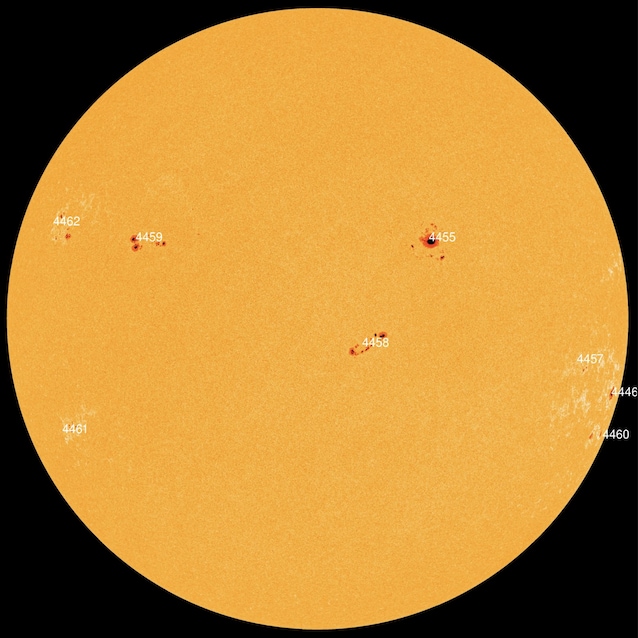
In particular, a flare of class X1.0 (the highest class), preceded by other flares of lesser intensity, of class M9.3 and M7.7. It was precisely these flares that produced three coronal mass ejectionsthat is, explosive expulsions of solar plasma (and its magnetic field) from the Sun.
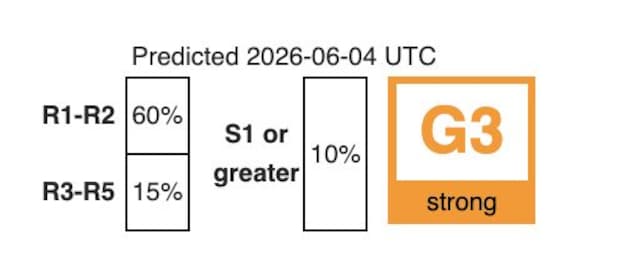
Based on all this data, NOAA then issued a warning for class G3 geomagnetic storm for the days of June 4th and 5th: according to the US Agency’s forecasts, the geomagnetic storm could arrive on Earth around 9:00 pm (Italian time) on June 4th.
Among other things, NOAA, in its bulletin, explicitly talks about a possible “combined arrival” of the three coronal mass ejections. This is precisely the scenario behind what is called “cannibal storm”: the latter, in fact, occurs when a CME, maybe left later, manages to reach one or more previous CMEs, ending up “to incorporate them”. In this way, the combined “force” of coronal ejections hits our planet, with the possibility of a more intense geomagnetic storm than would occur with a single CME.
It must be said, however, that “cannibalistic” storms they are not so rare during periods of maximum activity of the Sun.
What happens: possible risks and inconveniences
In general, however, there is nothing to worry about with this geomagnetic storm: despite being classified as “strong”, a G3 class event can cause limited and temporary effectssuch as possible disturbances to electrical networks, the operation of artificial satellites and high-frequency radio communications.
Looking in more detail at the NOAA forecasts, the possibility of minor or moderate radio blackouts (category R1 and R2) is 60%, while the possibility of intense radio blackouts (R3-R5) is just 15%.
Is there the possibility of seeing the Northern Lights also from Italy?
So during this storm it will be possible see the Northern Lights also from Italy? To answer this question, we must consult theKp index, a parameter ranging from 0 to 9 and which measures the disturbance of the Earth’s magnetic field. The geomagnetic storms of recent years have shown that, at our latitudes, it is possible to observe auroral phenomena (such as faint red auroras or auroral arcs of the HRHStable Auroral Red arc) with a Kp index equal to 7.
NOAA’s forecasts for the incoming geomagnetic storm indicate that the Kp index could actually reach a value of 7 between today and tomorrow, therefore giving us, at least in principle, the possibility of witnessing auroral phenomena also from Northern Italy: presumably, these auroras should not be visible to the naked eye, but only through specific instruments such as the webcams of Alpine refuges.
Be careful though: it is not certain that the Kp index forecasts will prove correct and, even if this were the case, This is a possibility and not a guarantee. For the auroras to form (and be visible at our latitudes) sufficient geomagnetic disturbance is not enough: the right alignment between the flow of solar particles and the Earth’s magnetic field. Without this alignment the particles simply cannot penetrate the “geomagnetic shield” of our planet.
We therefore just have to wait for any updates and, if necessary, be ready: if you are able to observe auroral phenomena from your area, you can send us the photos to the e-mail address «[email protected]»!
