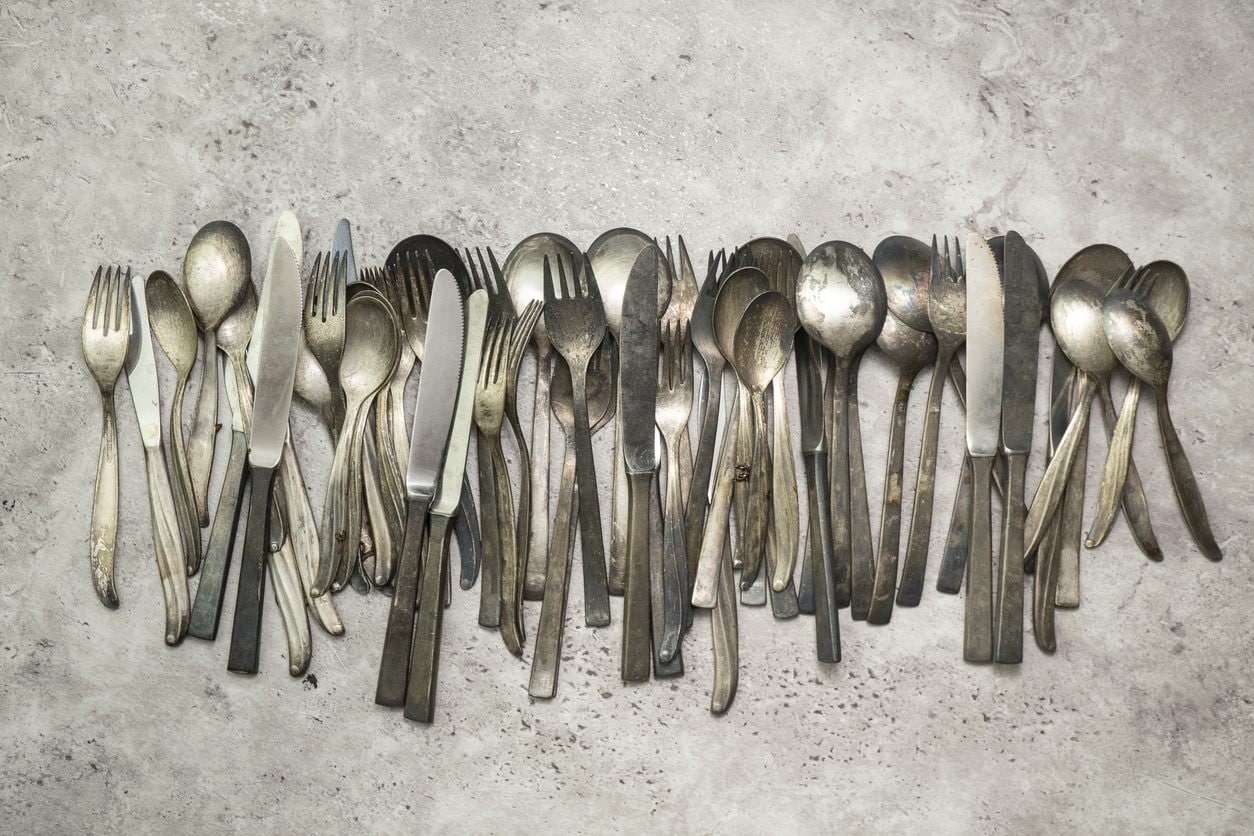
Just open the dishwasher and find a stained knife rust to discover that even thestainless steel It has its weaknesses. Although this material is designed to resist corrosion, high temperatures, alkaline detergents and salt residues favor chemical reactions which, over time, can affect the stainless steel in various points causing the formation of localized corrosion called, as explained by a study on Surface Technology, pitting corrosion. This is a phenomenon known since the 1980s, which manifests itself with classic dark or reddish spots on cutlery. Some types of steel, such as those often used for knife bladesare also more vulnerable than others, especially when they come into contact with different metals during washing, through a process known as galvanic corrosion. In short, if the cutlery rusts in the dishwasher It doesn’t mean they are defective: more often it means that even stainless steel, in the wrong conditions, can lose its distinctive resistance to corrosion.
The invisible shield of cutlery is almost invincible: how come it rusts
Some still call it “silverware“, but our cutlery now has little to do with silver. Nowadays spoons, forks and knives are mainly made with metallic alloys cheaper and more robust, above all stainless steelsalso known by the abbreviation stainless steel. These are based materials iron (Fe) and other chemical elements, such as chrome (Cr), essential for providing resistance to corrosion, or even Nickel (Ni) e carbon (C).
Stainless steel is designed to protect itself from corrosion, i.e deterioration of a material caused by its interaction with the surrounding environment. In the case of iron and its alloys, it is often a process in which water, oxygen and other substances favor reactions that degrade the surface of the material, often leading to the formation of rust. Thanks to a process called self-passivation, the chromium present in the alloy reacts with ambient oxygen to form a very thin protective layer rich in chromium oxidesinvisible but extremely effective, which isolates the underlying metal from the external environment and slows down corrosion.
The problem? This protective barrier he is not invincible. In particularly aggressive conditions, for example during dishwasher washing, it can be damaged, leaving the metal exposed to the external environment.
Why stainless steel could get ruined in the dishwasher and how to avoid it
So can stainless steel corrode too? Well, yes: the corrosion and degradation phenomena of stainless steels can be different and well documented by manuals such as the ASM (American Society for Materials) International Handook on the corrosion of materials. In the dishwasher, high temperatures (which can even reach 70 °C), alkaline detergents and above all chloride ions (Cl–), coming for example from salty food residues or from the water itself, they can affect the surface protective layer, leaving the underlying metal alloy very much more vulnerable to corrosion.
A study published in 1980 by Department of Materials and Resistance from the ICAI Superior Technical School of Madrid demonstrated that, under conditions simulating the internal environment of the dishwasher, the corrosion resistance of steel knife blades martensitic (among the hardest stainless steels) decreased as the temperature and concentration of salts increased, favoring phenomena of pitting corrosioni.e. pitting corrosion: it is a localized corrosion that can manifest itself as small dark or reddish spots on cutlery.
It is possible that another phenomenon called occurs galvanic corrosion. As the Association for Materials Protection and Performance explains, it occurs when two different metals come into contact in the presence of containing water electrolytes dissolved, i.e. electrically charged substances, such as chloride ion. Under these conditions, the more vulnerable metal tends to corrode much more quickly. In dishwashers this can happen, for example, when utensils made from different alloys remain in contact during washing: to avoid this, it will therefore be enough to arrange objects with different materials in different sections or in any case so that they don’t touch each other.
Another strategy, given that high temperatures can encourage corrosion, could be to choose washing programs at lower temperatures.
Knives are the most sensitive: it depends on the chromium
Then there is another important detail: not all stainless steels are the same. As reported by the 1980 study, knife blades, for example, can be made of stainless steel martensiticharder and with a quantity of chromium usually between 11 and 18%: it holds the edge better, but the percentages of chromium are lower than other types of stainless steel, making it more “attackable” by the external environment. Stainless steel austenitic instead, as described by the Centro Inox Milano, containing a higher percentage of chromium, it should better resist corrosion.
