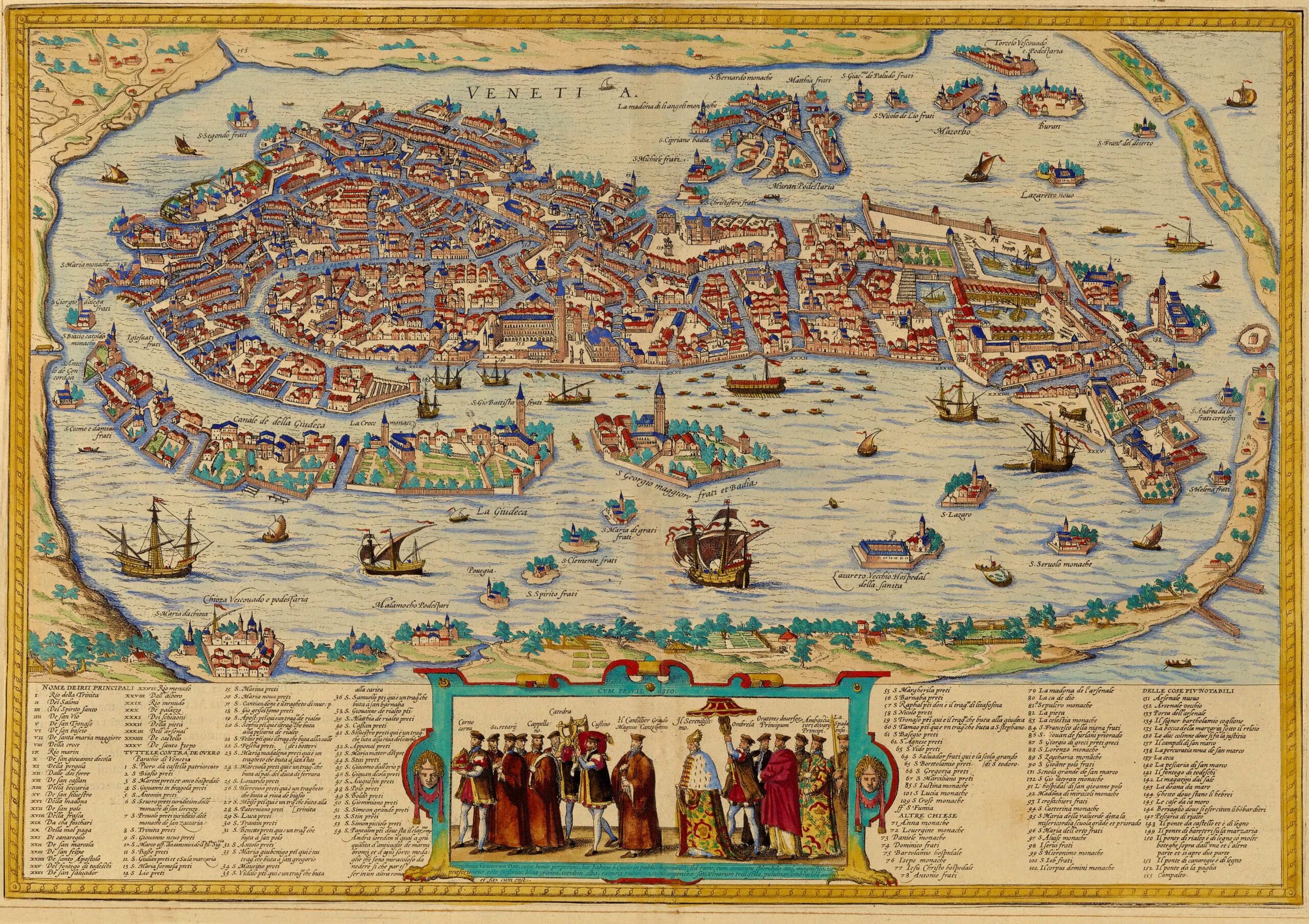
“Do you speak Venexian?” is the question you may hear while walking through the calluses of Venice, perhaps while trying to defend a dish of cicchetti from the assault of cocài. Talking about the Venetian also implies talking about Venice and its political and cultural history.
From one point of view linguisticthe Venetian (or lagoon Venetian) is one variant of the Venetian language spoken in the city of Venice, from the historic center and Murano to the neighboring areas of the lagoon and the mainland and in a large part of eastern and lagoon Veneto.
As also confirmed by Treccanithe Venetian had a huge historical importancegiven the economic and cultural centrality of the Serenissima Republic of Venice during the Middle Ages and the Renaissance: from a simple means of local communication it became an instrument of power, commerce and culture, capable of extending well beyond the borders of the lagoon.
A language like the Romance languages
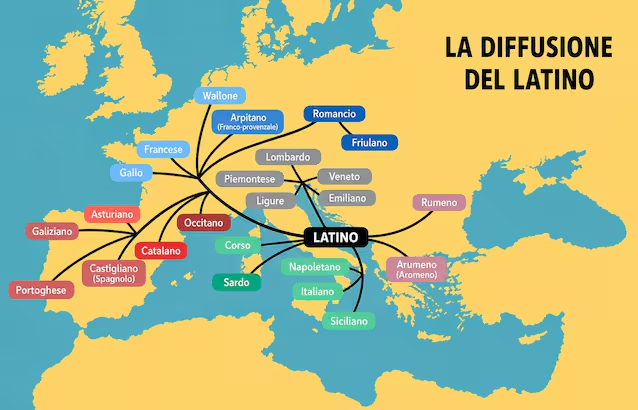
When Rome expanded its dominion between the 1st and 3rd centuries AD, the Latin spread throughout the Italian territory and beyond, overlapping with pre-existing languageswhich linguists call languages of substrate. This overlap generated local varieties of the Latin language, alongside the classical Latin (coded by authors as Cicero and Virgil) spoken Latins coexisted, distinguished both diastratically (i.e. according to social class) and diatopically (i.e. based on place).
After the fall ofWestern Roman Empire in 476 ADthe local varieties of Latin progressively differentiated into a multiplicity of different languages, giving rise to the different ones Romance languagesborn between VI and VIII centuries.. These languages were influenced by the languages (usually Germanic) of the nomadic peoples who settled in Europe in that period, leading to the fall of the empire itself. These languages acted as superstratesthat is, they influenced the nascent Romance languages by overlapping with the already spoken Latin.
In this phase the Venetian language was also born, of which – as has been said – Venetian is part. So Venetian is not a variant of Italian nor does it derive from itare “sister languages” like Italian and French for example.
The evolution of Venice and the Venesian: the historical role
In Italy, in fact, a single language did not immediately establish itself. Already Dante AlighieriIn the De vulgari eloquentia (1303-1305) identified at least fourteen vulgar distinct in the peninsula, including the Venetian one. In this regard, Venice represents a special case.
Historically founded in 697 AD as a Byzantine duchy, its isolated geographical position in the lagoons of the upper Adriatic allowed it to maintain a political link with the Byzantine Empireat least until the progressive autonomy established already in the 8th century. This isolation partially protected it from the Germanic influences of the Lombard area, present since 568 AD, which favored a more autonomous linguistic development compared to other areas of northern Italy.
During the centuries of Republic of Venicewhich lasted until the arrival of Napoleon in 1797, Venetian further consolidated itself as the most prestigious and central for the importance that the Very serene had in those centuries, extending its influence far beyond the lagoon and the political borders. It became the language of tradeof theadministration and of theentertainment as well as in the territories of the Republic also in Istria, Dalmatia and in large areas of the eastern Mediterranean.
Linguistic characteristics of Venetian
First, on phonetic levelthe phenomenon of “the evanescent”for which the consonant /l/ in the intervocalic position tends to attenuate until it almost disappears, sometimes omitted and sometimes rendered graphically with a And or a “the” crossed out (e.g.: beautiful shear“beautiful girl”; cavei“hair”; gondoea/gondola“gondola”; sioła“onion”). Another typical phenomenon is the progressive loss of final vowels, so words tend to end in a consonant (frutariól, “greengrocer”; sonadór, “player”). Sometimes even the initial vowels suffer the same fate, as in now“now” e ‘listen“listen”.
From the point of view morphological we note the repeated use of subject pronouns (you can sleep straight away“you are sleeping”). Interesting is metaphonesis present in many words (I put“months”) famous in the verbal conjugation of the first person plural (ndemo“let’s go”; Let’s go“we do”).
Also the lexicon represents an element of strong autonomy. Many Venetian terms are unknown or difficult to understand for a non-native. Words like “cossa” (What), “fio” (son) may be recognisable, while “putel” (child), “ciàcoe” (small talk) or “again” (today, from Latin to anc hodie) show a significant distance. At the same time, the Venetian received lexical influences from Greek, from Arabic and from the languages ofBalkan area with which it had very close relations thanks to its intense commercial exchanges in the Mediterranean.
In fact, Italian has borrowed terms directly from the Venetian dialect, to such an extent that it is not just words of specific use such as gondola, ghetto or arsenal that derive from Venetian, testifying to the cultural and commercial prestige of the Republic of Venice. Perhaps not everyone knows that some words that are much more common than one might think have also been included, such as “HI”, “gazette”, “puppet”, “forty”, “pants”, “fraud/cheating” or “ballot”.
Finally, a very curious coincidence concerns the Spanish languagewhich has many affinity superficial with the Venetian dialect. Many words are completely the same, because many words are written or even pronounced in the same or almost the same way. Some examples are friend, digestion, fanfare, thief, macaque, pay, rama, sedate, tenca, vaca, bull, bacalào (salted cod), brazo (arm), cuchara (table spoon), tamizar (sieve) etc.
In summary, the Venetian is a variant of the Venetian language daughter of a linguistic history that tells the story of the Serenissima and its people. Its evolution, parallel to that of the other Romance languages, and the central role it has held over the centuries testify to its cultural and identity value. Between calli and campielli, although threatened, the venesian continues to live as an authentic expression of a community and its historical memory.
Venetian is therefore a dialect that reflects the history and identity of the Serenissima, surviving among the streets as a living voice of collective memory.
Ca’ Foscari University of Venice
