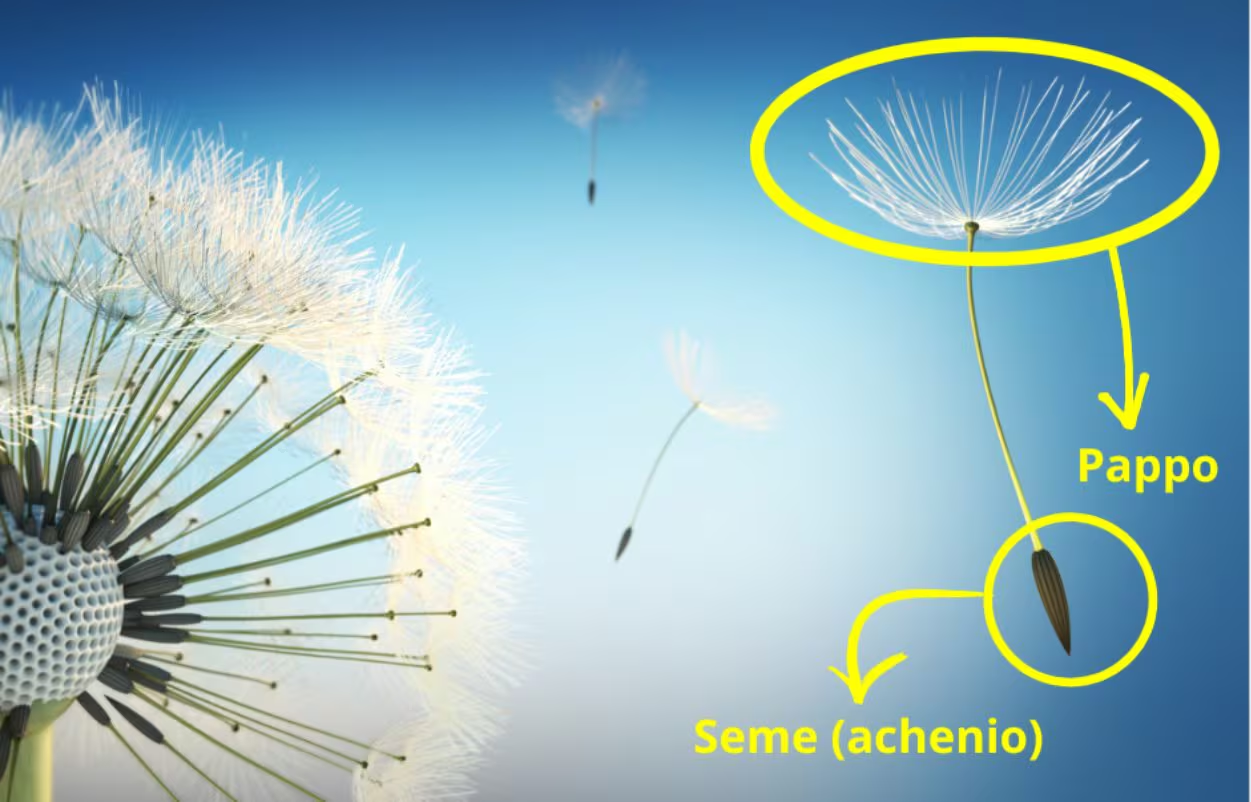
As children, and sometimes even as adults, we collected the soft white “balloons” of the plant Dandelion (Taraxacum officinale) and, blowing decisively, we released dozens of small feathery umbrellas into the air. Well, those shower heads of perfect spherical shape are theinfructescence (i.e. all the fruits) of the Dandelion – also known as dandelion – and each of those umbrellas carries a single achenea fruit of a fibrous nature that contains a seed: a bit like what happens with strawberries, where what we think are seeds are actually fruits. The dispersion mechanism of Dandelion seeds presents a series of aerodynamic devices so perfect that they could be an inspiration for human inventions. Every little umbrella, said pappusit works like a parachute and is composed of a hundred mobile bristles that allow the achene to maintain a certain stability in the air and to exploit the direction of the wind and humidity for correct dispersion of the seeds: it is a real flying machine. Try to follow the trajectory of the pappus after blowing on an infructescence and you will see that they all fall at a certain distance, landing perfectly vertically.
What flower is the dandelion and what is it for
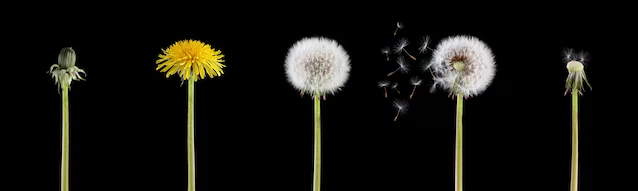
Each showerhead comes from the maturation of a yellow dandelion floweror rather than ainflorescencegiven that what appears to us as a single petal is actually a real tongue-shaped flower (ligula). From each flower of the inflorescence, when ripe, a flower develops achene, a dry fruit containing a seedequipped with the characteristic feathery pappus and inserted together with the other achenes on the apical part of the stem (the receptacle) to form a white spherical structure. In practice, each petal gives rise to a feathery “umbrella”. The whole of the achene and its bristle umbrella is called diasporaprecisely because it is a structure that the seed uses to disperse.
A gust of wind or our breath causes the individual achenes to detach and, thanks to the pappus of bristles, begin to fly. This is a dispersion anemocora, that is, favored by the wind. The pappus by shape and structure allows you to create a stable air vortex above the achene and keeps it suspended long enough to disperse away from the parent plant. The air passing through the bristles creates a small “rotating air ring” that maintains lift and stability in flight. However, when the pappus closes, the aerodynamic drag coefficient decreases and the seed falling phase begins. It has been observed that the pappus tends to close in humid conditions such as fog or rain and, conversely, the hairs are approximately horizontal when the air is dry. It can also take on a conical shape instead of a disc in order to become more aerodynamic. All precautions for an efficient flight.
The characteristics and properties of the common dandelion
The common dandelion (Taraxacum officinale) belongs to the Asteraceae family, the same as chamomile (Matricaria chamomilla), the marguerite (Bellis perennis) or cornflower (Centaurea cyanus). It is a perennial herbaceous plant native to the Eurosiberian area, but has now become ubiquitous (widely widespread and capable of adapting to and colonizing different types of environments). Very common and historically widely used, it has many different common names characteristic of almost every area of Italy: Dandelion, Dogtooth, Pisciacane, Piascialetto, Piumino, Donkey chicory, Yellow star and many others.
It is equipped with a mechanism asexual reproduction truly particular: the seed does not derive from the union of a male and a female gamete, but a cell of the mother plant is born directly and therefore it has identical DNA to that of the plant that generated it. For this particularity a plant is defined apomictic (from the Greek: without union, because the seed does not derive from the union of two gametes). From each seed transported by the wind, a new seed is born clonea dandelion perfectly identical to the mother plant, but in a different place. For this reason the populations of an area are genetically identical to each other. Dandelion is a medicinal plant, with many uses in medicine and in the kitchen: every part of it, roots, flowers and leaves, has a precise use. In the herbal tradition herbal it is appreciated for its properties anti-inflammatory, antibacterial and diuretic.
