The great experts in the sector indicate France, Spain and Brazil as the national teams to beat at the 2026 World Cup. But what happens if it’s not commentators or fans who predict the winner, but rather women artificial intelligences? We posed the same question to eight of the best-known AI systems — Gemini, ChatGPT, Claude, Copilot, Perplexity, DuckAI, Mistral And Meta AI — asking them to name the favorite national team, the second choice, a possible surprise and the probable top scorer of the 2026 FIFA World Cup. The results were surprising: on some answers there was almost unanimity, on others the AIs diverged sharply. And understanding why is more interesting than the predictions themselves.
The results: agreement on Mbappé, division on the winner
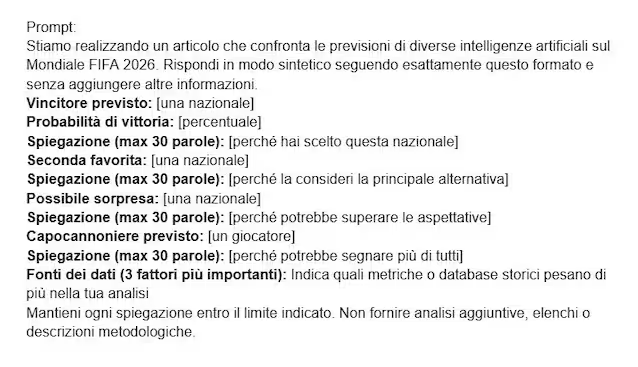
Each AI was subjected to the same promptstructured to obtain comparable answers relating to winner, chance, second favorite, possible surprise And top scorer, each accompanied by an explanation of maximum 30 words. The choice to use a rigid and identical format for all systems is not random: it is the most effective way to compare responses generated by different models in conditions that are as uniform as possible.
The clearest data is absolute unanimity on a name: Kylian Mbappe. All eight AIs indicate this as probable top scorermotivating the choice with speed, a central role in the French attack and a historic score in international competitions (he was top scorer at the 2022 World Cup). Such a compact consensus is rare and significant.
On the winner, however, the AIs are divided into four predictions:
- three systems (ChatGPT, Copilot, DuckAI) focus on Brazil with 22% probability;
- two (Gemini and Claude) choose the France with 18%;
- two (Mistral and Meta AI) indicate theArgentina — reigning champion — with percentages between 18% and 22%;
- Perplexity, citing Opta simulations and some analyzes attributed to Goldman Sachs, assigns the victory to Spain with 26%—the highest value of the entire sample.
Furthermore the France appears as second favorite in six out of eight answers, demonstrating a transversal consensus on its solidity.
How AIs think: historical data, ranking and quality of the squad
How does an artificial intelligence predict the winner of a World Cup? The sources most cited by the various systems are three: the FIFA ranking and Elo (which measures the relative strength of national teams on a statistical basis), the advanced individual statistics of players — such as expected goals (xG), assists and performances in the Champions League — ei historical results in FIFA tournaments, i.e. how many times a national team has reached semi-finals and finals in past World Cups.
It is on this basis that Brazil And France emerge as candidates: five world cups for Brazil (absolute record), two for France, with a final played in 2022. Argentina is rewarded by Mistral and Meta AI above all for being the reigning champion team and for the compactness of the group. Spain, on the other hand, benefits from a model that weighs probabilistic simulations on the tournament scoreboard, highlighting the golden generation of Lamine Yamal and Pedri.
Because some AIs diverge and some converge
The differences between predictions reflect differences in how each AI is programmed and how it processes available information. A system like Perplexity, for example, gives priority to up-to-date predictions and statistical models published by authoritative sources such as Goldman Sachs. Other systems — like Mistral — seem to weigh more qualitative and narrative factors (the “close-knit team”, the “tournament experience”), compared to a pure numerical analysis.
The fact that three out of eight AIs choose Brazil with exactly 22% probability suggests that they are likely drawing on similar sources — the same statistical analyzes or the same Elo ranking — and process them in a similar way. However, when the architectures or sources diverge, as in the case of Perplexity and Mistral, clearly different choices emerge.
The verdict of the field
Despite the sophistication of the models, the soccer remains one of the sports more difficult to predict statistically. The reason is simple: it’s a low-scoring game, where a single episode — an injury, a penalty, a fortuitous deflection — can overturn any prediction. At the 2022 World Cup, Morocco reached the semi-finals, a result that almost no model had predicted, while Saudi Arabia beat the future world champions Argentina.
AI can quantify the quality of a squad and calculate the chances of advancement stage by stage, but they cannot predict the atmosphere of a stadium that drags a team beyond its limits, or the match of a player’s life that no data had anticipated. And this is exactly it unpredictability the reason why, every four years, billions of people sit in front of a screen to watch the World Cup. And no algorithm, no matter how sophisticated, can still take the surprise away from us.
