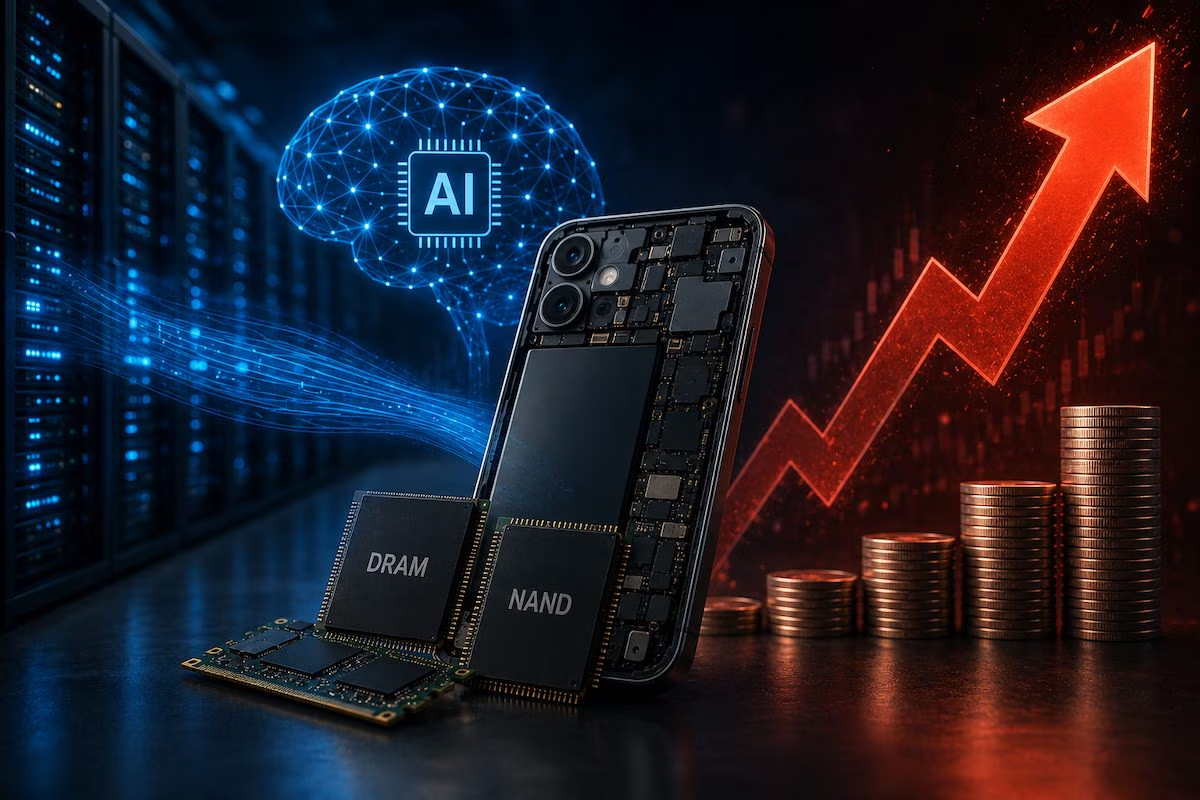
The race toartificial intelligence it is not only changing the way technology is used, but also the balance of the industry that makes it possible. To train and run increasingly complex AI models, enormous amounts of hardware resources are required, including electronic memories used to process and store data.
This growing demand could also impact a product that millions of people use every day: it smartphones. The components used in AI data centers are in fact produced by the same large groups that supply the consumer electronics market. Consequently, the displacement of a part of the production capacity towards the artificial intelligence sector could contribute to increasing the production costs of phones and, in some cases, theirs as well prices.
What are DRAM and NAND memories and why they are essential for AI
To understand why the growth of artificial intelligence could influence the price of smartphones, we must first understand what DRAM and NAND memories are and what role they play in electronic devices.
There DRAM it is the memory used by devices to manage ongoing operations. When you open an app, browse the web, or edit a photo, the necessary data is temporarily loaded into RAM so the processor can quickly access it. The more DRAM available, the greater the system’s ability to handle applications and processes simultaneously.
There NAND Flash instead it performs a different function. This is the permanent storage memory, the one that retains photos, videos, documents, applications and the operating system even when the device is turned off.
Both are essential components not only for phones, but also for computers, servers, consoles, modern cars and cloud infrastructures. Without DRAM and NAND, much contemporary electronics simply couldn’t function.
AI data centers consume enormous amounts of memory
If in smartphones DRAM and NAND are used to manage applications and store data, in data centers dedicated to artificial intelligence the memory requirement is much higher. In fact, large linguistic models require infrastructures made up of thousands of specialized servers that must process enormous quantities of information in very short times.
They are used to carry out these tasks GPU high performance supported by HBMmemories designed to offer much higher bandwidth than traditional technologies and allow rapid exchange of enormous amounts of data.
As AI services become more widespread, large industry players are investing billions of dollars in the construction of new data centers, fueling a growing demand for DRAM, NAND and especially HBM memories.
For memory manufacturers, the boom in artificial intelligence represents a particularly interesting economic opportunity. Indeed, the advanced components used in AI data centers guarantee higher margins compared to many of the memories intended for consumer electronics.
At the same time, demand from large industry players continues to grow rapidly. It is therefore becoming increasingly convenient for manufacturers to invest in the technologies required by data centers, considered among the most promising segments of the entire semiconductor market.
The production of memories for smartphones it’s not stopping. Rather, an increasing part of the production comes intended for the most requested and most profitable products. It is precisely this shift in industrial priorities that worries industry observers.
More expensive smartphones and less economical models: the possible scenarios
DRAM and NAND in fact represent an important part of the overall cost of a smartphone. If the price of these components increases, so does the production cost of devices tends to grow, given that in some smartphones the memories come to represent over 30% of the cost of the components.
Manufacturers can choose to absorb part of the price increases by reducing their profit margins, but this solution becomes more difficult especially in the economic segments of the market, where competition is very high and margins are generally smaller. Alternatively, companies can increase the final price of the devices or intervene on the technical specifications, for example by proposing versions with less memory than in the past. This is a dynamic that has already been observed several times in the technology industry: when the cost of a fundamental component increases, the effect tends to spread along the entire supply chain.
According to the forecasts of CCS Insightthe pressure exerted by the increase in memory costs could have significant consequences on the smartphone market: the analysis company estimates a contraction of 14.8% in 2026after a 4.4% decline in the first quarter of the year, and a possible reduction in supply in cheaper ranges of the market.
Manufacturers could in fact decide to focus on models that guarantee higher margins, reducing the number of entry-level devices available. In other cases they may choose to keep prices unchanged, but compensate for the increase in costs with configurations with less memory. For consumers this scenario could translate into most expensive smartphonesi, fewer choices and longer replacement times. If purchasing a new phone becomes more expensive, many people may decide to keep their device longer or move towards refurbished market. The same scenario could further favor its diffusion, so much so that one is planned for the sector growth of 15.4% in 2026.
The Apple case and the possible impact on future iPhones
There is also one of the companies that are observing the evolution of the memory market more carefully Apple. In an interview withWall Street Journalthe CEO Tim Cook explained that price increases may become inevitable due to the sharp increase in costs of memory and storage chips. According to Cook, the growing demand from data centers dedicated to artificial intelligence is in fact absorbing an ever-increasing share of available production.
The CEO further explained that his company is trying to absorb part of the increases to limit its impact on consumers. It was not indicated which products could be affected nor the extent of any price increases, but these statements show how even one of the world’s largest smartphone manufacturers is feeling the effects of the tensions that are affecting the entire semiconductor supply chain.
Who risks more and who could resist the crisis better
Larger companies can count on long-term supply agreementshigh purchasing volumes and a greater ability to negotiate favorable terms with memory manufacturers. This allows them to absorb any cost increases more easily. However, brands that operate mainly in the economic segments of the market could be more exposed. In these cases, even relatively small variations in the price of the components can significantly impact the profitability of the products, leaving companies less room for maneuver.
The comparison with semiconductor crisis occurred during the pandemic is inevitable, but the two situations have important differences. Between 2020 and 2021, the chip shortage was mainly caused by production disruptions, logistical problems and sudden imbalances between supply and demand. Many factories slowed production and supply chains suffered major slowdowns.
Today the scenario appears different. Factories continue to produce, but an increasing portion of available capacity is allocated to the memories and components required by the AI ecosystem. It is therefore not a shortage due to production problems, but rather one reallocation of resources towards a sector considered more strategic and more profitable.
When talking about artificial intelligence, attention often focuses on its most visible applications, such as chatbots, virtual assistants and image generators. Much less evident is thehuge hardware infrastructure necessary to make these technologies work.
If analysts’ predictions prove correct, the effects of the race for AI could also manifest themselves outside of data centers, influencing the consumer electronics market. More expensive smartphones, configurations with less memory and a greater diffusion of refurbished products could represent some of the most concrete signs of a transformation which, despite taking place behind the scenes, is already changing the balance of the entire technological industry.
