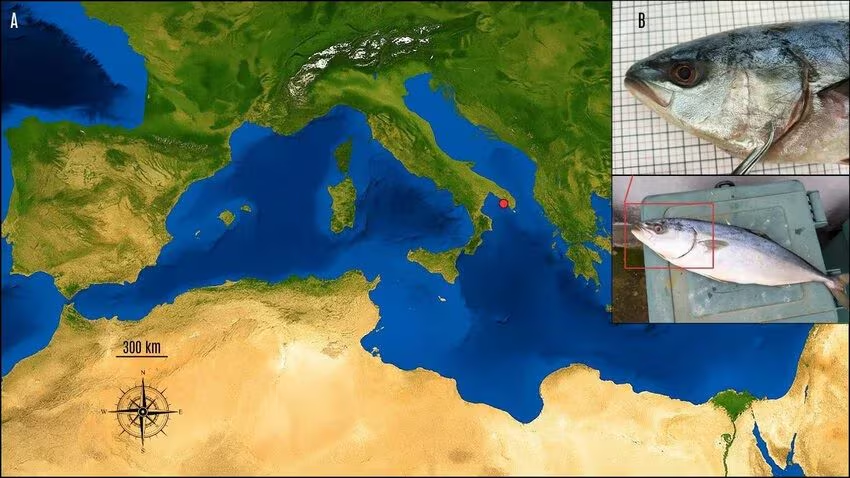
A few months ago a fisherman caught an unusual specimen along the coast of Nardò, in Puglia, in the waters of the Ionian Sea near the Marine Protected Area of Porto Cesareo. The fish looked like a common amberjack (Seriola dumerili), a species well known to Mediterranean fishermen, but with some morphological differences obvious enough to make those who know her well suspicious. The fisherman contacted the researchers, who after analysis identified the specimen as Seriola quinqueradiatathe so-called Japanese amberjack: a native species of the Pacific Northwest that was not never been recorded in the Mediterranean. The study documenting the discovery was published in 2026 in the scientific journal Acta Adriatica by a team led by the University of Catania. A few weeks later, the same fisherman in the same area caught a second, larger one. Two individuals caught in less than two months in the same area represent sufficient data to think of an introduction event, although it is still premature to talk about a stable population. On the other hand, our seas are not new to the arrival of alien species: just think of the blue crab or the scorpion fish, recently spotted in the same Apulian waters.
What is the Japanese amberjack and where does it normally live
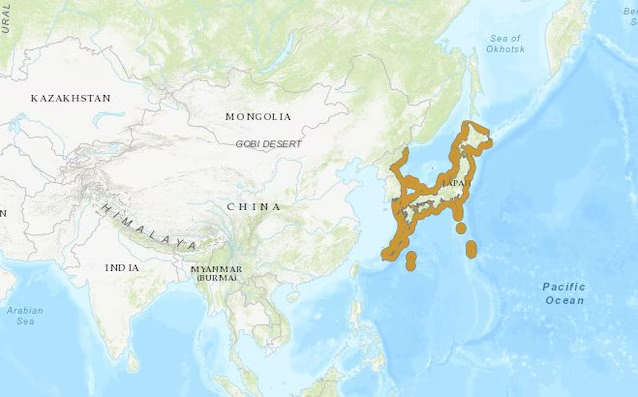
Seriola quinqueradiata it belongs to the Carangidae family, the same to which the common amberjack belongs. Four species of the Seriola genus are already present in the Mediterranean: S. dumerili, S. rivoliana, S. fasciata And S. carpenteri. The Japanese amberjack would be the fifth, and the only one of Pacific origin. Its natural range extends along the coasts of Pacific Northwest: from the East China Sea and the Sea of Japan to Japanese and Korean coastal waters, with seasonal movements mainly linked to sea surface temperature and ocean currents.
Adults are pelagic predators (i.e. they live in open water, not on the bottom) capable of traveling long distances seasonally. The young, however, spend the first weeks of life associated with drifting floating algae, which act as a refuge and as a vector of passive transport.
How it is distinguished from the common amberjack and how it was identified
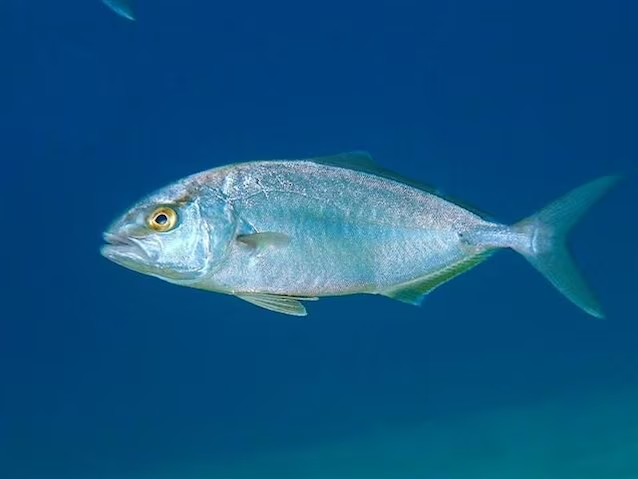
The species of the Seriola genus look very similar to each other, to the point that they are often confused in fishing environments. To distinguish with certainty the Japanese amberjack (S. quinqueradiata) from their Mediterranean “cousins”, researchers analyze specific diagnostic characters that concern the physical proportions, colors and morphology of precise anatomical structures.
One of the key traits for identification is the supramaxilla: in S. quinqueradiata this bone, which delimits the back part of the mouth, is particularly wide, has an almost right postero-dorsal angle and extends backwards until it reaches about half of the eye socket. In Mediterranean species, on the contrary, it takes on a much more tapered shape.
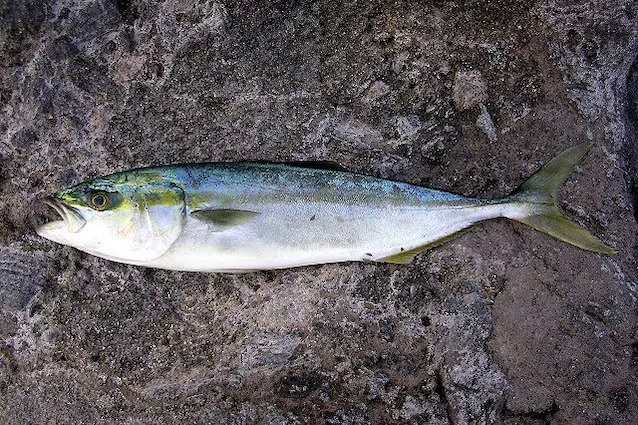
On a physical level, the peaceful species has an elongated and moderately compressed body, with gill rakers long and flattened and a deeply forked caudal fin. Exactly counting the spines and rays (of both the dorsal and anal fins) is also crucial in confirming the diagnosis. Finally, when alive, this amberjack has a typical yellow longitudinal stripe which runs from the snout to the tail crossing the eye (which fades over time).
The definitive identification of the specimen captured in Nardò occurred by combining the morphological analysis with the DNA barcoding: a method that consists of isolating and sequencing a short fragment of the mitochondrial gene COI (cytochrome c oxidase, subunit I), whose sequence is specific for each species and works as a molecular identifier. The sequenced fragment (644 base pairs) was compared with the international database GenBank: the correspondence with S. quinqueradiata sequences was del 99.84%with 100% coverage. The analysis was further confirmed by constructing a phylogenetic tree with the sequences of all congeneric species available in the database, in which the Apulian sample clearly groups with the Japanese amberjacks.
The first specimen had a gutted weight of 587 grams and a fork length of 35.5cmdimensions compatible with a young individual (the species can exceed 100 cm). The second, captured on March 23, 2026 in the same area, measured 60cm For 2,580 gramsand was consumed by the fisherman before it could be analyzed, the identification in this case was based on photographs, which showed external morphological characteristics consistent with those of the first specimen.
A billion-dollar business: aquaculture and market
From an economic point of view, we are talking about one of the most important farmed fish species in the world. In Japan it is an authentic gastronomic institution: known as hamachi as a young man and buri as an adult, it is a product of the highest quality consumed strictly raw, a fundamental ingredient for sushi and sashimi. Aquaculture, as explained by the Ministry of Health, consists of a real controlled production of aquatic organisms, such as fish, molluscs and crustaceans. This practice develops in two main ways. The first is theextensive aquaculturewhich simply exploits the natural productivity of the environment in which the animals grow. On the contrary, theintensive aquaculture pushes production beyond the natural limits of the basin: by massively increasing the density of reared animals, artificial integration of nutrition becomes indispensable, regularly supplying formulated feed or natural food from the outside.
As reported by FAO data, the breeding of this species has historical roots in the 1930s, but experienced a real commercial boom in the 1960s thanks to the invention of floating net cages. Today the market is almost totally absorbed by domestic demand and Japan de facto holds an absolute monopoly on world production, flanked only by a very small share in South Korea. However, after the historical peak of almost 170,000 tons reached in 1995, today volumes have stabilized between 130,000 and 160,000 tonnes per year. The overall value of Japanese amberjack farming in 2004 was 1.276 billion dollarsbut profitability is currently threatened by rising operating costs.
How it could have arrived in the Mediterranean
There is no direct evidence on the path followed by the captured specimens, but the researchers have identified three plausible scenarios based on what is known about the biology of the species and on the introduction vectors already documented for other alien species in the Mediterranean.
The first is the transport via ballast water. Large cargo ships take on sea water to stabilize themselves during navigation and release it at the destination port. Eggs, larvae and microscopic organisms of any species can be found in ballast water. So long as S. quinqueradiata lays pelagic eggs in coastal waters, inadvertent introduction through this vector cannot be ruled out. The second scenario concerns the aquaculture activities. The species, as we have seen through FAO data, is intensively farmed in Japan and other East Asian countries. The globalization of the sector has increased the cases of accidental or undeclared translocation of living species between different basins. It doesn’t appear that S. quinqueradiata be bred in the Mediterranean, but small-scale experimental introductions or private plantings cannot be ruled out. The third scenario, considered less likely, is deliberate or accidental release linked to the trade of live animals or transport to aquariums. Given the size of the species and its predominantly commercial use, this route is considered marginal compared to the first two. Natural transoceanic dispersal from the Pacific to the Mediterranean is considered virtually impossible. There are no direct connections between the two basins, and no historical observations suggest spontaneous movements of this species towards the Atlantic or the Mediterranean.
Will this sighting remain an isolated case or is the Japanese amberjack destined to reappear in a more structured way? To understand this, the researchers highlight the need for further monitoring. The discovery, in fact, is yet more proof of how the biodiversity of the Mediterranean is rapidly remodeling, under the pressure of human activities and climate change. That’s why the citizen science and direct reports from fishermen will be increasingly fundamental.
