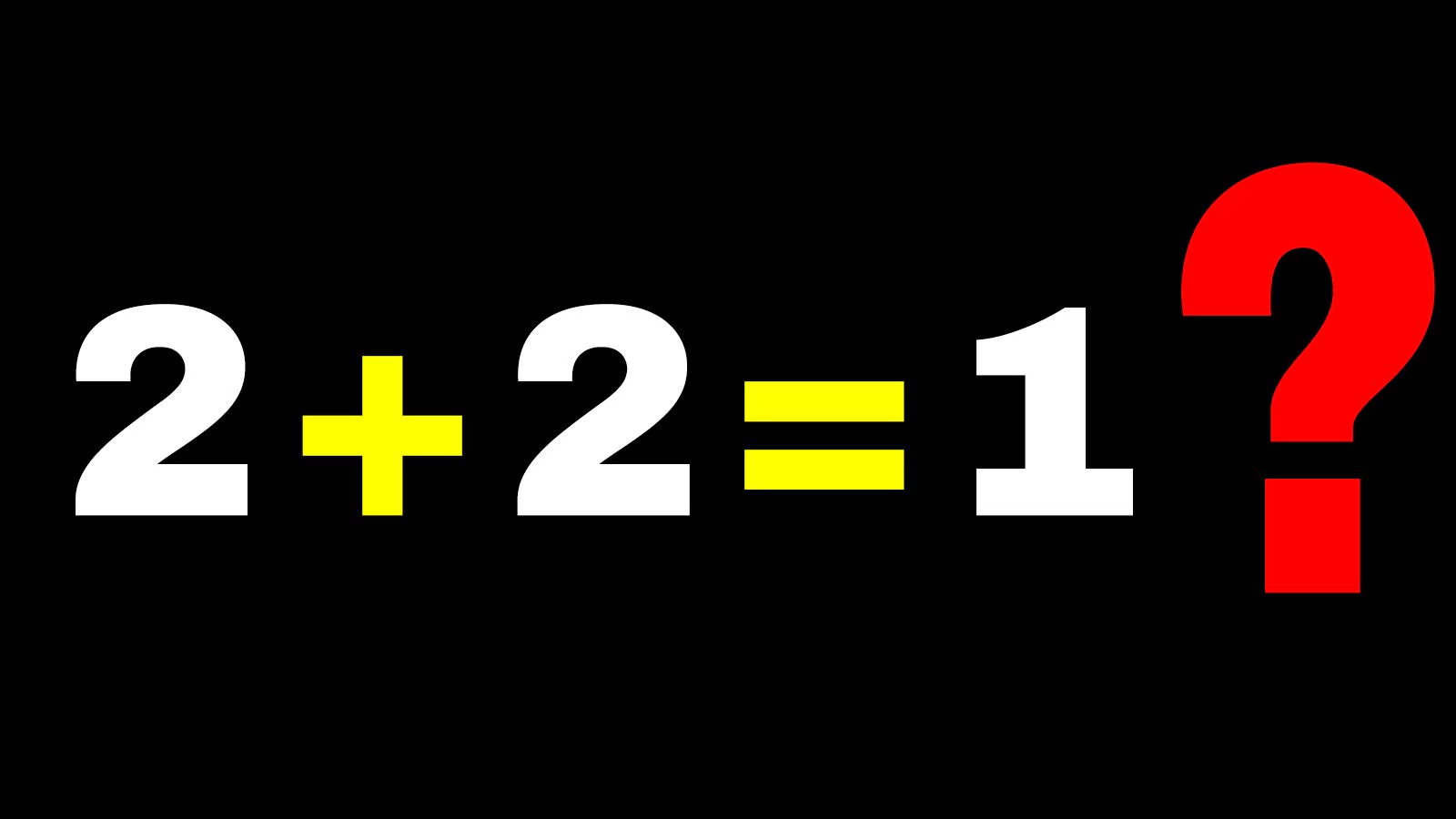
In mathematics two plus two – 2 + 2 – does not always equal 4it can also be 0 or 1 as long as we use the rules ofmodular arithmeticalso known as clock arithmetic. In this type of arithmetic, based on the calculation of the remainders of integer divisions, the numbers are not infinite and when the largest number is exceeded we start again from the smallest, just like in the clock!
Let’s see how calculations are done with these numbers and in what sense 2 + 2 equals, or does not equal, 4, and let’s see what modular arithmetic has to do with respect to number 97 with the IBAN verification.
Clock arithmetic
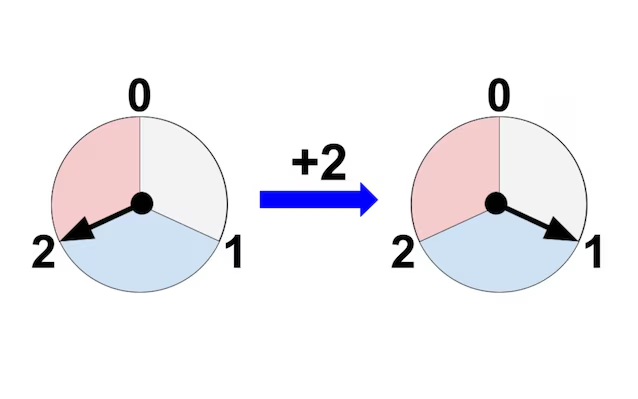
Let’s start with one example concrete. Let’s imagine a clock that counts the number of quarters that have passed in a year – which are 3 – and suppose that 2 have passed quarters up 3 since the beginning of the year. The hand will then point to the number 2.
Let’s wait another 2 quarters. This means that we will have reached 2 + 2 = 4 quarters. But on our watch there is no 4! In fact, after 2 the number 0 returns, then 1, then 2 again. So starting from 2, moving the hand by 2 quarters, we fall on 1 again (as we see in the figure below).
In other words according to this clock 2 + 2 = 1not 4. But it is not the only strange result we can obtain: for example, if the hand is on 2 and we add 1 quarter, the hand will move to 0. In short, in this watch 2 + 1 = 0 and also 1 + 2 = 0.
We have understood that in this clock – in this “numerical world” – there are only 3 numbers: 0, 1 and 2. And therefore all the others do not exist? Not exactly. They exist, but they are all congruous. Let’s try to understand what it means.
4 and 1 are “equal”: modular arithmetic
Now let’s imagine that 3 quarters have passed since the beginning of the year, so the hand will have made a complete revolution and will be at 0. So 3 and 0 are the same number in this “world”!
Likewise, the hand will be at 0 if the past quarters are 6, 9, 12 or any multiple of 3. In short, in this “numerical world” tall multiples of 3 will be the same number.
In the case, however, in which 4 quarters have passed – as in our example of 2 + 2 – the hand, after having traveled a complete revolution – 3 quarters – will have stopped at the number 1 and with the passage of time will return there every time 3 further quarters have passed.
In other words, the needle will be on the number 1 when 4, 7, 10, 1000, … quarters have passed, that is all numbers that when divided by 3 give a remainder of 1Indeed:
4 = 3 × 1 + 1
7 = 3 × 2 + 1
10 = 3 × 3 + 1
1000 = 3 × 333 + 1
In mathematics we say that all these numbers I am congruous 1 module 3 and it is written
4 ≡ 1 (mod 3),
7 ≡ 1 (mod 3)
10 ≡ 1 (mod 3).
1000 ≡ 1 (mod 3).
The same thing happens for the number 2: all the numbers that when divided by 3 give a remainder of 2 are congruent 2 modulus 3, such as 5, 8, 11 and 14.
In practice
there are not infinite numbers, but only 3, the number 0, the number 1 and the number 2 which correspond to the possible remains of the divisions by 3.
This set of numbers, in mathematics, is called “Z module 3”, and it is written Z3. And numerical sets of this type can be defined starting from any number! For example Z2 (“Z module 2”) contains only i numbers 0 and 1 (and it is very different from binary numbers which are infinite), Z12 contains the numbers from 0 to 11 (used for the wristwatch, usually with the 12 instead of the 0), while Z24 contains i numbers from 0 to 23 and that’s what’s used to describe the 24 hours of the day!
